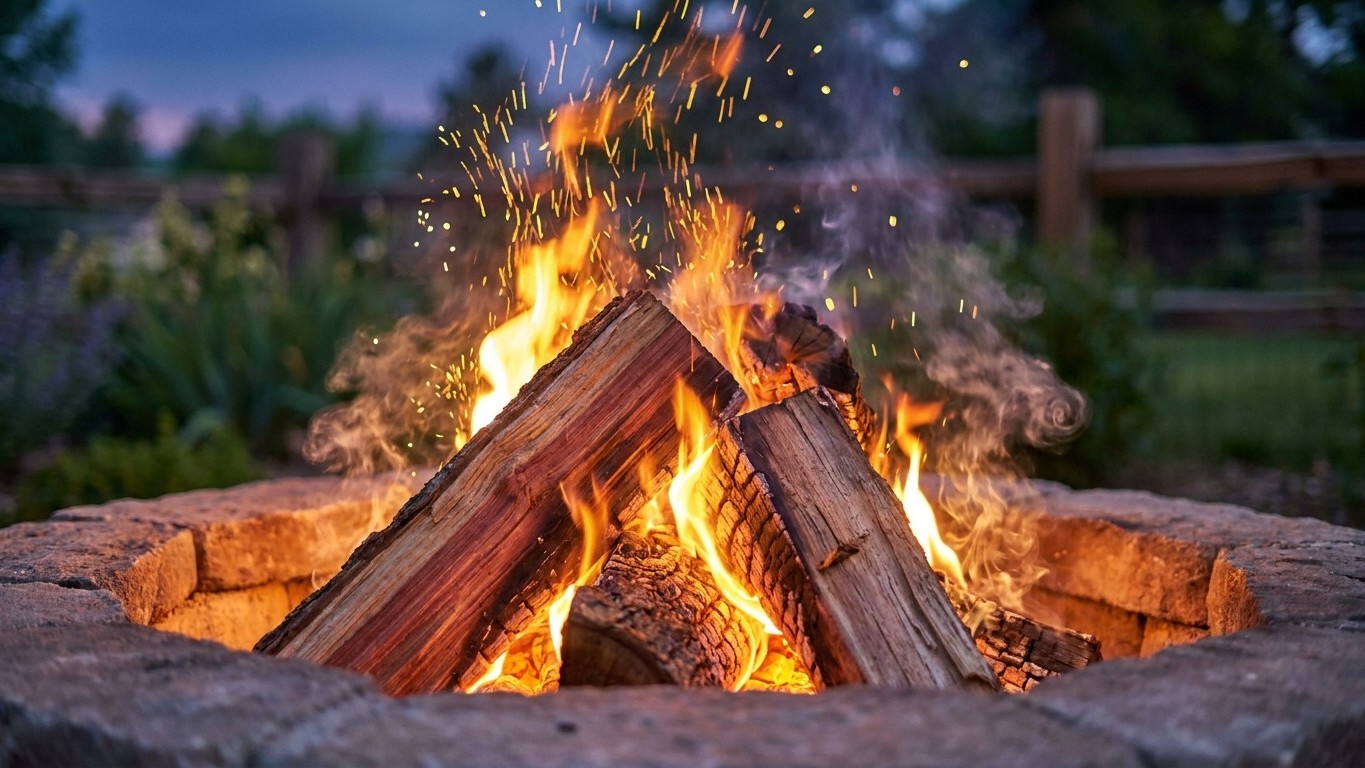

Redcedar and Rocky Mountain juniper burn hot and fast, throw off a strong aromatic smoke, and pop with sparks more than almost any other wood you’ll load into a stove or fire pit. They’re solid choices for kindling and shoulder-season fires, but the resin content that makes them smell so good is the same trait that makes them a poor pick for an all-night burn in an open fireplace.
Not Actually a Cedar

Here’s the mix-up that trips up a lot of firewood buyers: eastern redcedar (Juniperus virginiana) and Rocky Mountain juniper (Juniperus scopulorum) aren’t cedars at all. They’re junipers that picked up the “cedar” nickname because of their reddish, aromatic heartwood, the same smell you’d recognize from a cedar chest or closet liner. True cedars (the Cedrus genus) grow mostly in the Mediterranean and Himalayas and rarely show up in a US firewood pile.
Eastern redcedar covers a huge range, from Texas up through the Great Plains and into New England. Rocky Mountain juniper takes over west of that, scattered across Colorado, Wyoming, Montana, and into the high country of the Southwest. Both trees are scrubby, slow-growing, and often harvested more as a land management byproduct (they’re notorious for taking over pastureland) than as a dedicated firewood crop. That’s actually good news for anyone clearing property: the wood you cut down to open up grazing land or reduce wildfire fuel load doubles as usable heat.
Heat Output: Middle of the Pack
According to SDSU Extension, dry redcedar and Rocky Mountain juniper produce 21 million BTUs per cord, which puts them ahead of soft woods like pine or spruce but behind dense hardwoods like oak, hickory, or hard maple, which can top 24 million BTUs per cord. Think of it this way: you’d need roughly a cord and a half of redcedar to match the heat output of one cord of shagbark hickory.
That mid-range BTU number comes with a catch. Redcedar and juniper are light, closer in density to some construction-grade softwoods than to oak or ash. A lower density means the wood burns through faster, so even though the per-pound heat content is respectable, you’ll be feeding the stove more often to maintain the same temperature over an evening. It’s a wood that heats a room quickly but doesn’t hold a coal bed the way a dense hardwood does overnight.
How It Stacks Up in Real Terms
A homeowner burning primarily oak might load the stove once before bed and wake up to usable coals. Switch to straight redcedar, and that same load is likely to burn down to ash well before morning. That’s not a flaw so much as a design mismatch: this wood shines in short, hot bursts, not slow, sustained heat.
The Sparks, Smoke and Creosote Question
This is the part that matters most for anyone deciding whether to burn it indoors. Redcedar and juniper carry a heavy load of resinous oil in the wood and bark, the same oils responsible for that sharp, pleasant cedar smell when the wood ignites. Those oil pockets heat up fast and release trapped gas unevenly, which is exactly why this wood is famous for popping and throwing sparks, sometimes aggressively.
In an open masonry fireplace or around a backyard fire pit, that spark behavior is a real safety consideration. A stray ember landing on a rug, dry grass, or bare skin isn’t a hypothetical risk with this wood the way it might be with a quieter-burning hardwood. In a modern EPA-certified wood stove with a glass door and a sealed firebox, the sparking issue mostly disappears since the embers have nowhere to go. That’s the practical dividing line: fine in a closed stove, riskier in an open hearth or outdoor pit without a screen.
The resin content also affects chimney maintenance. Any wood burned before it’s properly seasoned, or burned at a low smoldering temperature, deposits more creosote in the flue. Resinous woods like redcedar and juniper aren’t unique in this regard (pine and other softwoods carry the same reputation), but the extra oil content means it pays to burn this wood hot and fast rather than trying to choke down the airflow for a long, slow burn. A hot fire and a clean, well-drafted chimney keep creosote buildup to a minimum regardless of species; a smoldering fire in this wood is more likely to leave a sticky residue behind. Annual chimney inspection remains standard advice from fire safety organizations regardless of what species you’re burning.
Splitting, Seasoning and Storage
Redcedar and Rocky Mountain juniper are generally easy to split, though both species tend to grow with twisted, knotty grain that can throw off a maul swing if you’re not paying attention. The wood often has a noticeably darker heartwood ringed by lighter sapwood, and that heartwood is where most of the aromatic oil concentrates.
Because the wood is lower density than oak or maple, it dries out faster too. Where a big oak round might need a full one to two years stacked and covered before it’s ready to burn, split redcedar or juniper can often reach a safe moisture content (under 20 percent, measured with a basic moisture meter) in six months to a year, especially if it’s split into smaller pieces and stacked somewhere with good airflow and sun exposure. That faster seasoning window makes it a practical choice for anyone who’s clearing land in spring and wants usable firewood by the following winter, a turnaround that’s simply not realistic with denser hardwoods.
Storage deserves a small note here: the strong cedar scent that makes this wood a favorite for kindling can also transfer to anything stored nearby. Stacking it directly against a house wall or inside an attached garage isn’t a problem for the structure, but don’t be surprised if nearby stored linens or firewood-adjacent storage bins pick up a faint cedar smell over a season.
Where This Wood Actually Earns Its Keep
The best use for redcedar and Rocky Mountain juniper isn’t as your primary overnight heat source. It’s as kindling and fire-starting material. The oil content that causes sparking also means this wood catches fast and burns hot right out of the gate, which makes it excellent for getting a fire established before adding denser, longer-burning splits like oak or ash on top.
It also performs well in shoulder seasons, those stretches in early fall or late spring when you want a quick, comfortable fire in the evening without needing the sustained output of a January cold snap. A few cedar splits in the stove after dinner will warm the room fast and burn down to nothing by the time you’re ready for bed, no lingering coal bed to manage or bank for the morning.
Outdoor fire pits are another natural fit, provided there’s some distance from flammable material and ideally a spark screen. The aromatic smoke that some people find overpowering indoors tends to read as pleasant and campfire-like outside, and the fast burn rate matches how most people actually use a backyard fire pit: a couple hours of company around the flames rather than an all-night burn.
Where it falls short is any situation calling for sustained, unattended heat: a wood stove meant to carry a house through a cold night, or a furnace-style outdoor wood boiler expecting long burn cycles. For that kind of heat, oak, hickory, or hard maple remain the better call, with redcedar or juniper better reserved for the kindling box and the early stage of every fire you build.