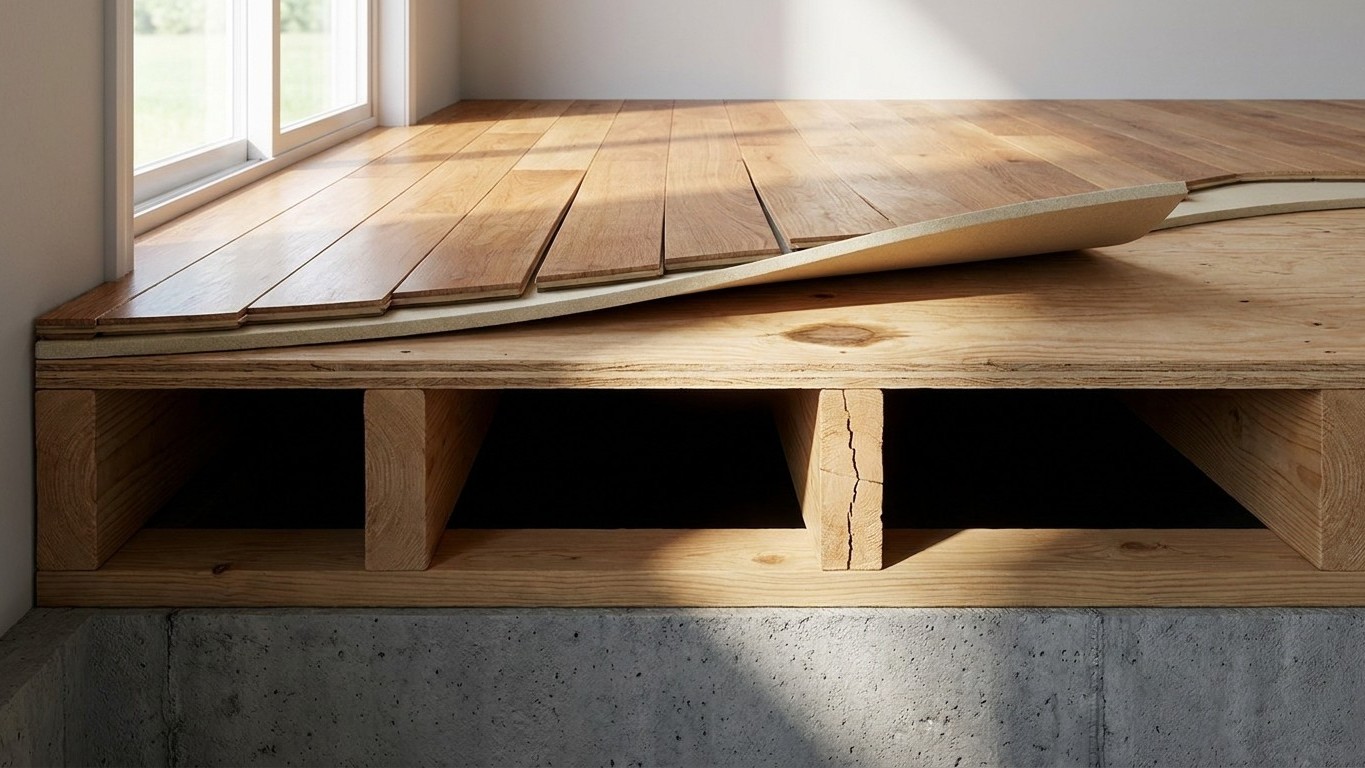

A squeak by the bed, a cupped board near the kitchen sink, a crack running clean through one tile: none of these live in the surface you’re staring at. They start in the layer underneath it, and the surface is just where the trouble finally shows up. Figure out which of the four layers, joists, subfloor, underlayment, or the covering itself, is actually misbehaving before you touch a sander, a bottle of adhesive, or a grout float.
The four layers under your feet

Every floor, whatever you see on top of it, is built the same way: four layers stacked from the framing up. The joists are the structural skeleton, wood or engineered lumber spanning between the foundation and the load-bearing walls. The subfloor is the sheet material, usually plywood or oriented strand board, fastened or glued across those joists, and it’s what every other layer rests on. The underlayment sits on top of the subfloor for one specific job: leveling small imperfections, adding cushioning or sound-dampening, or blocking moisture rising from a concrete slab. Not every installation has one. The covering is the layer you actually walk on, whatever it happens to be: hardwood, tile, laminate, vinyl plank, or carpet.
Why the surface can mislead you
You can only see the covering. That’s the whole problem with diagnosing a floor from a glance. A cupped board tells you moisture is present somewhere, but the board itself is just reporting news that started below it, usually in the subfloor or the air underneath in a crawlspace. Sand that board flat without finding where the moisture is coming from, and it cups again within a season. The rule worth carrying into every other page on this subject: separate the covering from what’s underneath it before deciding what to fix.
The table below sorts the four layers by what each one does and what kind of trouble usually announces itself there. Read it as a first sort, not a verdict. A soft spot can start in the subfloor and still show up as a squeak in the covering by the time anyone notices it.
| Layer | What it does | Symptoms usually traced to it |
|---|---|---|
| Joists | Carries the structural load, spans the framing | Bounce underfoot, a felt dip or slope across a room, sagging |
| Subfloor | Anchors the covering, spreads load evenly across the joists | Soft spots, squeaks, popped fasteners, a spongy feel |
| Underlayment | Levels, cushions, or blocks moisture rising from a slab | Hollow sound under tile, subfloor seams telegraphing through, sound carrying between floors |
| Covering | The surface you walk on and see | Cupping, winter gaps, cracked tile, lifted seams, scratches, staining |
Where each layer gets its own guide
Two of these layers get dedicated treatment because they’re skipped over so often. What a Subfloor Actually Does goes into how that sheet layer is fastened, what it’s meant to carry, and why a squeak often traces back to one loose fastener rather than the whole floor. Flooring Underlayment Explained covers when that layer is required, when it’s optional, and what happens when the wrong type ends up under the wrong covering.
The covering itself splits into several distinct materials, each with its own failure pattern worth understanding on its own terms: Solid vs Engineered Hardwood, Luxury Vinyl Plank Flooring, Laminate Flooring Explained, Tile Flooring: What to Know, Carpet Flooring Explained, and Cork and Bamboo Flooring each work through one covering type in depth. Which one belongs in which room is a separate question again. Basement Flooring: Choosing, Bathroom Flooring: Choosing, and Kitchen Flooring: Choosing each deal with a room that puts an unusual demand on a covering, and Flooring With Dogs and Cats covers what a household with pets adds on top of that.
Reading a floor from the top
Most floor problems announce themselves with one clear symptom, and that symptom is the fastest way to guess which layer is misbehaving before you pull up a single board. The table below sorts fifteen common complaints by the layer they usually belong to and the guide that goes further on each one.
What the symptom usually points to
| What you observe | Usually belongs to | Guide |
|---|---|---|
| A squeak underfoot | Subfloor, a loose fastener or a board rubbing another | Squeaky Floors: The Causes |
| A dip or bounce felt walking across a room | Joists | Sagging Floors: What They Mean |
| A soft or spongy patch in a wood floor | Subfloor | Soft Spots in a Wooden Floor |
| Board edges curling up while the center stays low | Covering, reacting to moisture below | Cupped Hardwood: The Cause |
| Gaps opening between boards each winter | Covering, reacting to dry indoor air | Why Hardwood Gaps in Winter |
| Staining, warping, or a musty smell after a leak | Covering and subfloor together | Saving a Water Damaged Floor |
| Laminate peaking or tenting along a seam | Covering, no room left to expand | Why Laminate Peaks and Lifts |
| Vinyl plank lifting at the seams | Covering or the adhesive under it | Why Vinyl Flooring Lifts |
| A tile that cracks straight through | Subfloor flexing under a rigid covering | Cracked Floor Tiles: Causes |
| Grout crumbling or cracking along the lines | Subfloor movement or a mixing problem | Cracked and Crumbling Grout |
| A tile that sounds hollow when tapped | Underlayment or the thinset bond | Hollow and Loose Floor Tiles |
| Carpet rippling or bunching | Covering, stretched wrong or humidity-swollen padding | Rippled Carpet: The Cause |
| Surface scratches in hardwood | Covering, finish wear only | Scratched Hardwood Floors |
| Dark stains from pet accidents | Covering, sometimes into the subfloor | Pet Stains on Hardwood Floors |
| A slope across an entire room | Joists or the foundation beneath them | Sloping Floors: When to Worry |
Treat every row as a starting point, not a diagnosis. The same soft spot can trace back to a leaking supply line, a rotted joist, or nothing more than a subfloor seam that was never screwed down properly. What the table buys you is a shortcut past the most common wrong guess, which is to blame the covering for a problem sitting one or two layers below it.
Water and movement, the two causes
Almost every fault covered on this site traces back to one of two things: water where it shouldn’t be, or movement that has nowhere to go. Once you understand both mechanisms, the individual symptom pages make a lot more sense, because they’re really just describing where one of these two forces found the weakest point in the stack.
Water: swelling across the grain
Wood absorbs moisture unevenly. It barely changes along its length, but it swells and shrinks noticeably across the grain, so a board gets wider or narrower depending on how much moisture is in the air or in the subfloor beneath it. When humidity rises, or a slab underneath is damping upward, boards swell against each other and have nowhere to go but up, which is what produces cupping. When indoor air turns dry, the reverse happens: boards shrink and the gaps between them open. This is exactly why testing what’s underneath a covering for moisture matters more than testing the covering itself; a board that looks fine today can still be sitting on a subfloor holding more moisture than it should. Testing a Slab for Moisture walks through how that check is actually done before you blame a board for something the concrete underneath it is causing. Acclimating Flooring Before Install covers the other half of this: letting new material adjust to a room’s humidity before it goes down, so it isn’t fighting that swelling and shrinking from the first week.
Movement: floors that can’t flex where they need to
A floating floor, laminate or click-together vinyl, isn’t fastened to the subfloor. It moves as one connected sheet across the whole room, expanding and contracting together as temperature and humidity change. That only works if a gap is left at every wall and every transition for the sheet to move into. Skip that gap and the floor has nowhere to go but up, buckling or peaking along a seam. The Flooring Expansion Gap covers how wide that gap needs to run and why it has to go around the entire perimeter, not just the long walls. Flooring Transitions Explained deals with the strips that cover that gap where one room’s flooring meets another’s, and why they have to allow movement rather than pin the floor down.
A rigid covering behaves differently. Tile can’t flex at all, so any movement in the subfloor beneath it, a slight give between joists, a crack in a slab, gets concentrated into whatever spot is weakest: a grout line, or the tile itself. A hairline crack in a tile is rarely about the tile. It’s almost always the subfloor moving under a covering that was never built to move with it.
- Signs pointing to water: cupping, dark staining, a musty smell, trouble concentrated near plumbing or an exterior wall.
- Signs pointing to movement: peaking at a seam, gaps that open every winter and close every summer, cracks running in a straight line rather than scattered at random.
Which trade a floor problem belongs to
A flooring fitter, a plumber, and a structural engineer are three different phone calls, and sending the wrong one costs a wasted visit before the right person shows up. The layer where a problem actually lives is usually what decides which of the three you need.
Sorting the call before you make it
- Flooring fitter: the problem is confined to the covering or the layer just under it, it’s dry to the touch, and the rest of the floor feels solid and level. Cracked tile, hollow-sounding boards, peaking laminate, rippled carpet, surface scratches, and pet stains all belong here first.
- Plumber: there’s active moisture, a stain that keeps returning after cleaning, a musty smell, or the trouble sits near a bathroom, kitchen, laundry area, or exterior wall with no obvious other cause.
- Structural engineer or foundation contractor: there’s a slope across a room, a bounce running through more than one board, doors that started sticking at the same time the floor changed, or wall cracks that line up with the floor problem.
Anything actively wet, anything structural, and anything that smells has already stopped being a flooring question by the time a fitter would normally get the call. That’s a different kind of visit, and a flooring fitter’s tools won’t do anything about a leaking supply line or a settling foundation.
Plenty of what shows up on a floor isn’t a repair call at all. A dull finish, light surface scratching, or a floor that just needs a deeper clean is maintenance, not damage. Cleaning Hardwood Floors and Cleaning and Sealing Grout cover the routine side of upkeep, while Refinishing a Hardwood Floor and Screen and Recoat Explained cover the two levels of restoring a worn finish once cleaning alone stops doing the job.
Line up all three names before you call anyone. A flooring fitter can usually tell within a single visit whether the covering itself is at fault. A plumber can rule out a supply line or a drain in about the same amount of time. A structural engineer’s written assessment takes longer to arrange, but it’s the one report that matters if the floor problem turns out to be a foundation problem wearing a covering’s clothes.