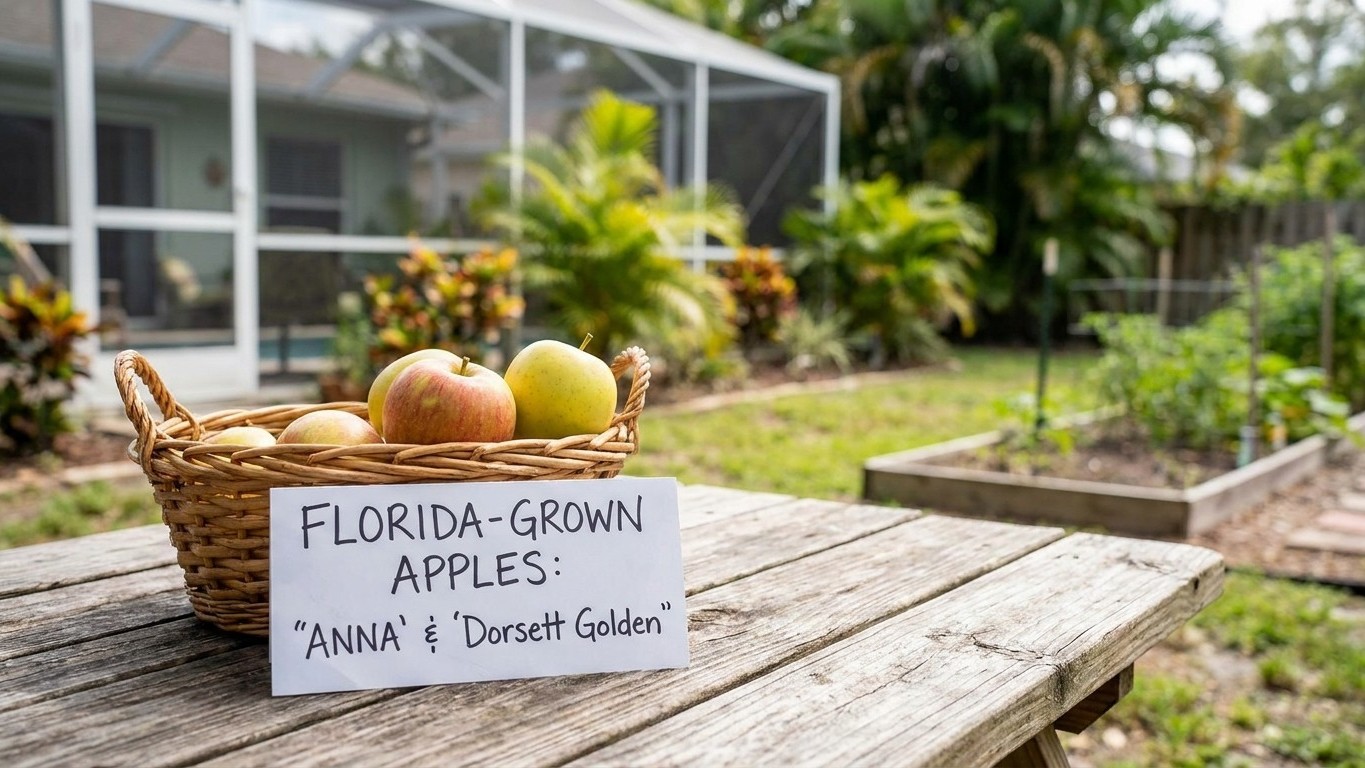

Can any apple actually fruit in your Florida yard? Yes, but only if it’s a low-chill type, and even that depends on your own winters, not the plant tag. Florida nights rarely get cold enough, long enough, for a tree to rest properly and wake up ready to bloom on schedule. So before you order anything, find out how much real winter chill your yard gets in a typical year, and start there, not with a cultivar name someone else swears by.
The short answer for Florida
For most of the state, apples are a marginal crop, and no single cultivar makes that automatically easy. NOAA’s 1991-2020 climate normals put Jacksonville’s coldest month mean minimum at 41.4°F, a figure that measures how much genuine winter cold the tree gets to rest in, not how cold a single overnight low can go. That number matters because apple trees need a stretch of temperatures at or below roughly 45°F to break dormancy and flower on a normal schedule. In north Florida, near Jacksonville, nights get cold enough often enough to deliver some of that chill most winters. Farther south, the margin narrows fast.
What the right choice depends on is less “which variety” and more how much winter chill your particular yard receives, year to year. Two winters in the same county can differ by weeks of accumulated chill, because a mild winter and a colder one land very differently on a crop that needs consistency to flower well. No named apple cultivar in wide commercial distribution is documented by a Florida source as reliable across the whole state, and a page that claims otherwise is guessing. The honest short answer is that north Florida gives the best odds of any part of the state, low-chill types bred for the Deep South and Gulf Coast are the only realistic category to plant, and any specific selection needs confirming with your county’s UF/IFAS Extension office before you order a tree.
Treat the frost dates themselves as a proxy. Jacksonville’s last spring frost, per NOAA NCEI’s 32°F freeze probabilities, falls in the February 16 to March 7 window, and the first fall frost arrives November 26 to December 13. Those are the only weeks in a Florida winter cold enough to reliably contribute chill hours, and points south of Jacksonville see progressively fewer of them, some years none at all.
Working through it

None of the widely sold northern dessert apples are actually adapted to the state. What is verifiable is the framework growers use to sort candidates, and that framework has two separate filters that most beginners collapse into one.
Hardiness and chill are different questions
Hardiness is about survival. It asks whether the wood and roots tolerate the coldest night of the year. Florida’s winters are so mild statewide that hardiness is rarely what kills an apple tree here. Winter chill is a different question entirely. It asks whether the tree gets enough sustained cold, generally understood as hours spent at or below roughly 45°F, to complete dormancy and flower on a normal, synchronized schedule the following spring. A tree that survives every winter can still fail every spring if it never chills properly, because buds break erratically, flowers open weeks apart from each other, and pollination and fruit set fall apart as a result.
That distinction is why a hardiness rating alone tells you nothing useful about whether an apple will fruit in Florida. Nearly every apple sold at a garden center north of here is hardy enough to survive a Florida winter. Almost none of them are bred for low enough chill to flower properly in one.
The categories, ranked realistically
Sorted from least to most workable in this state:
| Category | Typical winter chill need | Florida fit | What you give up |
|---|---|---|---|
| Standard northern dessert types | High, accumulated over a long, consistently cold winter | Poor almost everywhere in the state | Erratic bloom, little to no fruit most years |
| Moderate-chill types bred for the mid-South | Moderate | Marginal, and only in north Florida in a colder-than-average winter | Unreliable cropping year to year |
| Low-chill types bred for the Deep South and Gulf Coast | Low | The only realistic category anywhere in the state, best odds in north Florida | Softer fruit, shorter storage life, less of the crisp texture northern apples are known for |
Even inside that third row, a specific selection still has to be confirmed against your own county, because low-chill breeding narrows the gap without closing it, and a warm winter can still leave a low-chill tree short of what it needs. That confirmation is exactly the kind of local check Growing Apples in Florida walks through in more detail, including how to source a tree already suited to a warm-winter chill category rather than relying on a plant tag alone.
None of this means the state is a lost cause. It means the decision gets made at the category level first, low-chill against everything else, and only after that does a named selection from a nursery that specifically breeds for the Deep South become worth comparing against what your county extension office has actually seen bear fruit nearby.
What changes across Florida
North Florida is where an apple has the best chance in this state, and Jacksonville’s own numbers show why. NOAA’s 1991-2020 climate normals put the last spring frost there in the February 16 to March 7 window and the first fall frost in the November 26 to December 13 window, per NCEI’s 32°F freeze probability data. Every week inside that span is a week the coldest inland spots in north Florida, including areas well north and west of Jacksonville itself, are actually accumulating some winter chill. That is still a modest amount by the standard any northern apple cultivar needs, but it is measurably more than the rest of the state gets.
Move south past roughly the Orlando area and the pattern breaks down. Central Florida sits well outside the frost climatology described above, and NOAA’s own station data flags some years there with no freeze recorded at all. A winter with no freeze is a winter with very little apple-relevant chill, whatever category of cultivar you planted.
South Florida, around Miami, is effectively frost-free in most years, and that changes the whole growing calendar for the region, not just for apples. The main outdoor season there runs through the cooler months, and summer is the hard season to work around. For a crop that specifically depends on cold to flower, a frost-free winter is close to a disqualifying condition, and no source in this state’s extension literature documents a workaround for it.
Coastal exposure adds a second, smaller effect on top of the north-south gradient. A site right on the Atlantic or Gulf coast runs milder overnight than an inland site at the same latitude, because the ocean moderates the swing. An inland north Florida yard is generally the best position in the state for accumulating what little chill an apple tree here can get, though no figure in the available data quantifies that coastal difference in hours.
The mistakes this climate punishes
Buying a tree because the tag says it survives Florida winters is the single most common mistake, and it shows up two or three springs later when the tree leafs out over six or eight weeks instead of all at once, drops most of its flowers, and sets no fruit. Survival and flowering are not the same test, and a nursery tag built around cold hardiness will not warn you about chill.
A short list of the other errors that show up specifically in this climate:
- Planting a moderate or high-chill selection in central or south Florida, where an average winter simply does not deliver enough cold hours, however hardy the tree itself is.
- Fertilizing heavily into fall, which pushes soft new growth right into the period around Jacksonville’s first fall frost window of November 26 to December 13, per NOAA NCEI, the one stretch of real cold the tree needed to harden off before.
- Assuming a single tree is self-sufficient. Erratic bloom caused by inadequate chill often staggers flowering badly enough that a pollination partner blooms on a different week entirely, even when both trees are supposed to overlap.
- Judging chill by air temperature at head height instead of by what the tree’s own buds experience in a sheltered microclimate, which can run a few degrees warmer than the open yard and quietly cut the effective chill further.
- Skipping a local check before ordering, then discovering after two seasons that the selection shipped was bred for a chill range the county rarely reaches, which is the exact gap The Florida Apple Calendar, Stage by Stage is built to catch before you plant.
Each of these shows up on a delay. Fertilizing late does not cost the current season, it costs the tree’s hardening off before whatever cold does arrive. A wrong chill category does not fail in year one, when a young tree may not flower much anyway. It fails in year two or three, once the tree is mature enough that a real crop is actually expected and does not show up.
Checking this against your county
Chill accumulation, freeze frequency, and which low-chill selections have actually borne fruit nearby all vary county to county in Florida. The single most useful step before planting an apple tree here is a call or visit to your county’s UF/IFAS Extension office, reachable through the statewide directory at UF/IFAS Extension. Extension agents track local chill hour totals, know which nearby yards have actually produced a crop, and can tell you whether this is a year worth trying at all. That local answer will always outrank a generic recommendation, including this one.
Common questions
Do I need two apple trees to get fruit, or will one tree do?
Plan on two compatible trees. Most apple cultivars need cross-pollination from a genetically different tree with an overlapping bloom period, and Florida’s erratic mild-winter bloom pattern makes that overlap less predictable than in a climate with a clean, uniform spring.
Will an apple tree even survive in south Florida, if it never fruits?
Yes, most apple trees are hardy enough to live through a Florida winter almost anywhere in the state, since hardiness is about surviving cold, not about needing it. In south Florida the tree may simply stay ornamental, because the winter rarely supplies the chill it needs to flower and set fruit.
How do I find out how much chill my own yard actually gets?
Ask your county’s UF/IFAS Extension office first, since agents often track local chill hour totals already. You can also hang a min/max thermometer near the tree and log hours at or below roughly 45°F yourself through the winter, but treat one season’s log with caution. As the trial orchard note above shows, a single warm week late in winter can erase weeks of chill a tree had already banked.
Is there a specific low-chill apple bred just for Florida that I should order?
Several nurseries market low-chill selections bred for the Deep South and Gulf Coast. Call your county UF/IFAS Extension office and ask what has actually borne fruit nearby before you commit to a specific selection from a catalog.