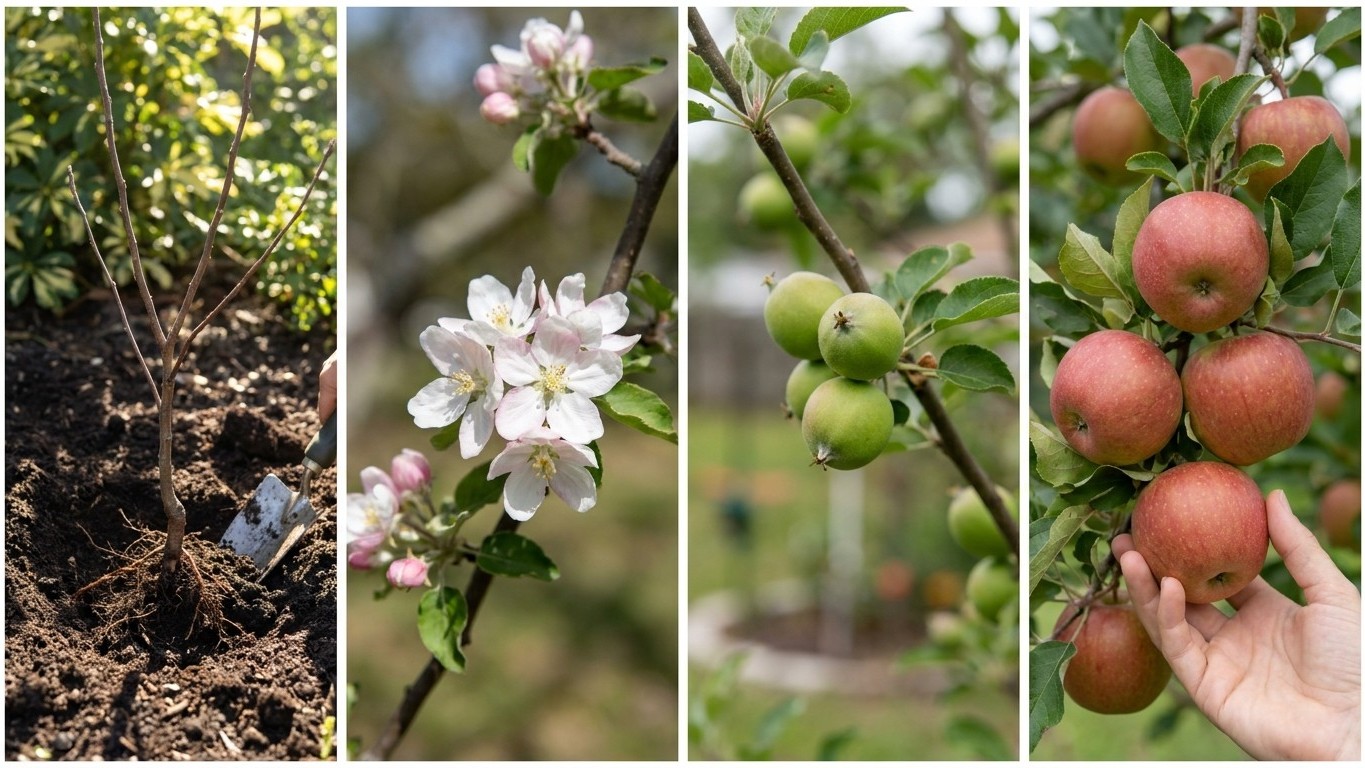

Forty-one point four degrees — that’s the coldest month’s average low in Jacksonville, and it’s the number that decides whether an apple tree planted anywhere in Florida ever fruits. North Florida is the only real option, and only for low-chill cultivars like ‘Anna’, ‘Dorsett Golden’ and ‘Ein Shemer’, bred to flower on 100 to 300 chill hours instead of the 800 or more standard apples expect. A tree can survive every winter here and still bloom thin or late, because surviving cold and accumulating enough of it are two different questions entirely.
The short answer for Florida
The short answer is that most of Florida is too warm in winter for standard apples, and the only realistic growing region is north Florida, using cultivars bred for almost no winter chill. Jacksonville’s NOAA NCEI 1991-2020 climate normals put the coldest month’s average daily minimum at 41.4°F, a winter mild enough that only apples needing roughly 100 to 300 chill hours below 45°F, such as ‘Anna’, ‘Dorsett Golden’ and ‘Ein Shemer’, have any real chance of flowering and fruiting reliably.
That answer depends on two separate filters, and conflating them is the single biggest reason a Florida-planted apple tree survives for years without ever fruiting properly. Hardiness asks whether the tree survives the winter it gets, and Florida’s winters pass that test easily almost everywhere in the state. Winter chill asks something different: whether the tree accumulated enough cumulative hours of cold to break dormancy evenly and flower on schedule. A tree can be perfectly hardy and still bloom sparsely, late, or not at all if it never got its chill.
What this depends on
If you’re still choosing a site, rootstock or cultivar, that decision comes first. See Growing Apples in Florida for the groundwork this calendar assumes is already in place. Once a low-chill cultivar is in the ground in north Florida, the calendar below is what to work from, staged against Jacksonville’s frost window rather than a fixed month, because a warm winter or a cold spring shifts every stage earlier or later by weeks.
Working through it

Every stage in an apple tree’s year is a response to accumulated cold and rising temperature, not to the calendar page. The same cultivar can reach green tip in mid-January one year and early February the next, depending on how quickly winter chill built up and how fast late-winter warmth arrived. In north Florida, the stage that matters most is whichever one lands closest to Jacksonville’s NOAA-normal last spring freeze window of February 16 to March 7.
From dormancy to bloom
- Dormancy (December into January): the tree is leafless and accumulating chill hours below roughly 45°F. Jacksonville’s coldest month has a NOAA-measured average minimum of 41.4°F, cold enough for a low-chill cultivar’s dormancy requirement but nowhere near enough for a northern-bred one.
- Green tip: buds swell and show the first green. Low-chill cultivars often reach this stage well before Jacksonville’s last-freeze window closes.
- Pink and bloom: open or nearly open flowers are the most cold-sensitive tissue on the tree. A freeze that lands inside the 30 to 70 percent probability band NOAA assigns to that February 16 to March 7 window can take out an entire bloom in one night.
From fruit set to harvest
Once flowers have set fruit and the spring frost window has reliably passed, risk drops off fast. There’s no equivalent hazard waiting at the other end of the season. For the low-chill cultivars that actually work in north Florida, harvest falls in summer, months ahead of Jacksonville’s NOAA-normal first fall freeze of November 26 to December 13. Fall frost is rarely what decides a Florida apple crop. The spring freeze window overlapping with bloom is what does.
Chill hour figures are the ranges nurseries publish on the tag, and they hold regardless of where in the state a tree is planted. What shifts by location is how reliably a given winter delivers them, and how late or early bloom lands relative to the local frost window. See The Best Apple Varieties for Florida for the fuller ranking.
| Cultivar | Approx. chill hours needed | Bloom timing risk | Pollenizer needed |
|---|---|---|---|
| ‘Anna’ | 200-300 | Early; can precede the last-freeze window in a mild winter | Benefits from ‘Dorsett Golden’ or ‘Ein Shemer’ nearby |
| ‘Dorsett Golden’ | 100-200 | Very early; highest exposure to a late freeze | Partly self-fruitful, better with a pollenizer |
| ‘Ein Shemer’ | around 300 | Slightly later than ‘Anna’ | Good pollenizer for ‘Anna’ and ‘Dorsett Golden’ |
| ‘TropicSweet’ | around 250 | Early, similar window to ‘Anna’ | Needs a pollenizer |
What changes across Florida
Jacksonville’s frost dates describe north Florida’s coastal plain, and even nearby areas differ from that single reference station. NOAA notes that three of the thirty winters in its 1991-2020 record produced no freeze at all at that station, which means the window itself is a probability band, not a guarantee, even within the same county.
North Florida versus the peninsula
Inland sites in north Florida, away from the ocean’s moderating effect, tend to run colder on a still winter night than the coast a few miles away, because open water holds heat that bare ground gives up quickly after dark. That difference can push a local last freeze later than Jacksonville’s airport reading, or pull it earlier, depending on which side of that coastal-to-inland line a planting sits on.
Move south into central Florida, around Orlando and the lake country nearby, and winters get milder still. Large lakes there moderate their immediate shoreline the same way the ocean does at the coast, but the region as a whole gets far fewer hours below 45°F than north Florida does in an average winter. That’s a chill problem, not a frost problem. Even the lowest-chill apple cultivars available start to struggle to break dormancy evenly there.
South Florida, from around Orlando’s latitude down through Miami, is effectively frost-free in most years, which is exactly why its growing calendar for cold-tender crops inverts and runs through winter instead of around it. Apples don’t follow that pattern. No local extension trial documents a low-chill apple cultivar fruiting reliably in south Florida, because the region’s problem isn’t frost risk. It’s winters too warm and too short to satisfy dormancy at all.
The mistakes this climate punishes
Florida’s apple calendar has a short list of ways to fail, and each one shows up at a specific stage rather than as a vague seasonal problem.
The bloom-timing mismatch
The costliest mistake is a variety whose bloom regularly lands ahead of Jacksonville’s NOAA-normal last freeze window of February 16 to March 7. ‘Dorsett Golden’ breaks dormancy earliest of the common low-chill cultivars, so in a mild winter followed by a normal-timed late freeze, it’s the one most likely to be in open bloom exactly when a 32°F night arrives. The damage shows as blackened flower centers within a day or two of the freeze, so by the time it’s visible the crop for that year is already gone.
The wrong chill category
The second mistake is planting a cultivar bred for a northern climate, one that needs 600 to 800 or more chill hours, anywhere in Florida. It will usually survive; hardiness isn’t the issue. What fails is dormancy itself: buds break unevenly, some branches leaf out weeks after others, bloom is sparse and drawn out, and fruit set is poor even in a year with no frost at all. This shows up every year, not just a cold or warm one, because the tree’s chill requirement simply isn’t being met on a Florida winter regardless of how that winter runs.
The third mistake is timing. Feeding a young apple tree late into fall pushes soft new growth right before the first freeze risk arrives. That new growth hasn’t hardened off, so it’s the first tissue to blacken in a freeze event, even on an otherwise freeze-tolerant tree. Stop nitrogen feeding well ahead of the fall freeze window for the site’s own local normal, and let growth harden on its own going into winter.
Checking this against your county
Jacksonville’s NOAA frost dates and the cultivar chill hours above are a starting point, not a substitute for what a county-level office knows about a specific site. The University of Florida’s IFAS Extension network, reachable through its statewide directory at sfyl.ifas.ufl.edu, can confirm how a particular county’s winters have run in recent years and which low-chill cultivars local growers have actually gotten fruit set on.
That’s worth doing before planting, not after a bloom fails. A county agent can also flag site-specific cold pockets, like low ground that drains cold air more slowly than a slope nearby, that no statewide frost map will show.
Common questions
Can I grow a Honeycrisp or Fuji apple tree in Florida?
Not successfully in most of the state. Both need far more winter chill than Florida winters deliver, so the tree usually survives but leafs out unevenly and sets little or no fruit. A low-chill cultivar bred for the Gulf South, such as ‘Anna’ or ‘Dorsett Golden’, is the realistic substitute.
Do I need two apple trees to get fruit in Florida?
Most of the low-chill cultivars that work in Florida set more fruit with a second, different cultivar nearby to cross-pollinate, even when the catalogue lists them as partly self-fruitful. Pairing ‘Anna’ with ‘Dorsett Golden’ or ‘Ein Shemer’ is the standard combination.
My apple tree bloomed but then dropped every flower. What happened?
The two usual causes are a freeze during bloom or a winter that didn’t deliver enough chill to trigger a proper dormancy break, and both produce weak, uneven flowering that aborts easily. Check whether a freeze fell inside the local last-freeze window around the time the tree was blooming before assuming it’s a chill problem.
Why didn’t my apple tree lose its leaves this winter?
An apple tree that stays partly leafed through a Florida winter usually didn’t get enough cumulative cold to force it into full dormancy, which is a chill problem rather than a disease or watering issue. It’s common on cultivars pushing the upper end of what a mild Florida winter can supply, and it tends to show up as weaker bloom the following spring.