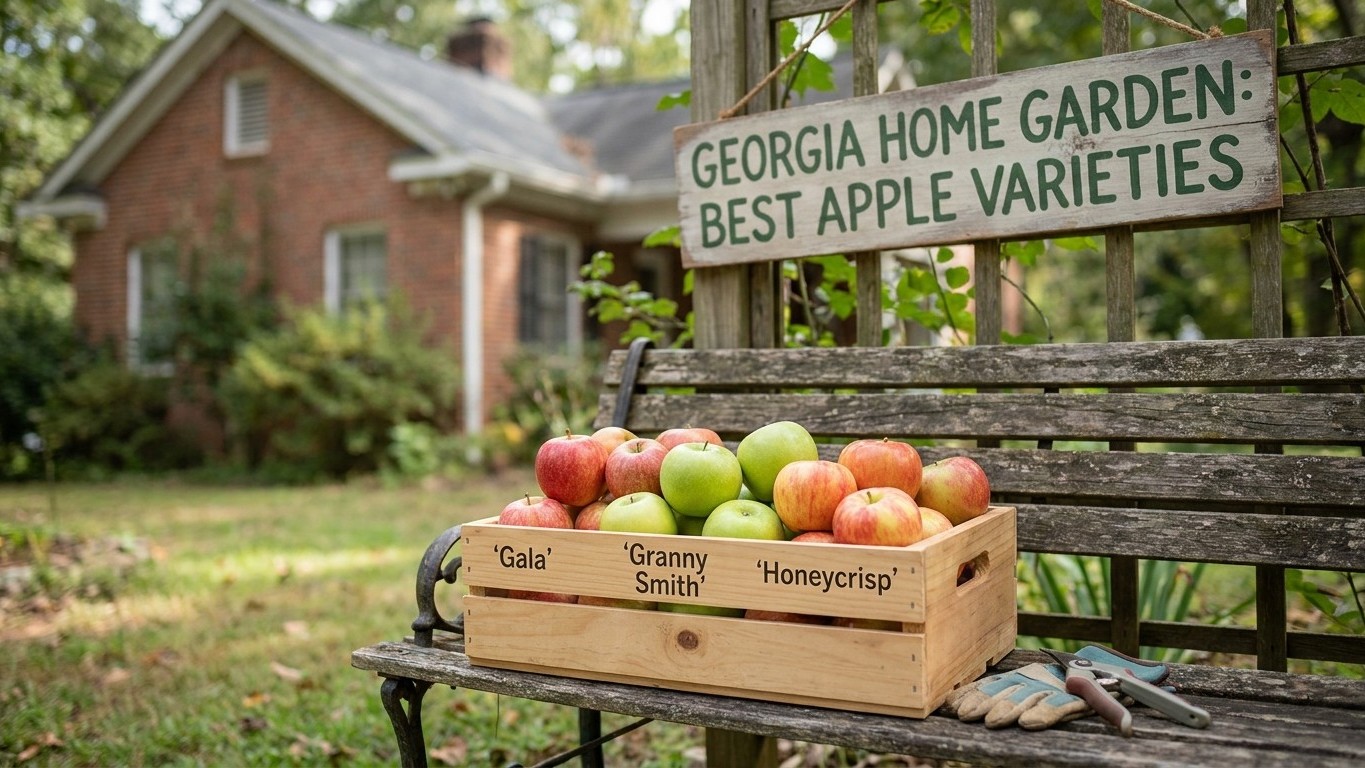

Georgia can grow apples almost everywhere, but the state has no single best variety. NOAA’s 1991-2020 climate normals put Atlanta’s coldest month average minimum at 34.3°F, mild enough that winter hardiness is rarely what fails a tree here. What decides success is whether a cultivar’s chill-hour requirement matches your particular elevation and region. Before buying a tree, check UGA Extension’s county-specific fruit variety recommendations rather than picking a name off a nursery tag.
The short answer for Georgia
There’s no single best apple for Georgia, because there’s no single Georgia winter. The right variety is the one whose chill requirement matches what your particular spot actually gets — a mountain hollow banks cold very differently than a yard near Atlanta or down in the coastal plain. Before you buy a tree, find out which chill category your elevation and region call for, then choose the cultivar name from there.
What that mild figure does not tell you is whether a given cultivar will flower on schedule, set fruit, and ripen before the year is out. That depends on winter chill, the accumulated cold a tree needs before it can break dormancy properly in spring. A tree that never banks enough chill blooms late, unevenly, or not at all, no matter how far south its hardiness rating says it should thrive. This is the filter that actually separates a workable Georgia apple choice from a disappointing one, and it runs opposite to hardiness: north Georgia’s higher elevations bank chill reliably every winter, while the Piedmont around Atlanta and the coastal plain further south risk a warm winter shorting a high-chill tree of what it needs.
There is no statewide answer because there is no statewide winter. A cultivar list that works at higher elevation in north Georgia is not the same list that works in the coastal plain further south. UGA Extension publishes chill-hour ratings and county-level cultivar recommendations for exactly this reason, and that list is where a specific variety name should come from, not a generic garden guide.
Working through it

Ranking apple choices for Georgia means ranking chill-hour categories first and cultivar names second, because the category is what your climate actually enforces. Three broad bands cover most of what’s sold for the Southeast: low-chill, moderate-chill, and high-chill selections. Each comes with a real cost.
Hardiness is not the limit here
Cold hardiness asks whether the tree survives winter. Chill asks whether it flowers on schedule the following spring. Georgia’s winters, even in the coldest counties, rarely threaten an apple tree’s survival, so hardiness zone maps are close to irrelevant for this decision. Chill is the filter that decides whether the tree you planted actually produces a crop most years.
What each chill category costs you
Low-chill selections break dormancy on relatively little accumulated cold, which makes them the safer bet in the warmer Piedmont and the coastal plain, where a mild winter can otherwise leave a high-chill tree short. The tradeoff is that a low-chill tree in an unusually cold winter, or one planted at higher elevation, can bloom too early and sit exposed through additional frost. Moderate-chill selections split the difference and are the most forgiving choice across most of the state’s mid-elevation counties. High-chill selections need a long, cold dormancy to flower evenly, which north Georgia’s mountains deliver most winters, but the same tree planted near Atlanta or further south risks a warm year that never lets it break dormancy properly, producing a thin, uneven bloom and a light crop.
| Chill category | Where it is the safer bet | What you give up |
|---|---|---|
| Low-chill | Coastal plain, warmer Piedmont | Earlier bloom, more exposed to a late frost |
| Moderate-chill | Most of the state’s mid-elevation counties | Least forgiving of extremes in either direction, but no major weakness |
| High-chill | North Georgia mountains and higher elevations | Unreliable bloom in a mild winter or at lower elevation |
Rootstock is the other lever, and it works independently of the chill decision. A dwarfing rootstock brings a tree into bearing sooner and keeps it small enough to spray and pick without a ladder, but it anchors less firmly, needs staking, and is less forgiving of a droughty summer. A standard or semi-dwarf rootstock takes longer to bear and grows taller, but tolerates a rough site better once established. Neither choice fixes a chill mismatch. Get the chill category right for your elevation first, then choose rootstock for the space and labor you actually have.
For the actual cultivar names that fit each category in your county, UGA Extension’s fruit variety publications are the source to use, since they are revised as new cultivars are trialed and old ones fall out of favor. A nursery tag or a national gardening blog will not know whether your particular county runs closer to the mountain pattern or the Piedmont pattern.
What changes across Georgia
The frost dates and winter minimum used above come from NOAA’s reference station at Atlanta, and Atlanta is not the state. The airport site sits in an urban heat island in the Piedmont, at a moderate elevation, and its readings run milder than much of north Georgia and colder than the deep coastal plain.
North Georgia and the mountains freeze several weeks earlier in fall than the NOAA Atlanta window suggests, and they hold cold longer into spring. That earlier, deeper cold is exactly what banks chill hours reliably, which is why high-chill selections have their best shot at flowering evenly up there. It also means the growing season is shorter and a late bloom has less room to recover from a frost.
The coastal plain runs the opposite way. Winters there are milder and shorter, which is kinder to bloom timing but harder on chill accumulation. A cultivar that needs a long, cold dormancy can come up short there in a mild year, even though the same tree would never notice a frost problem.
The Piedmont around Atlanta sits between the two, which is exactly why the reference-station figures used here are a starting point and not a verdict for any specific county. Elevation does most of the work within a single county too: a valley bottom that collects cold air overnight can run several degrees colder at bloom time than a slope a short drive away, which is the kind of difference no statewide figure can capture.
The mistakes this climate punishes
Planting a high-chill cultivar in a warm winter pocket is the mistake that shows up slowest and hurts the most. The tree looks fine for two or three years, then a mild winter arrives, the tree fails to break dormancy on schedule, and the bloom comes thin and staggered instead of all at once. By the time an orchardist recognizes the pattern, several seasons of light crops have already gone by. This mistake is most likely in the Piedmont and coastal plain, where NOAA’s Atlanta normals already show a coldest-month average minimum of only 34.3°F, mild enough that a high-chill tree cannot count on the winter to finish the job every year.
The opposite mistake, a low-chill cultivar at a cold mountain elevation, shows up faster. The tree breaks dormancy at the first stretch of warm weather, blooms early, and then sits exposed when a normal late frost arrives inside NOAA’s March 11 to March 29 last-frost window for the Atlanta area, a window that runs earlier in the mountains but still later than an early bloom can wait out. An early bloom in a season with a late frost is the single most common way a Georgia apple crop is lost outright rather than just reduced.
Feeding a tree late in the season is the third mistake, and it shows up in fall rather than spring. Nitrogen applied in mid to late summer pushes soft new growth right when the tree should be hardening off for winter. That new growth is the first tissue killed when the first fall frost arrives, and NOAA’s normals put that arrival at November 13 to December 1 for the Atlanta area, earlier still in north Georgia. Stop feeding well before that window opens, not on a calendar date but once the tree’s own growth has slowed for the season, which is the stage that actually matters. For the full stage-by-stage sequence this timing fits into, see The Georgia Apple Calendar, Stage by Stage.
Checking this against your county
Everything above is a framework, not a substitute for a local check. UGA Extension maintains the current fruit variety recommendations, chill-hour ratings, and disease-resistance notes by region, and that is the list to cross-check before you buy a tree, since it is revised as cultivars are trialed and dropped. Start at UGA Extension and search for its home garden apple and fruit publications, or call your county office directly. If you have not yet worked through site selection, spacing, and planting for the crop as a whole, Growing Apples in Georgia covers that ground first.
Common questions
Can I grow apples in south Georgia’s coastal plain?
Yes, but the choice narrows to selections with a genuinely low chill requirement, since the coastal plain’s mild winters are the harder limit there, not cold hardiness. Check UGA Extension’s variety list for the coastal plain specifically before you plant, since a cultivar that thrives in north Georgia can underperform badly on the coast.
Do apple trees need a second tree nearby to produce fruit?
Most apple cultivars are not self-fertile and need a second tree, or a neighbor’s tree, blooming at roughly the same time to set fruit. If you only have room for one tree, ask your extension office or nursery which cultivars in your chill category overlap in bloom timing before you commit to a single tree.
How do I know if my tree got enough winter chill?
Watch the bloom the following spring rather than trying to count hours yourself. A tree that got enough chill blooms in one concentrated flush. A tree that came up short blooms late, thin, and staggered over several weeks, even though nothing else about the tree looks unhealthy. If that pattern repeats for two or three winters running, the cultivar is mismatched to your site’s chill, not diseased.
My tree bloomed and then we got a frost. Is the crop gone for the year?
Flowers killed by frost do not reopen or reset that same season, so a hard freeze on an open bloom typically means a light or absent crop that year regardless of how healthy the tree is otherwise. NOAA’s 1991-2020 normals put the Atlanta area’s last spring frost in the March 11 to March 29 window, and a bloom that opens before that window closes is the tree, not the weather, taking the risk.