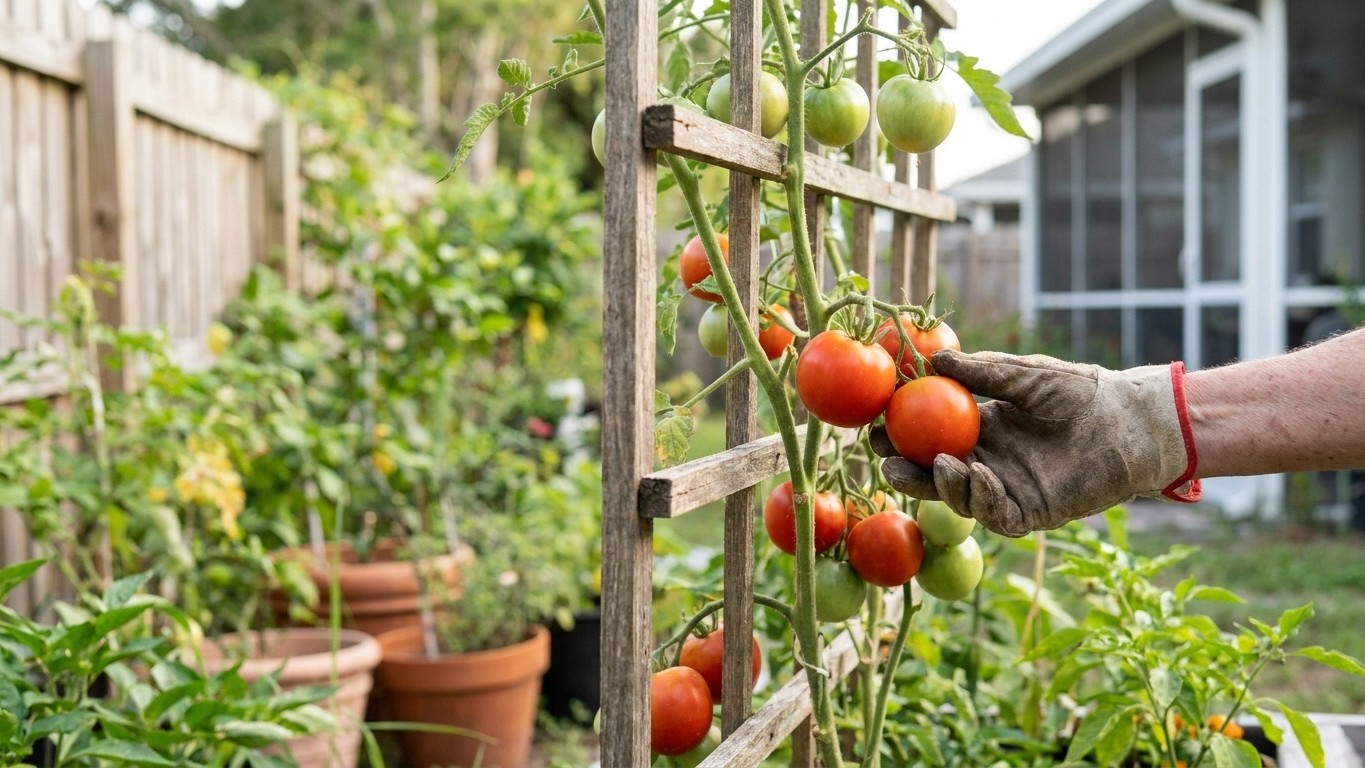

February 16 to March 7 — that’s the stretch a Jacksonville weather station has logged as its last freeze window over three decades, and it’s the anchor point for every tomato calendar in this state. Three seasons in thirty stayed frost-free entirely, so treat that spread as a starting guess, not a promise, especially further north or up on higher ground. Count back six to eight weeks from it and you land somewhere between late December and late January for starting seed indoors.
When to plant Tomatoes in Florida

NOAA’s National Centers for Environmental Information track the 32°F freeze probability at station USW00013889 near Jacksonville, and the 1991-2020 normals put the last spring freeze somewhere between February 16 and March 7. That is a range, not a single date. Three of the thirty years in that record saw no freeze at all, which tells you how much this window can shift from one season to the next even at a single station. Gardeners north of Jacksonville or up on higher ground should expect that window to run later, and anyone relying on this figure should treat it as a Jacksonville-area estimate rather than a fixed statewide date.
Starting seed indoors
Tomato seed wants six to eight weeks of indoor growth before it goes outside as a sturdy transplant. Counting six to eight weeks back from the Jacksonville frost window of February 16 to March 7 lands seed-starting somewhere in late December through late January, depending on where your own last frost falls within that stretch. Start on the earlier side if your site tends to run cold, and later if you are close to the coast or in a sheltered spot that historically stays milder.
Hardening off and transplanting
Give seedlings seven to ten days outdoors in increasing sun and wind before they go into the ground permanently. This step matters more in Florida than the calendar might suggest, because a plant raised entirely under grow lights and then dropped straight into full spring sun can scorch its leaves in a single afternoon. Transplant into the garden once you are past the local frost window, and lean toward the later end of it if a cold snap is in the forecast, since a light frost can still set a young tomato plant back by weeks even when it does not kill it outright.
Central and south Florida run a different calendar
South of roughly the Orlando line, freezing temperatures become rare enough that the entire tomato season inverts. Instead of racing to beat a spring frost, growers there plant through the fall and winter months and treat summer as the season to avoid, since high heat and humidity bring disease pressure and poor fruit set that no frost date will ever cause. Do not apply the Jacksonville frost window to Orlando or Miami gardens. That inversion is a real contrast with states such as Indiana, where tomatoes stay strictly a summer crop from frost to frost, a calendar covered in our guide to growing tomatoes in Indiana. Georgia gardeners just across the state line work through a similar spring frost calculation to north Florida’s, and that timing is laid out in our guide to growing tomatoes in Georgia.
Soil and site preparation
Tomatoes want a minimum of six to eight hours of direct sun, and in Florida’s sandy soils, drainage matters just as much as sunlight. Much of the state’s native soil drains fast and holds nutrients poorly, so working in two to three inches of compost or aged manure a few weeks before planting gives roots something to hold onto besides quartz sand. Do this early enough that the amendment has time to settle and start breaking down before transplant day, rather than mixing it in at the last minute.
Bed layout and spacing
Raised beds or mounded rows help in low spots where summer rain sits, since tomato roots rot quickly in standing water. Space plants 24 to 36 inches apart within the row and leave at least four feet between rows for airflow, since cramped plants in Florida’s humidity are far more prone to fungal disease than the same varieties grown with breathing room. Drive stakes or set cages in place at planting time rather than after the plant has sprawled, since disturbing established roots later checks growth right when the plant needs to be putting on size.
Test soil pH before you plant if you have not done so recently. Tomatoes prefer a slightly acidic to neutral range, and county extension offices offer soil testing that will tell you exactly where your bed stands rather than leaving you to guess.
Varieties that suit Florida
The traits that matter most here are a short enough days-to-maturity count to beat the arrival of serious summer heat, and disease resistance suited to a humid climate where fungal and viral pressure builds fast once the weather turns warm and wet. Determinate varieties tend to concentrate their harvest into a shorter window, which can be an advantage if you want to get most of the crop in before conditions turn hard on the plants.
Cherry types ripen fastest. Sun Gold reaches maturity in 57 days from transplant and carries high resistance to Tobacco Mosaic Virus and Fusarium Wilt race 1. Counting 57 days from either end of the Jacksonville transplant window of February 16 to March 7 puts first ripe fruit somewhere from mid-April to early May. Amish Paste, at the other end of the scale, needs 85 days and pushes ripening into mid-May through the end of May, right as Florida’s afternoon heat starts climbing toward the range where tomato pollen becomes less viable and fruit set drops off.
For growers who want documented disease resistance built in, Celebrity Plus, Big Beef Plus, Granadero and Tiren all carry resistance ratings against nematodes, verticillium wilt, or tomato mosaic virus, traits worth having in ground that has grown tomatoes or their relatives before. Heirlooms like Cherokee Purple and Brandywine carry no listed disease resistance in the catalog and tend to need closer watching for wilt and leaf disease as a tradeoff for their flavor.
| Variety | Days from transplant | Type | Notable resistance | Best for |
|---|---|---|---|---|
| Sun Gold | 57 | Indeterminate | Tobacco Mosaic Virus, Fusarium Wilt race 1 | Early cherry harvest |
| Sakura | 55 | Indeterminate | Nematodes, Tomato Mosaic Virus, Fusarium Wilt races 1, 2 | Fastest maturity, heavy nematode pressure |
| Supersweet 100 | 60 | Indeterminate | Verticillium Wilt, Fusarium Wilt race 1 | Long cherry harvest |
| Juliet | 60 | Indeterminate | Late Blight, Early Blight (Intermediate) | Grape tomatoes, humid summers |
| Jasper | 60 | Indeterminate | Late Blight (High), Early Blight | Cherry with strong blight defense |
| Amalfi | 68 | Determinate | Nematodes, Late Blight, Early Blight (all Intermediate) | Sauce tomatoes in disease-prone ground |
| Cherokee Purple | 72 | Indeterminate | None listed | Flavor, needs closer disease watching |
| Big Beef Plus | 72 | Indeterminate | Nematodes, Gray Leaf Spot, Tomato Mosaic Virus | All-purpose slicer |
| Granadero | 75 | Indeterminate | Nematodes, Verticillium Wilt, Tomato Mosaic Virus | Roma type for canning |
| Tiren | 75 | Indeterminate | Verticillium Wilt, Tomato Mosaic Virus, Fusarium Wilt race 1 | Slicer for repeat tomato ground |
| San Marzano II | 78 | Indeterminate | None listed | Classic paste tomato |
| Celebrity Plus | 78 | Determinate | Nematodes, Gray Leaf Spot, Tomato Mosaic Virus | Concentrated harvest, disease pressure |
| Brandywine | 78 | Indeterminate | None listed | Heirloom flavor, watch for wilt |
| Amish Paste | 85 | Indeterminate | None listed | Long-season paste, beat the heat early |
Catalog days-to-maturity figures are counted from the transplant date, not from seed, and they shift by a week or two either way depending on how warm or cool the season runs. Treat every number above as a starting estimate rather than a guarantee.
What to plant alongside
Basil is the classic tomato companion, and it earns the spot honestly: it shares no major diseases with tomatoes, stays low enough not to compete for light, and its flowers draw pollinators and small predatory insects that help keep aphids in check. Borage does similar work, pulling in bees while its coarse leaves shade the soil around the base of the plant.
Marigolds get credit for repelling nearly every pest in the garden, and most of that reputation is folklore. Their documented benefit is narrower but real: French marigolds suppress root-knot nematode populations when grown in the bed over a full season, which matters directly in Florida’s sandy soils where nematodes are a persistent problem, and it is part of why several of the varieties above carry nematode resistance ratings. Marigolds planted as a border for one season are not going to noticeably cut whitefly or hornworm numbers, whatever the seed packet implies.
Keep tomatoes away from corn, since corn earworm and tomato fruitworm are the same insect and planting both crops side by side just gives it a continuous buffet. Skip planting near potatoes, peppers or eggplant too, since all four are nightshades that share susceptibility to blight and verticillium wilt, and a disease that starts in one can move straight into the others. Fennel is worth avoiding near almost anything, tomatoes included, since it releases compounds into the soil that suppress the growth of many neighboring plants.
Watering, feeding and support
Water deeply and less often rather than a light daily sprinkle. Frequent shallow watering trains roots to stay near the surface, where Florida’s sandy soil dries out fast and leaves the plant vulnerable the moment you miss a day. A two to three inch layer of mulch, straw or shredded leaves both, keeps soil moisture steadier between waterings and cuts down on the soil splashing up onto lower leaves that spreads fungal spores during Florida’s heavy summer rain.
Feeding through the season
Work a balanced fertilizer into the bed at transplant time, then side-dress again once the first fruit clusters start to set. Too much nitrogen too early produces a lush, leafy plant with little fruit, since the plant puts its energy into leaves rather than blossoms. A lighter, more frequent feeding schedule generally beats one heavy application, especially in sandy soil where nutrients wash through quickly after rain.
Staking, caging and pruning
Indeterminate varieties, which is most of the list above, keep growing and setting fruit until frost or disease stops them, and they need a stake or a sturdy cage tall enough to support that continued growth. Determinate varieties like Celebrity Plus and Amalfi grow to a set size, set fruit over a shorter window, and need less support and pruning as a result. For indeterminate types, pinch out the suckers that form in the crotch between the main stem and each leaf branch to keep the plant from turning into a tangled thicket that traps humidity and invites disease.
Common problems

Most tomato failures in Florida trace back to one of a handful of causes, and the symptoms usually point straight at the culprit if you know what to look for.
- Blossom end rot: a flat, sunken, dark leathery patch on the bottom of the fruit, caused by inconsistent watering interrupting calcium uptake rather than a lack of calcium in the soil itself.
- Fruit cracking: rings or splits radiating from the stem, usually after a dry spell followed by heavy rain that the fruit’s skin cannot expand to accommodate fast enough.
- Leaf curl: upward-curling leaves during a stretch of high heat are usually just the plant protecting itself from moisture loss, but curl paired with yellow mottling points to a viral problem instead.
- Wilt: a plant that wilts in full sun and recovers overnight is likely just responding to heat, but one that wilts and stays wilted, especially with yellowing that starts low and moves up, is showing fusarium or verticillium wilt, which is exactly what the resistance ratings on varieties like Tiren and Big Beef Plus are bred to fight off.
- Poor fruit set: blossoms that drop without forming fruit are common once daytime heat and nighttime warmth both climb high enough to affect pollen viability, which is one more reason to favor faster-maturing varieties that finish their harvest before peak summer heat arrives.
Pests to watch for
Whiteflies cluster on leaf undersides and spread viral disease as they feed. Hornworms are large enough to spot by the chewed leaves and dark droppings they leave behind before you ever see the caterpillar itself. Stink bugs cause cloudy, discolored spots inside the fruit where they have pierced the skin to feed. Root-knot nematodes live in the soil and show up as stunted, yellowing plants with knotted, swollen roots when you pull one up to check, which is the main reason nematode-resistant varieties are worth choosing if a bed has grown tomatoes, peppers or eggplant in recent seasons.
Pests that actually show up in Florida
UF/IFAS Extension keeps a running list of the pests that show up in Florida vegetable gardens, and most of them never touch a tomato plant. Pickleworm and melonworm attack squash and melons, not tomatoes, and cycad aulacaspis scale is a threat to sago palms, not vegetables. If you grow only tomatoes you can cross those three off your worry list entirely. Whiteflies, hornworms, and root-knot nematodes are genuine tomato pests, but they’re covered above under Common problems. The rest of the state’s list that actually lands on tomato foliage and fruit is short.
Chilli thrips (Scirtothrips dorsalis) show up first as scarred, bronzed new growth and curled, stunted leaf tips rather than as visible insects, since the thrips themselves are barely a sixteenth of an inch long. UF/IFAS notes they build to their worst numbers during long hot dry stretches, so watch new growth closely once summer heat sets in. Pruning out and destroying the damaged shoots as soon as you spot them keeps a light infestation from spreading to the rest of the plant.
Fall armyworm caterpillars chew ragged holes through leaves and can strip a young plant fast, feeding down in the leaf whorls where they’re easy to miss until the damage is done. Handpicking works on a small planting. On a bigger one, a Bacillus thuringiensis spray applied while the caterpillars are still small stops them before they do real damage.
Eastern lubber grasshoppers (Romalea microptera) are hard to mistake once you see one: big, slow-moving, and yellow or black depending on their stage, chewing leaves down to the ribs. UF/IFAS records them in Florida gardens from roughly March or April through October or November, with the heaviest numbers in July and August. They’re tough to kill as adults, so the real window is catching the young nymphs early and knocking them into soapy water by hand.
Aphids cluster on new growth and leave a sticky residue behind, and fire ants often work the same plants, tending the aphids for their honeydew while stinging anyone who reaches into the foliage to pick fruit. A strong water spray or insecticidal soap handles aphids, and a labeled bait product around the mound handles the ants without spraying the plant itself.
Tomatoes set out in August or September, for a fall crop, run into more of these pests at once than a spring planting does, since most of them thrive in the same hot weather that lingers into early fall. Full pest photos and updates live on UF/IFAS Extension’s Gardening Solutions Pests page.
Harvest and end of season
Pick fruit once it has reached full color for its variety, whether that is the deep red of Big Beef Plus, the near-black shoulders of Cherokee Purple, or the golden-orange of Sun Gold. Fruit that is showing color but still firm will finish ripening perfectly well on a kitchen counter out of direct sun, which is a useful option when rain is forecast and you would rather bring fruit in than risk it splitting on the vine.
Store ripe tomatoes at room temperature rather than in the refrigerator, since cold temperatures dull both texture and flavor. Fruit that is fully ripe and won’t be eaten within a few days can be frozen whole for later use in sauce, skins and all, or processed into sauce or paste right away.
As the season winds down
NOAA’s data for the Jacksonville area covers the spring frost window in detail, but the return of fall frost is far more variable from one location to the next, so check your county extension office rather than relying on a single date. Once nights start cooling in fall and a frost looks likely, pick any fruit that has started to show color, even if it is still mostly green with a blush, and bring the whole plant’s remaining harvest indoors to finish ripening rather than losing it to a hard freeze overnight.
Local help
County-level planting dates, soil testing and pest identification are exactly what your state extension service is set up to handle, and the guidance holds up better than a generic calendar because it accounts for your specific spot rather than a single reference station. Reach the University of Florida’s network through the extension service directory, and for other crops timed to the state’s range of climates from the panhandle to the Keys, see our Florida guides.
Where to Go Next
Everything above is the overview — the three pages below are where the specifics live. If you’re still working out when to actually get plants in the ground, start with the tomato planting calendar, which counts backward from your local frost window instead of handing you a single statewide date — useful if you’ve ever watched a Valentine’s Day transplant in Jacksonville turn to black mush overnight because “last freeze” there is really a three-week spread.
Once timing is settled, the choice of what to plant matters just as much. The roundup of varieties that ripen in time covers twelve picks suited to how late frost actually arrives in north Florida, with set-out windows running from early to late March.
And because Florida’s tomato season brings its own rotating cast of trouble, the tomato pest guide walks through what shows up when — aphids and thrips early on, whitefly and hornworms once it heats up, then fruitworm, stink bugs and root-knot nematodes through the rest of fruiting.
Common questions
Can I grow tomatoes in Florida all year?
Not in one location. North Florida gardens near Jacksonville follow a spring-to-fall pattern bounded by the frost window NOAA tracks, while central and south Florida gardens flip that pattern and grow through fall and winter, resting the beds during peak summer heat and humidity instead.
Why do my tomato flowers fall off without setting fruit?
The most common cause in Florida is heat, since sustained high daytime and nighttime temperatures interfere with pollen viability well before any visible sign of stress shows up on the leaves. Choosing a faster-maturing variety so more of the harvest lands before peak heat is usually more effective than trying to fix fruit set once temperatures are already high.
Do I need to prune tomato suckers?
Only really matters for indeterminate varieties, and it is optional rather than mandatory even there. Removing suckers keeps the plant more open and airy, which helps in Florida’s humidity, but a determinate variety like Celebrity Plus or Amalfi does not need this kind of pruning at all.
Is it too late to plant if I missed the early transplant window?
It depends on how much of the season is left before summer heat sets in hard. A fast variety like Sakura at 55 days or Sun Gold at 57 days can still fit in a shorter remaining window that would leave no time at all for an 85-day variety like Amish Paste, so switch to a quicker cultivar rather than skipping the season entirely.
Why are my tomato leaves yellowing from the bottom up?
That pattern usually points to a soil-borne wilt disease such as fusarium or verticillium rather than a simple nutrient problem, especially if the plant also looks wilted in full sun and does not recover overnight. Pull the affected plant once it is clearly declining rather than letting it sit in the bed, since these pathogens persist in soil and can affect the next tomato crop planted in the same spot.