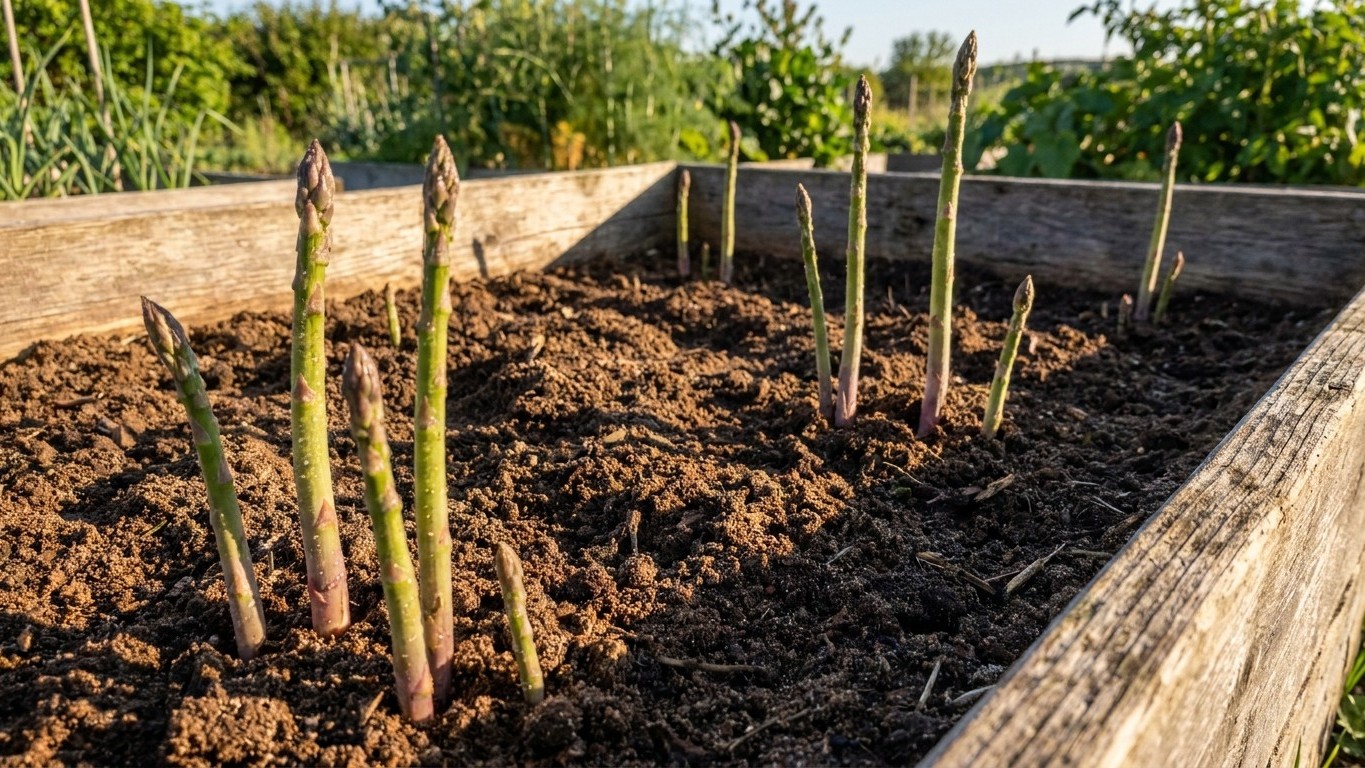

Stop cutting when most of the spears coming up are thinner than a pencil. That is the end-of-harvest rule, and it is something you look at, not a week on the calendar. Cut spears keep best at 32 to 35°F with the butt ends standing in water. In Florida, though, the harder part comes first: a bed that produces nothing to cut until its third year, and only if the ground drains. The full bed plan is in Growing Asparagus in Florida.
The short answer
What the state soil does with water
Florida’s official state soil is the Myakka series, a Spodosol: sandy, acid, strongly leached ground that typically grows under conifers. USDA NRCS records the representative surface layer as 97 percent sand, 2 percent clay and 1 percent silt, with organic matter around 2.0 percent and a surface pH about 5.1, strongly acid. That pH belongs to the mapped soil, not to your yard. The drainage class matters more here, and it reads poorly drained.
Sand that drains poorly sounds like a contradiction. Sand alone sheds water fast, so a poor rating points to water that stops somewhere, and in flat country the usual suspects are a high water table or a tight layer under the sand. Whatever the cause, the practical result is a spot that can stay wet after a downpour.
That matters more for asparagus than for any other crop on this site. Crowns go into 8-inch furrows, nothing is harvested until year 3, and then the bed produces for 10 to 15 years. Utah State University Extension, the source behind this plan, sets one soil requirement: most soils will do provided they are well drained. A tomato bed that sits wet gets abandoned after one season. An asparagus bed that sits wet is a fifteen-year mistake, and an 8-inch furrow in a low spot works like a small trench for collecting water.
So does Florida’s dominant soil drain well enough? Not reliably. Plenty of yards sit on something quite different, since the state spans hundreds of soil series, and any lot a builder has scraped or filled follows its own rules. The state soil is a starting point, not a diagnosis of your garden. Your county Extension office can point you to a soil test, and the longer version of this question is in Will Florida Soil Hold an Asparagus Bed for Fifteen Years?
If your spot does not drain
Pick a different spot before you pick a different crown. Choose the highest ground you have, and look at it after a hard summer rain: standing puddles are your answer. If every spot holds water, build up. A raised bed or a broad mound lifts the furrow above the wet layer. The source gives no height for one, so match it to what your test and your puddles tell you.
Patience is part of the price. The harvest clock runs four weeks in the first cutting season, six in the next, then eight, and in every season the stopping point is the pencil-thin spear. Taking a few early spears from a young bed is not an option the source offers.
Will the summer here water it for you?
What a north Florida summer delivers
The Utah State guidance asks for 1 to 2 inches every other week for the first two years, then every three weeks after that. NOAA’s climate normals for the Jacksonville reference station show about 21.2 inches of rain across June, July and August (June 7.6, July 6.77, August 6.88), out of 53.4 inches for the year. July is the driest of the three, and it is still wetter than most months elsewhere in the country.
Spread across a 13-week summer, that is roughly 3 inches every two weeks, comfortably above the bed’s upper mark. On paper, the summer waters the asparagus for you, and the gardener adds close to nothing. The other nine months share the remaining 32.2 inches, about 3.6 inches a month, so spring is where the hose does its real work in a young bed.
The average hides plenty. Summer rain tends to arrive as thunderstorms, and a hard one runs off more than it soaks in. Days at or above 90°F pull water back out of the ground. And a sandy surface lets rain through within the day, so a fortnight’s gauge total can overstate what the roots can reach. On poorly drained ground the same storm does the opposite and sits on the crowns. These are normals for one station, not a forecast and not your garden. A slope, a city or a rain shadow changes them.
A routine that fits
- Set a straight-sided rain gauge at the edge of the bed and note every storm. It settles the question for your plot better than any regional average.
- For the first two years, aim for 1 to 2 inches every other week, counting rain toward that total. If the gauge falls short, make up the difference with the hose, slowly enough that it soaks in instead of running off.
- During a run of 90°F days, check the soil by hand a few inches down rather than trusting the calendar. A sandy bed can dry out between storms even in a wet summer.
- After two years, stretch to once every three weeks at the same 1 to 2 inches.
- In a bed on poorly drained ground, watch for the opposite problem. Skip the hose entirely after storms and look at drainage, not at watering.
When to put the crowns in
Anchoring early spring to frost dates
Crowns go in during early spring. In north Florida, NOAA’s 1991 to 2020 normals put the last 32°F freeze around February 16 to March 7, the band where the odds of another freeze at or below 32°F run between 30 and 70 percent. That is a mean date, an average, so some years the last freeze comes earlier and some years later. Early spring in Jacksonville therefore means around mid-February into early March, and a cold snap after planting is not a surprise. Note that three of the thirty falls on record saw no freeze at all at that station, which is a reminder of how loose the averages are.
Jacksonville is north Florida, and the reference station is an inland airport. Central and south Florida are effectively frost-free, and there the growing calendar inverts. The main season runs through winter and summer becomes the hard part. Do not apply this window to Orlando or Miami. No planting dates for those areas are published here, so check with your county Extension office.
The furrow is 8 inches deep, but it does not get filled in at once. Backfill gradually across the year, about two inches every other month, as the plants grow up out of the trench. Four of those additions fill it. Filling it at planting time defeats the point of the furrow.
Crowns, seed and the four named varieties
Crowns are the route this plan is written for, and the year 3 harvest clock assumes them. Starting from seed is the slower alternative, since you raise the plant yourself before it ever reaches the furrow. This page has no published seed-sowing dates and no published harvest timeline for seed-started beds, so assume the count starts later, not earlier.
The source names four varieties and gives only their sex. Jersey Giant and Jersey Knight are all-male. UC 157 F1 and Purple Passion are male/female. It publishes nothing on flavor or yield, and no reason to choose one over another, so any ranking you read elsewhere is not supported here. This page names no nursery either. Spring is also when pests find the first spears, and What Eats Asparagus in Florida, and When covers who shows up and when.
Common questions
How do I know it is time to stop cutting?
Look at the spears. When most of what is coming up is thinner than a pencil, the cutting season is over. Weeks give the length of each season (four in the first harvest season, then six, then eight). The pencil is how you know you have reached the end of it, and it is not a week number.
How should I keep cut spears?
UC Davis Postharvest gives the target as 32 to 35°F with 95 to 100 percent relative humidity, and says high humidity is essential to prevent desiccation. The window is narrow on both sides: above 50°F spears toughen quickly, and at about 30.9°F or lower they freeze, turn water-soaked and go extremely soft. At home, stand the cut butts upright in a little water, or wrap them damp, because they lose moisture through the cut end faster than anywhere else. More detail is on the UC Davis asparagus fact sheet.
Can I cut a few spears before year 3?
No. The source says the bed is not harvested until year 3. The plants in years one and two are building the root system that pays off for 10 to 15 years, and the schedule is not meant to be bent.
Does the state soil description mean my yard will not drain?
Not necessarily. The Myakka series is the soil that represents Florida, not the soil under every house in it, and river bottoms, higher ground and filled or scraped lots can all differ. The pH of about 5.1 and the poor drainage rating describe the mapped surface of that series, not a worked garden bed. A soil test gives your own numbers, and a hard summer rain gives you the drainage answer for free.