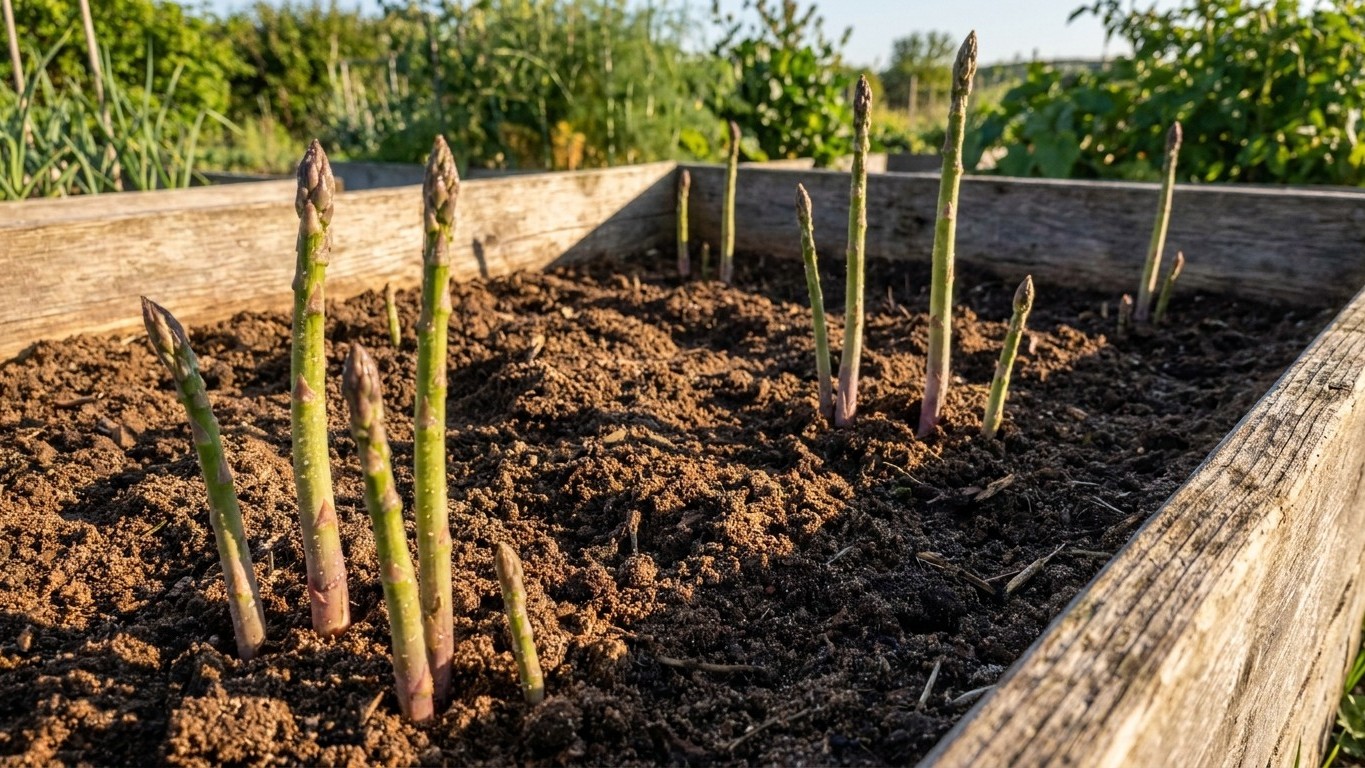

Florida’s official state soil won’t tell you what’s under your own lawn, but it does explain the risk built into a fifteen-year commitment. The Myakka series, the sandy ground picked to represent the state, carries an official rating of poorly drained. Asparagus is one of the few vegetables that stays in one spot for ten to fifteen years, and its only real soil demand, according to Utah State University Extension, is drainage. So the honest answer is conditional: yes, if the bed drains, and on much of Florida’s flat sandy ground that means building the drainage yourself rather than trusting the ground to provide it.
The short answer
Start with the two numbers that matter most. an Asparagus Bed, once established, produces for ten to fifteen years, and the only soil condition Utah State University Extension attaches to that promise is that the ground drains. Nothing about pH, nothing about fertility beyond “most soils will do.” Drainage is the single gate the crop asks you to pass through, which makes it worth checking against what the state’s own representative ground actually does.
The Myakka series, named Florida’s official state soil by state law in 1989 and tracked by the USDA’s soil survey program, is about as sandy as soil gets: 97 percent sand, 2 percent clay, 1 percent silt in the surface layer, with organic matter around 2.0 percent and a strongly acid surface pH near 5.1. On paper, that much sand should drain in minutes. But the USDA’s own data records this series as poorly drained anyway. Spodosols like Myakka carry a dense, often iron- or organic-cemented layer beneath the sandy surface, and that layer acts like a shelf, holding water above it even while the topsoil looks bone dry twenty minutes after a storm. A bed planted straight into that kind of profile can sit with wet feet for days after summer rain, which is exactly the condition asparagus crowns rot in.
None of this means your particular yard behaves like the mapped Myakka series. A state soil is a representative sample, not a survey of every backyard in it; a lot scraped and filled during construction, a spot near a drainage swale, or ground on a slightly higher ridge can drain in an entirely different way than the county average. The only way to know is a simple test: dig a hole about a foot deep, fill it with water, and watch how long it takes to disappear. If it’s gone within a few hours, plant in the ground. If water is still standing after most of a day, don’t fight the ground for fifteen years. Build a raised bed, or at minimum a mounded row eight to ten inches above grade, backfilled with soil worked to drain, and put the crowns there instead.
The source is silent on soil pH requirements for asparagus, so no target number is given here, and the Myakka series’ own pH of 5.1 describes that mapped soil, not necessarily what a soil test will return from a cultivated garden bed. A pH reading is worth pulling from your own soil test rather than borrowing from the state soil profile.
Will the summer here water it for you?
an Asparagus Bed has a simple watering rule for its first two seasons, then an easier one after. Lay that against what a Florida summer typically delivers and the gap, or the surplus, becomes clear.
- Establishment years (roughly the first two seasons): the bed wants 1 to 2 inches of water every other week. Spread across a month, that works out to roughly 2 to 4 inches of water needed monthly.
- What summer actually brings: normals for the reference station covering this record show June averaging 7.6 inches of rain, July 6.77 inches, and August 6.88 inches, for a three-month total near 21.2 inches. Every one of those months clears the 2-to-4-inch establishment target on paper.
- The catch is distribution, not volume: Florida summer rain tends to arrive as short, heavy thunderstorms rather than a steady drizzle. A storm that drops an inch in twenty minutes runs off a sandy surface fast rather than soaking the root zone evenly, so weeks can pass between soakings even in a month with plenty of total rainfall on the books.
- Mature beds (year three and beyond): the requirement eases to 1 to 2 inches every three weeks, a lighter ask that Florida’s driest summer month, July at 6.77 inches, still comfortably covers on paper.
- The practical takeaway: a rain gauge staked in the actual bed, checked weekly, is what settles whether supplemental watering is needed in a given stretch. On sandy, poorly drained ground the bigger summer risk usually isn’t drought, it’s water sitting too long after a storm, which argues for watching drainage as closely as watching rainfall totals.
When to put the crowns in
Crowns go into the ground in early spring, set in furrows about 8 inches deep. For a large part of Florida, spring’s starting gun is set by the last expected frost, and the normals for the reference station covering this record put that window at around February 16 to March 7. That figure is a thirty-year average from freeze-probability data, not a guarantee, so treat it as a rough marker rather than a calendar date to circle. It’s also worth noting this window comes from an inland north Florida station; three of the thirty years in that record saw no freeze at all, and further south into central and south Florida the growing calendar effectively flips, since those areas run close to frost-free and summer heat becomes the harder season to manage. A frost window built for north Florida shouldn’t be applied to a bed in Orlando or Miami.
Once crowns are in, patience is the whole game for a while. There’s no harvest at all in the first two years; the plant is spending that time building the root system that will feed the bed for the next decade. Year three brings the first cutting, and even then it’s limited: about four weeks of harvest, stretching to six weeks the following year, then eight weeks in later years once the root system is fully established. The signal to stop cutting each season isn’t a date on the calendar, it’s the spears themselves: when most of them start coming up thinner than a pencil, harvest stops and the plant is left to grow ferns that recharge the roots for next year. The furrow itself isn’t filled in all at once either; soil gets backfilled gradually, about two inches every other month across the first growing season, rather than dumped in at planting.
Starting from seed is the alternative to crowns, and Utah State University Extension lists it as a workable route, though it adds time up front since seedlings need a season of growth before they’re ready to set out, compared with a crown that’s already a year or more old at planting. On variety, the published record stays narrow: Jersey Giant and Jersey Knight are named as all-male varieties, while UC 157 F1 and Purple Passion are male and female. No flavor comparison, yield figure, or reason to prefer one over another is published by that source, so any claim beyond sex classification isn’t backed by it.
| Variety | Sex type |
|---|---|
| Jersey Giant | All-male |
| Jersey Knight | All-male |
| UC 157 F1 | Male/female |
| Purple Passion | Male/female |
Common questions
Does the state soil mean my garden will drain poorly?
No. The Myakka series describes a representative surface sample used to speak for Florida as a whole, not a diagnosis of any single yard. Filled lots, raised ridges, and river-adjacent ground can all behave differently. A simple hole-and-water drainage test on your own plot is the only reliable check.
Can I plant asparagus if my soil holds water?
The bed itself doesn’t have to sit in native ground. Building a raised bed or mounded row, filled with soil that drains, satisfies the same drainage requirement without needing to change the ground underneath it.
How soon can I eat asparagus after planting crowns?
Not for two full years. Year three brings the first harvest, and even that’s capped at roughly four weeks before the plant needs to be left alone to grow ferns for the rest of the season.
Is there an ideal pH for asparagus in Florida?
Not one published by Utah State University Extension, the only source behind these growing figures. The state soil’s own surface pH runs strongly acid, near 5.1, but that number describes the mapped Myakka series, not necessarily a cultivated bed. A soil test on the actual planting site is the way to get a real number.