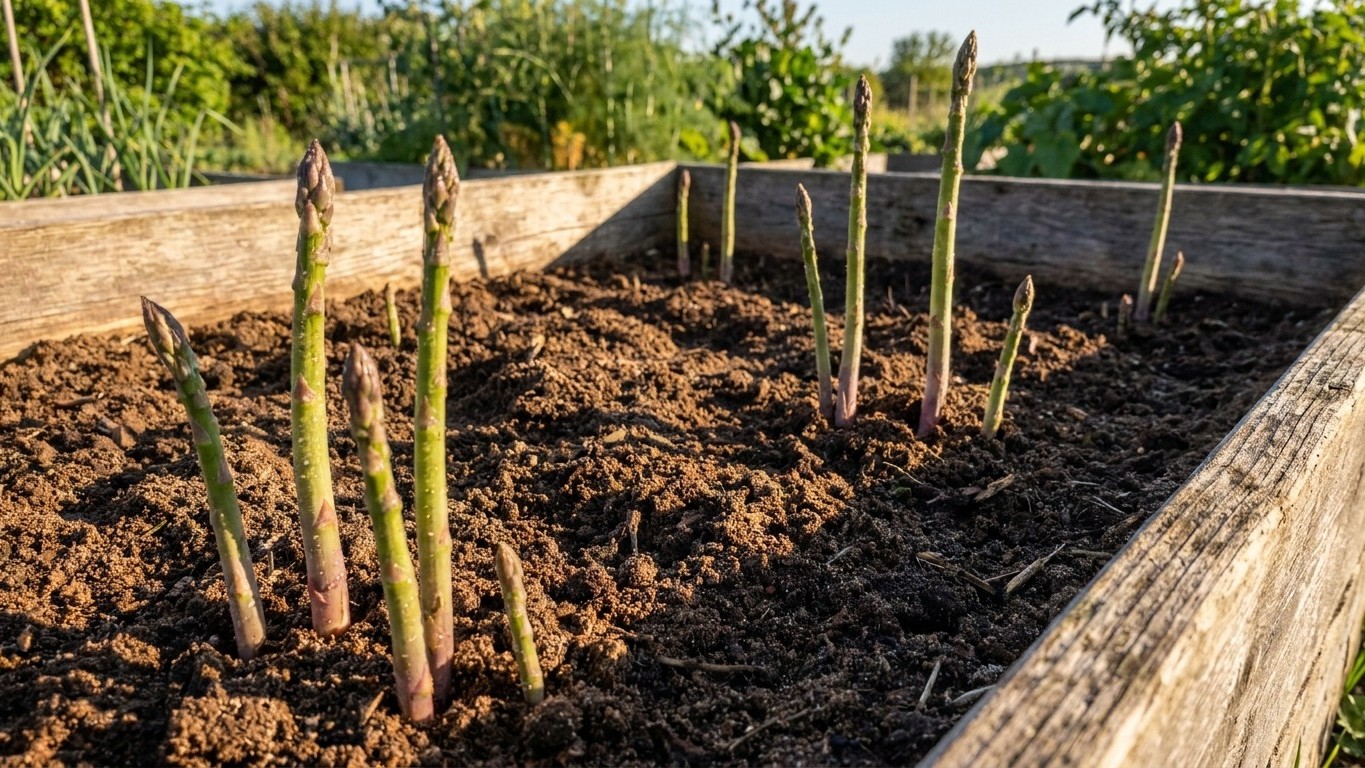

UF/IFAS Extension documents eleven landscape and garden pests statewide, but only a handful of them have any real business on an asparagus bed: aphids, chilli thrips, eastern lubber grasshoppers, fire ants, root-knot nematodes, and whiteflies. The rest of that list feeds on cycads, melons, or tomatoes, not on asparagus ferns or spears. Timing tracks the fern’s growth stage more than a fixed date on a calendar, and it shifts again once the bed is a few years old and stops being harvested every spring.
Which pests attack asparagus in Florida
UF/IFAS Extension documents eleven pests for Florida gardens and landscapes: Aphids, Chilli thrips (Scirtothrips dorsalis), Cycad aulacaspis scale, Eastern lubber grasshopper (Romalea microptera), Fall armyworm, Fire ants, Hornworm caterpillars, Melonworm, Pickleworm, Root-knot nematodes, and Whiteflies. That is the full statewide list this site draws from, and it is short enough that padding it with anything else would be a guess, not a fact.
Four of those names have nothing to do with asparagus. Cycad aulacaspis scale feeds on cycads and sago palms, an ornamental host with no relation to a vegetable fern. Melonworm and pickleworm are cucurbit specialists that go after squash, cucumbers, and melons, and an asparagus bed offers them none of that. Hornworm caterpillars work through the nightshade family, tomatoes, peppers, tobacco, and skip past asparagus entirely because the foliage chemistry they key on isn’t there.
What’s actually left on the plate
That leaves six candidates worth watching. Aphids and whiteflies are generalist sap feeders that will settle on the feathery mature foliage once it fills out. Chilli thrips have a wide host range and rasp at new growth, which on asparagus means the tender spear tips and young fern before it hardens. Eastern lubber grasshoppers are unfussy chewers, big, slow, and flightless as adults, and they will strip foliage from almost anything green in their path, asparagus included. Fire ants rarely eat plant tissue directly, but they build mounds in disturbed soil and will attack anything that disturbs them, including a hand reaching in to cut a spear. Root-knot nematodes work underground on the root system itself, and they matter more here than on most vegetables because this bed stays in the same ground for 10 to 15 years with no rotation to break their buildup.
Fall armyworm sits in an odd spot: UF/IFAS documents it statewide as a pasture, turf, and vegetable pest, but it isn’t a named asparagus feeder in the same way the others are. It’s included here because it turns up in mixed vegetable plots and can wander onto adjacent rows, not because asparagus is a preferred host.
When each one shows up, and what it does first
North Florida’s last spring freeze, at the Jacksonville reference station, falls between February 16 and March 7. Crowns typically go in the ground around that window, so the first flush of fern growth follows shortly after. That timing does not hold statewide: central and south Florida run effectively frost-free, and there the growing calendar flips, with the main season running through the cooler months and summer becoming the harder stretch. Anyone gardening south of about Orlando should read the sequence below by growth stage, not by the frost date itself.
Sap feeders show up first. Aphids and whiteflies cluster on the earliest fern growth, and the first sign is usually sticky residue on the foliage or a fine stippling where they’ve been feeding, well before any visible colony is obvious. Chilli thrips follow the same early window, targeting the softest new tips, and their damage looks like a bronzed, slightly curled distortion at the growing point rather than a hole.
Later in the season
Eastern lubber grasshoppers arrive later, as nymphs mature into the large adults through the warmer months, and the first sign is ragged, chewed edges on the fern rather than anything subtle, since these insects eat in volume once they’re grown. Fire ant mounds tend to appear or expand after heavy rain, and the driest month, July, at 6.77 inches, is actually when mounds are easiest to spot because the soil surface stays drier and cracked, less likely to collapse and hide them. Root-knot nematode damage doesn’t announce itself in a single week at all. It builds slowly, over multiple growing seasons, as ferns come up thinner and spears run smaller than they should for a bed that’s already past its third year, the point at which harvest normally starts.
Telling the damage apart from everything else
A yellowing fern or a stunted spear has more than one possible cause on Florida ground, and guessing wrong wastes a season. The state’s representative soil, the Myakka series, sits at a surface pH around 5.1 and is 97 percent sand yet still classed as poorly drained, because a hardpan layer perches water below the surface. That combination, sandy on top and slow-draining underneath, produces symptoms that look a lot like nematode or insect damage but aren’t.
| What you see | Possible cause | What separates them |
|---|---|---|
| Thin, stunted ferns bed-wide | Root-knot nematodes, or poor drainage | Nematode damage shows patchy, worse in some rows; drainage problems track low spots after rain |
| Sticky residue, curled tips | Aphids or whiteflies, or nutrient stress | Insects leave visible colonies on the underside of foliage; nutrient stress does not |
| Ragged, chewed foliage | Eastern lubber grasshopper, or wind and hail | Chewed edges are irregular and concentrated where insects feed; storm damage is uniform across exposed rows |
| Bronzed, distorted new growth | Chilli thrips, or drought stress | Thrips damage stays confined to the newest tips; drought stress affects the whole plant evenly |
None of this replaces a look at the actual soil or the actual insect. When the cause isn’t obvious, a county extension agent can confirm it faster than any list of symptoms can.
What actually works here, and what is a waste of time
Physical barriers placed early beat almost anything applied later. Fine mesh row cover over young ferns keeps chilli thrips and whiteflies off the tenderest growth during that first flush, and it costs nothing to remove once the fern toughens. Hand-picking eastern lubber grasshoppers works surprisingly well precisely because they’re slow and flightless as adults; a five-minute pass through the bed in the morning, when they’re sluggish from overnight cool, removes more of them than any spray timed to the same week. Fire ant mounds near the bed are best relocated or disrupted before spear season starts, since a mound that goes untouched through a wet spell only grows.
What wastes time is treating the calendar like it’s fixed. Spraying on a set schedule regardless of what’s actually present misses the insects that show up early and hits the bed after they’ve already moved on. Watering on a routine schedule causes the same kind of mistake in reverse: during July, the driest summer month at 6.77 inches of rain, a stressed, wilting fern gets misread as pest damage when it’s really just short on water, and treating it for insects that aren’t there does nothing but delay the actual fix.
Root-knot nematodes are the one problem physical barriers and hand-picking can’t touch, because they live in the soil, not on the foliage. There’s no consumer treatment that reliably clears them from an established bed, and since this planting can’t be rotated out for over a decade, the county extension office is the right call for anything beyond site selection at planting time.
Where to check this for your own county
UF/IFAS Extension is the source for every pest named on this page, and the statewide list is exactly that: statewide. It says nothing about which of these six actually show up in one particular yard. A county along the Gulf coast on heavier ground behaves differently from a county further inland on sandy ridge soil, even though both sit under the same statewide extension umbrella.
The county extension office is the next step, not a general search. Most offices will identify a sample, chewed foliage, a scale insect, a suspicious root, faster and more reliably than matching symptoms against a table online. Many also run soil testing, which matters here specifically because the state’s representative soil runs acid and drains poorly despite being mostly sand; a reader’s own bed could be nothing like that, better drained, more alkaline, or worse, and there’s no way to know without a test pulled from that actual ground.
Start with a sample and a phone call to the local office rather than a guess. That single step settles more than another round of comparing photos, and it’s the only way to know whether root-knot nematodes are actually present before assuming a slow, stunted bed is doomed for the next decade.
Common questions
Do all six pests show up in every Florida garden?
No. UF/IFAS Extension documents these as present somewhere in the state, not as guaranteed in any one yard. Soil type, drainage, and nearby plantings all change which ones actually turn up.
Is fall armyworm a real threat to asparagus specifically?
It’s documented statewide as a broad vegetable and turf pest, but it isn’t listed as a targeted asparagus feeder the way aphids or chilli thrips are. Watch for it if it’s already active in nearby crops.
Can root-knot nematodes be fixed once they’re in an asparagus bed?
There’s no reliable way to clear an established bed of them, which is part of why site selection before planting matters so much for a planting that stays put for 10 to 15 years. A county extension office is the right place to check a soil sample before committing a spot.
Does the frost date in this article apply everywhere in Florida?
No. The February 16 to March 7 window comes from a north Florida reference station. Central and south Florida run effectively frost-free, and the growing calendar there runs on a different rhythm entirely.