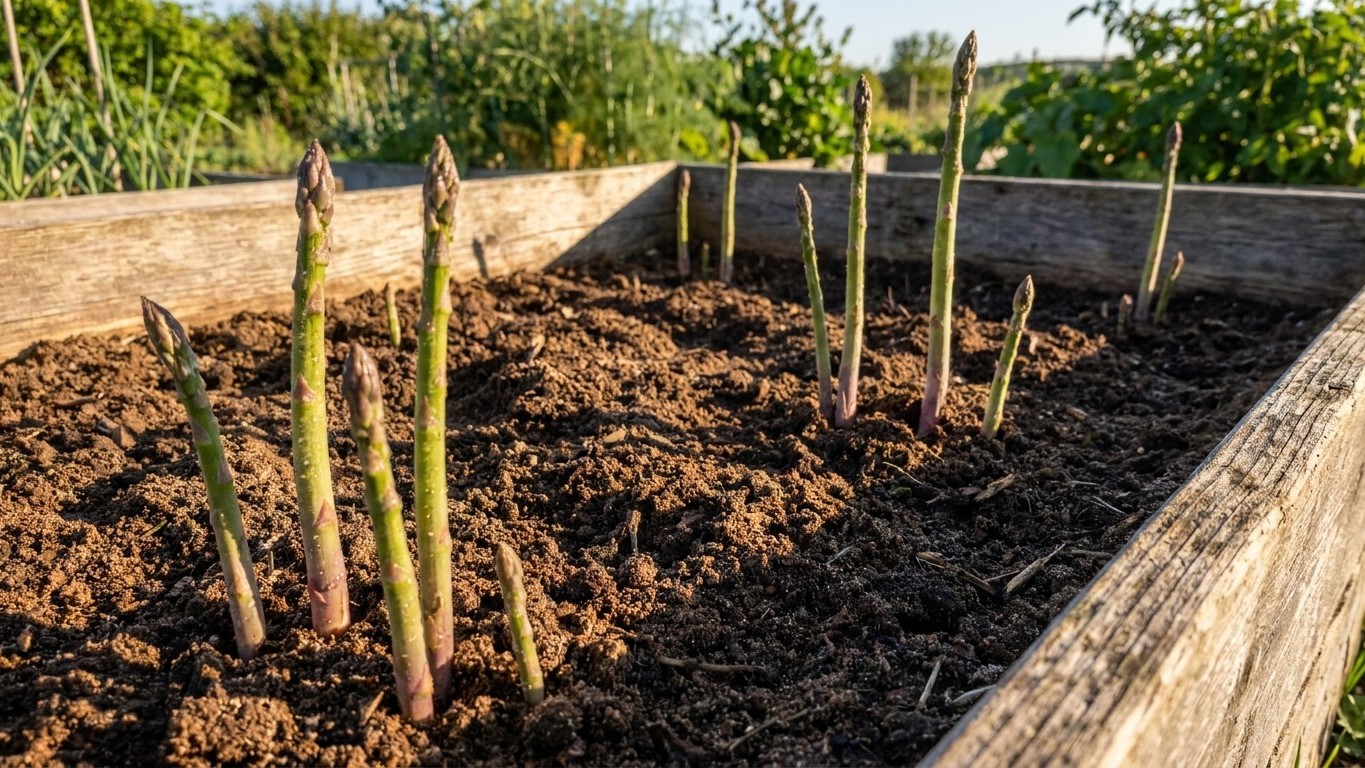

The Tifton series, the soil USDA lists as representative of Georgia, is sandy and well drained by nature: 84 percent sand, only 6 percent clay. That single trait answers the fifteen-year question for most of the state, because the only soil requirement an Asparagus Bed carries is drainage. Where a garden sits on heavy, standing-water ground instead, the fix is a raised bed, not a different crop.
The short answer
Asparagus is a plant you commit to, not one you rotate out after a disappointing season. Crowns go into the ground and, if the site suits them, keep sending up spears for ten to fifteen years. The plant itself is not fussy about fertility or pH going in. The one thing it asks for, according to Utah State University Extension, is a spot that drains. Sitting in wet soil rots the crowns before they ever get established, and no amount of feeding fixes that afterward.
That’s where the Tifton series matters. It’s the soil USDA records as representative of Georgia, an old, heavily weathered Ultisol with a surface that runs 84 percent sand, 6 percent clay, and 9 percent silt, organic matter around 0.8 percent, and a slightly acid surface pH near 5.5. Sand-dominant ground like that sheds excess water quickly. It’s exactly the texture asparagus wants under it for a decade and a half, and it’s part of why the crop has a long history on the coastal plain and lower Piedmont, where Tifton-type soils are common.
None of that is a promise about any single backyard. The Tifton series is a mapped average across 173 sampled components, not a reading of the dirt behind a particular house. Riverside lots, ground near a creek, and anywhere a builder scraped topsoil and left compacted subsoil behind can behave nothing like the state’s representative series, even in the same county. A garden sitting in a low spot that stays soggy after rain is a garden where a fifteen-year asparagus bed is a bad bet as planted, not a soil problem to argue with. The practical move there is a raised bed filled with a well-drained mix, which sidesteps the native soil’s drainage entirely. Before committing a corner of the yard for over a decade, a basic soil test, and simply watching how fast water disappears after a hard rain, tells more than any state-level figure can.
The pH figure attached to the Tifton series, near 5.5, describes that mapped soil’s surface horizon, not a target number for an Asparagus Bed. Utah State University Extension’s guidance is silent on the pH asparagus prefers, so this article isn’t going to invent one. Drainage is the documented requirement, and drainage is the one to act on.
Will the summer here water it for you?
Established asparagus wants roughly 1 to 2 inches of water every other week through its first two growing seasons, then eases to about that same amount every three weeks once it’s settled in. Whether the sky covers that depends on the month, and on a soil that lets rain sink in rather than run off.
- Early summer (June): the reference station used for these normals records about 4.54 inches for the month, which works out to roughly 1 inch a week on average. Spread over two weeks, that’s close to the low end of what a young bed needs, but averages hide the gaps between storms, and on the fast-draining sand typical of the region’s Tifton-type ground, water that falls in one afternoon downpour doesn’t linger in the root zone the way it would on heavier clay.
- Midsummer (July): normal rainfall runs about 4.75 inches, similar to June. A bed on sandy soil in its establishment years still benefits from a supplemental soak between storms, especially through any stretch of a week or more without rain.
- Late summer (August): this is the driest of the three summer months at about 4.3 inches, and the month most likely to leave a young bed short. A gardener watching the ground dry out fast after each rain should plan to add water here rather than assume the sky will keep up.
- Across the whole summer: the three months together average about 13.6 inches, against roughly 50.4 inches for the full year. That’s a reasonable summer total on paper, but it’s a 1991-2020 normal for one reference station, not a guarantee for any specific yard. A rain gauge on the actual bed, checked weekly, is what turns “the region usually gets enough” into a real watering schedule.
When to put the crowns in
Crowns go into the ground in early spring, timed around the site’s last frost rather than a fixed calendar date. For the reference station used in these normals, the last spring freeze at 32 F falls somewhere between around March 11 and around March 29, a range built from freeze-probability data rather than a single guaranteed date. That window shifts by location: this same source notes that north Georgia and the mountains typically freeze weeks earlier heading into fall than the milder coastal plain, and an urban airport site tends to read milder than open countryside nearby. Treat the March 11 to March 29 span as a starting guide for timing, not a promise for a particular plot.
Planting itself follows a simple pattern. Crowns are set into furrows about 8 inches deep, then the furrow is backfilled gradually across the year rather than all at once, adding roughly 2 inches of soil back over the crowns every other month as the young shoots grow up through it. That slow fill lets the emerging spears keep pace with the soil level instead of getting buried too deep too soon.
Seed is the alternative route where a gardener wants to start from scratch rather than buying crowns, though it adds a full extra year before the plant reaches crown size and gets treated the same way from there. Whichever route is used, patience is the real requirement: Utah State University Extension is explicit that there’s no harvest at all in the first year after planting, and none in the second either. The first cutting doesn’t happen until the third year, and even then it’s limited, about four weeks of harvest that year, stretching to roughly six weeks the following year and about eight weeks in the years after that once the crowns are fully established. The stopping point each season isn’t a date on a calendar; it’s a visual cue, cutting stops once most of the spears coming up are thinner than a pencil, letting the plant put its energy into building fern growth for next year instead of spears.
The four named varieties in Utah State University Extension’s guidance are distinguished only by their reproductive type, not by flavor, yield, or any stated preference for one soil or region over another. Jersey Giant and Jersey Knight are all-male varieties; UC 157 F1 and Purple Passion are male-female mixes. No nursery is named as a source for any of them here.
| Variety | Type |
|---|---|
| Jersey Giant | All-male |
| Jersey Knight | All-male |
| UC 157 F1 | Male/female |
| Purple Passion | Male/female |
Common questions
Does a Georgia garden need to match the Tifton series exactly to grow asparagus?
No. The Tifton series is the soil USDA lists as representative of the state as a whole, not a requirement for any individual yard. What matters for a fifteen-year bed is that the actual planting site drains well; sandy, Tifton-type ground tends to do that on its own, while low or clay-heavy spots usually need a raised bed instead.
How much water does an Asparagus Bed need if summer rain falls short?
The target is 1 to 2 inches every other week for the first two seasons, tapering to roughly that amount every three weeks once established. When a rain gauge on site shows less than that, especially during a dry stretch like August’s typical low point, the gap needs to be made up with supplemental watering.
When exactly should crowns go into the ground?
Early spring, timed around the site’s last frost rather than a fixed date. For the reference station in these normals, that freeze window runs around March 11 to March 29, though it shifts earlier in north Georgia’s higher elevations and later, or milder, along the coastal plain.
How long before an Asparagus Bed can actually be harvested?
There’s no cutting at all in the first two years. The first harvest comes in year three, lasting about four weeks, then around six weeks the year after, and about eight weeks once the bed is fully established, stopping each season once most spears come up thinner than a pencil.