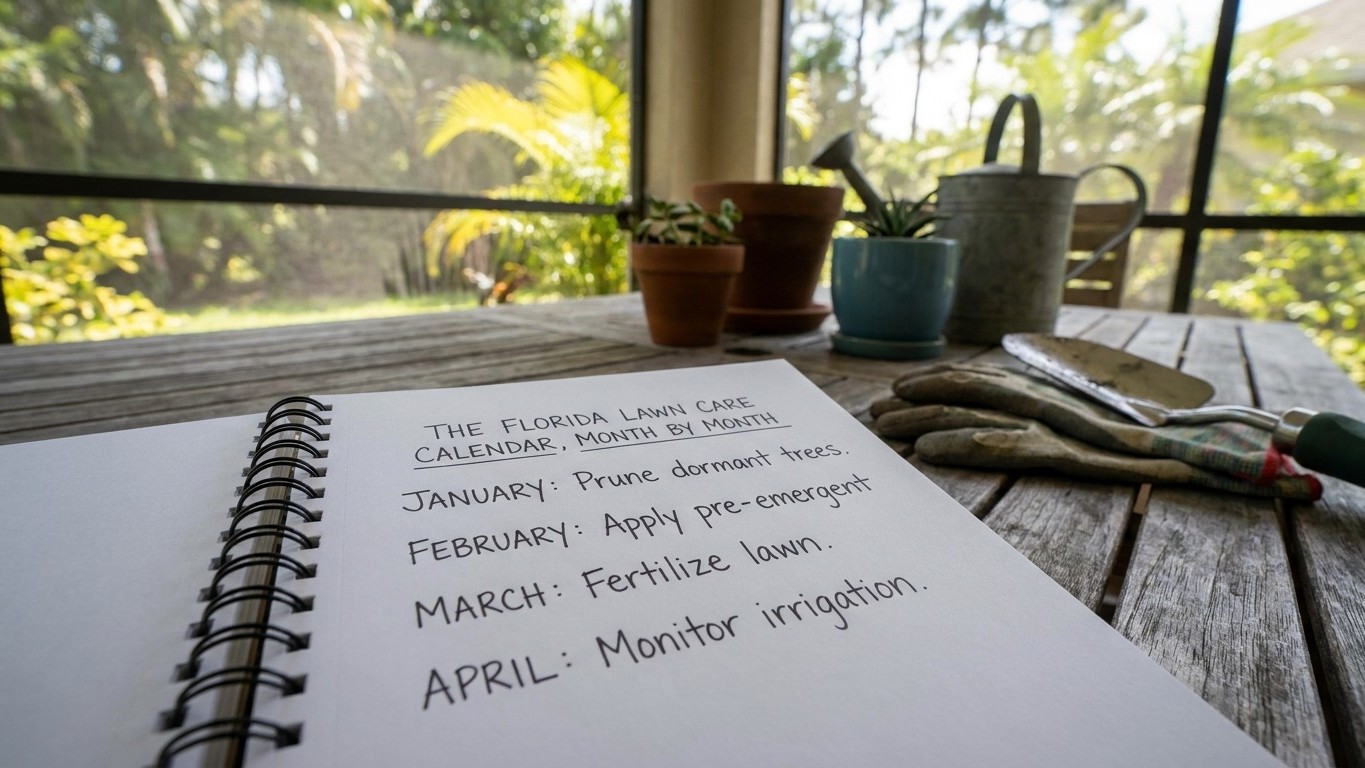

What should you actually do this month, standing in your own yard? It depends on which grass you’ve got and which part of Florida you’re standing in, and once you know both, the rest of the year mostly writes itself. Warm-season grass grows on a different clock north and south of Ocala — one goes dormant for winter, the other barely slows down — so the same calendar date can mean green-up in one yard and disease season in another. Before you mow, feed, or spread a single pound of seed, figure out which of the seven Florida-suited grasses you’re standing on.
The short answer for Florida
For most of Florida, the short answer is to grow a warm-season species, not a cool-season one, and to set your calendar by whether you’re north or south of the frost line. The Homestead Post’s climate assignment for the Jacksonville area places it in the warm lawn zone, and the seven species that actually hold up in Florida heat and humidity are Bahiagrass, Bermudagrass, Carpetgrass, Centipedegrass, Seashore Paspalum, St. Augustinegrass and Zoysiagrass, per Clemson Cooperative Extension’s HGIC 1214 guide to selecting a lawn grass. Kentucky bluegrass, tall fescue and other cool-season turf simply won’t survive a Florida summer, so leave them off the list entirely.
Why the answer depends on your species and your location
Which of those seven species you’re working with changes almost everything else on this page: mowing height, nitrogen timing, and how the grass reacts to the first cold snap. If you haven’t settled on a species yet, work through The Best Grass Seed for Florida Lawns before you set any dates, because everything below assumes you already know what’s growing in the yard.
The other variable is location. The freeze window from NOAA’s 1991-2020 normals for Jacksonville doesn’t apply the same way once you move south of Ocala. Central and south Florida rarely freeze at all, so the calendar there doesn’t so much shift as invert. Match your calendar to your grass species first, and to your position on the peninsula second, because getting either one wrong throws off every date that follows.
Working through the year

Before working through the seasons below, make sure you’ve already covered the basics in Florida Lawn Care, like a soil test and proper site prep, since this calendar assumes that groundwork is done.
The maintenance calendars used here come from Clemson Cooperative Extension, written for the same warm-season species grown across the Southeast. Florida’s own land-grant service, University of Florida IFAS Extension, publishes county-level advice for the same grasses, and the two agree on the broad shape of the season even where exact dates shift by a week or two. Four of the seven recommended species have a numbered Clemson calendar you can check line by line:
- St. Augustinegrass (Clemson HGIC 1218)
- Bermudagrass (Clemson HGIC 1216)
- Centipedegrass (Clemson HGIC 1215)
- Zoysiagrass (Clemson HGIC 1217)
Bahiagrass, Carpetgrass and Seashore Paspalum don’t have a numbered Clemson calendar, but they follow the same seasonal rhythm at a lower level of care, which is largely why homeowners choose them in the first place.
Spring
Spring is green-up season for every warm-season lawn. Clemson’s calendars for St. Augustinegrass, Bermudagrass, Centipedegrass and Zoysiagrass all call for the first nitrogen feeding once the grass has fully greened up, not on a fixed calendar date, because feeding a still-dormant lawn just feeds the weeds. Pre-emergent herbicide for summer annual weeds like crabgrass goes down before that green-up, timed to soil temperature rather than the calendar. Mowing height comes down gradually as growth resumes, following whatever height each species’ own Clemson calendar sets.
Summer
Summer is the main growing season north of Ocala and the hardest season south of it. In north Florida, near Jacksonville, this is when mowing frequency peaks and irrigation follows rainfall rather than a fixed schedule. In central and south Florida, where winters barely slow the grass down, summer heat and afternoon thunderstorm humidity bring the disease pressure that each species’ Clemson calendar flags, and this is also when scalping a lawn cut too short does the most damage.
Fall
The last nitrogen feeding of the year matters more than any other date on this calendar. Clemson’s maintenance calendars set a final feeding well before the grass is expected to slow down, because nitrogen applied too late pushes soft new growth that a frost then kills outright. Near Jacksonville, with NOAA’s 1991-2020 normals putting the first fall freeze between November 26 and December 13, that means the last feeding needs to happen well ahead of that window, not inside it. Overseeding with annual ryegrass for winter color, if you choose to do it at all, follows the same logic: only after the lawn has already begun slowing down.
Winter
North Florida lawns go dormant and turn brown after frost, which is normal, not dead, and green growth returns with warmth in spring. Central and south Florida lawns mostly keep growing through winter, so mowing and light feeding continue on a reduced schedule rather than stopping outright.
What changes across Florida
This entire calendar is anchored to one weather station near Jacksonville, and a state that runs nearly 500 miles north to south does not share one frost date. NOAA’s 1991-2020 normals for that station (USW00013889) put the first fall freeze between November 26 and December 13, but even that range is soft: three of the thirty years in that record saw no freeze at all at the airport site.
North Florida
The airport station sits inland. A lawn a few miles east near the coast, where the ocean moderates the cold, typically sees fewer hard freezes than the airport recorded, even though it sits in the same county.
Central and South Florida
Move south past Ocala and the picture changes completely. Orlando and points south are effectively frost-free most winters, and the growing calendar there doesn’t just shift, it inverts: the main growing season runs through the cooler months, and the stress period lands in the heat and afternoon storms of summer instead of at the year’s first freeze. A calendar built for north Florida’s frost window will tell a Miami lawn to do the wrong thing at almost every point in the year.
| Region | Freeze pattern | Hardest season for the lawn |
|---|---|---|
| North Florida (near Jacksonville) | Freezes most winters; NOAA’s 1991-2020 normals put the first at Nov 26 to Dec 13 | Late winter cold snaps and the first weeks after green-up |
| Central Florida (around Orlando) | Frost rare, not reliable enough to plan a calendar around | Hot, dry stretches of late spring; heavy summer rain and disease pressure |
| South Florida (around Miami) | Effectively frost-free | Peak summer heat and humidity |
Elevation plays a smaller role here than it does farther north, since most of the state sits close to sea level, but proximity to water still matters. Lawns close to the coast or near a large lake tend to run a few degrees warmer on a cold night than inland sites at the same latitude, simply because open water loses heat more slowly than dry ground.
The mistakes this climate punishes
Feeding too late in fall
Nitrogen applied close to the first frost pushes tender new growth that has no time to harden off. Near Jacksonville, where NOAA’s normals put that first freeze between November 26 and December 13, a feeding in early November can still leave the lawn vulnerable. The damage doesn’t show immediately. It shows three or four weeks later as blackened, mushy patches right after the first hard cold, and it’s often mistaken for disease rather than timing.
Seeding a cool-season grass
Kentucky bluegrass, tall fescue and other cool-season species aren’t on the list of grasses recommended for this zone, and seeding them here wastes both seed and a season. They germinate fine in a Florida spring and then die outright once summer heat and humidity arrive, usually by early to midsummer. If a bag of seed at the store is labeled for a cool-season lawn, it’s the wrong bag for Florida, regardless of the price or the coverage claims on the label.
Cutting too short in summer
Scalping a warm-season lawn during the hottest, driest weeks removes the leaf area the grass needs to shade its own root zone and cope with heat stress. The damage often doesn’t show as thinning turf until weeks later, once drought and disease have had time to move into the weakened patches, and by then it reads as a watering problem rather than a mowing one.
Assuming brown means dead
A warm-season lawn that browns after the first freeze near Jacksonville is dormant, not dying, and it greens up again once spring warmth returns. Panic-feeding or reseeding a dormant lawn in winter wastes money and can do more harm than the frost did, by encouraging exactly the tender growth described above.
Checking this against your county
Every date and rate here is anchored to one weather station near Jacksonville and to Clemson’s species calendars, written for the whole Southeast rather than Florida alone. Before locking in a feeding or mowing date, check it against your county office through University of Florida IFAS Extension’s statewide directory, Solutions for Your Life, which routes to the agent covering your address. Your county agent will know the local frost record and soil type better than any statewide calendar. That matters most if you’re gardening well north or south of Jacksonville, where these figures stop applying cleanly.
Common questions
Can I mix a warm-season and cool-season grass in the same yard?
Not successfully. One of the two will die back completely for months at a time no matter what you do, since they need opposite seasons to grow. Pick one species suited to your zone and overseed with a different species only for temporary winter color, not as a permanent second lawn.
Why is my centipedegrass still brown when my neighbor’s St. Augustinegrass has already greened up?
Warm-season species green up on soil temperature, not on the calendar, and they don’t all hit that threshold at the same time. Centipedegrass is known for lagging behind St. Augustinegrass and Bermudagrass in spring, so a brown centipede lawn next to a green St. Augustine lawn in the same yard usually isn’t a sign of trouble.
Do I actually need to overseed with ryegrass for winter color?
No, it’s cosmetic, not necessary for the lawn’s health. Overseeding keeps a north Florida lawn green through the dormant months near Jacksonville, but a dormant, brown lawn will recover on its own once spring warmth arrives, with or without ryegrass on top of it.
Does any of this apply if I live in Miami or the Keys?
Only loosely. The frost dates and dormancy timing are built around a north Florida weather station, and south Florida rarely sees a freeze at all, so the calendar there runs on the opposite pattern, growing through winter and struggling most in peak summer heat.