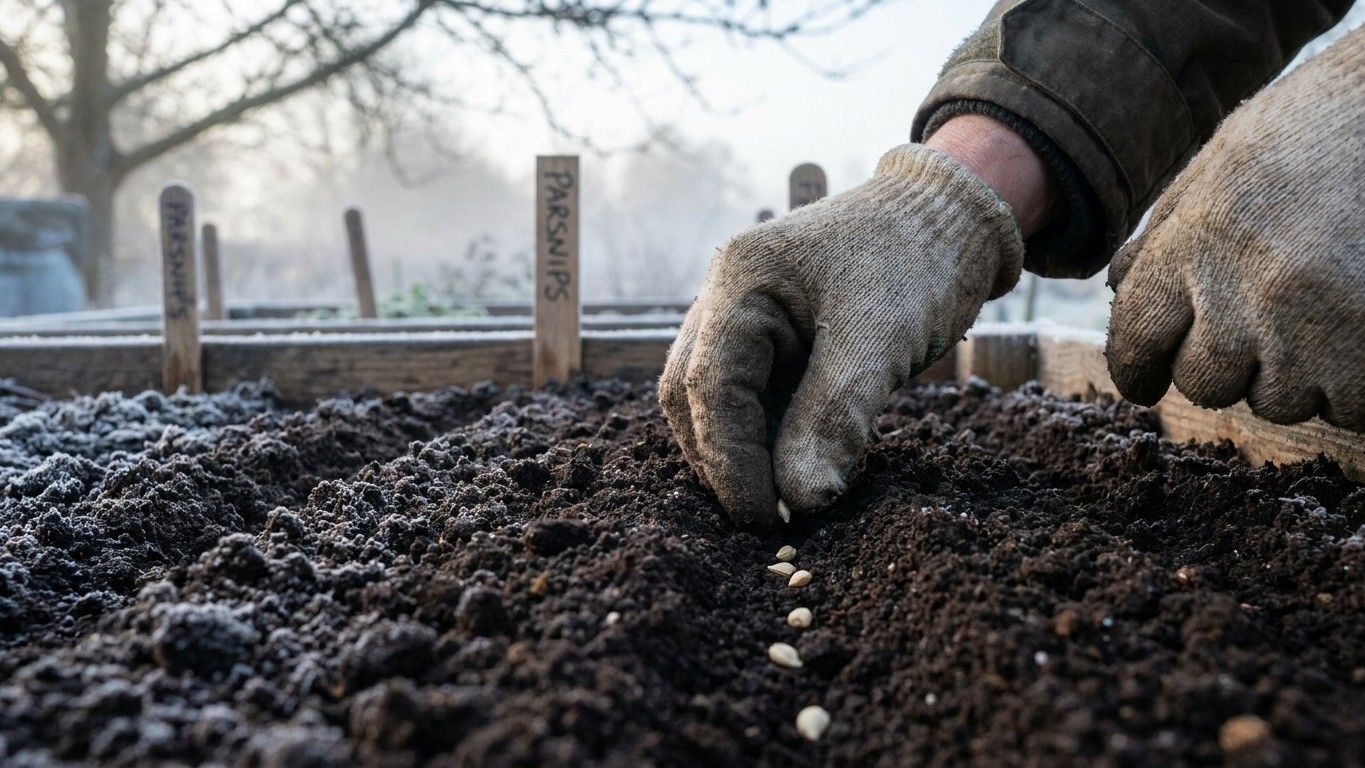

North Florida gardeners get the best shot at a genuinely sweet parsnip by sowing in late summer, roughly the first week of August through the first week of September, timing the root to mature right as the season’s frost arrives instead of into the heat of late spring. Central and south Florida almost never freeze, so the crop there will grow fine but won’t sweeten, whenever it’s sown.
The short answer
Does this part of Florida deliver several frosty weeks in a row? That single question decides whether a parsnip pulled from the ground here tastes like something worth growing, or just like a pale carrot with an attitude problem. The number that answers it is the mean minimum temperature of the coldest month, and for a reference station in Jacksonville, representing north Florida, that figure is 42.9°F, according to NOAA NCEI Climate Normals covering 1991-2020.
That’s an average, not a floor. It means that on a typical night in the coldest month, the low sits well above freezing, even though actual freezes do happen. NOAA’s freeze-probability data for the same Jacksonville-area station puts the first fall frost between November 26 and December 13, and the last spring frost between February 16 and March 7. Three of the thirty years in that record saw no freeze at all at that inland airport site. So frost in north Florida is real, but it’s a visitor, not a resident. It shows up for a stretch of roughly two and a half to three months and then leaves.
What that means for a parsnip: the crop can grow well here, and if timed right it can pick up a real, if modest, dose of cold exposure that starts converting starch to sugar. This isn’t the deep, weeks-on-end freeze of a northern garden where roots sit under snow for a month. It’s a marginal window, worth using deliberately rather than counting on by accident.
Central and south Florida change the picture completely. Those regions are effectively frost-free, and the growing calendar there flips: the main season runs through the cooler winter months, and summer heat is the obstacle, not the opportunity. None of the frost dates above apply south of roughly the Ocala area, and a gardener in Orlando or Miami who tries to schedule around a north Florida frost date is planning against a season that doesn’t exist where they live. If sweetening from frost matters to you and you garden in central or south Florida, that particular reward isn’t available locally, no matter the sowing date.
Does the season fit?
- Germination first. Parsnip seed is sown directly in the row, not started indoors and transplanted, and it’s slow: Utah State University Extension puts germination at 14 to 21 days. Nothing visible happens above ground for two to three weeks after sowing, which trips up a lot of gardeners into thinking the seed failed and re-sowing too soon.
- Full maturity takes 100 to 120 days from that same seeding date, again per Utah State University Extension. That’s roughly three and a half to four months from the day seed goes into the soil to the day a root is ready to pull.
- Test the spring option against north Florida’s frost dates. The usual guidance for cold-climate gardeners is to sow parsnips 2 to 3 weeks before the last frost. Applied here, using the February 16 to March 7 last-frost window, that puts seed in the ground around late January to mid-February. Count 100 to 120 days forward from that sowing date and harvest lands in late May or June, well after the frost season has ended and into the front edge of Florida’s summer heat. The crop can still grow, but there’s no frost left anywhere near maturity to sweeten it.
- Test the fall option instead. Work backward from the first fall frost window of November 26 to December 13. Subtracting the 100 to 120 day maturity period lands the sowing date around early August to early September. Seed sown then reaches maturity right as the season’s first frosts arrive, and the roots can stay in the ground through the colder stretch that follows, into December and January, picking up several cold spells before harvest.
- The verdict. A late-summer sowing lines up with north Florida’s actual frost window; a spring sowing timed the way it’s typically done up north misses that window entirely and pushes maturity into the heat instead. For sweetness, fall sowing fits; spring sowing doesn’t.
What goes wrong here
- Forked roots from heavy or stony ground. Some Florida lots have a compacted layer, shell fragments, or clay pockets beneath the topsoil, and a parsnip root hitting resistance splits around it instead of growing straight. Utah State University Extension recommends deep, sandy soil for parsnips, and says heavy soil should be double dug before sowing. Loosening the bed to at least 12 to 15 inches, or building a raised bed filled with loose, stone-free soil, solves this before it starts.
- Forked roots from overwatering, a separate cause from the one above. Too much moisture, especially uneven soaking followed by dry spells, can cause the taproot to split just as surely as a rock in the row does. The fix is even, moderate watering rather than heavy irrigation, letting the soil dry slightly between waterings once seedlings are established.
- A spring-sown crop that runs out of season before it’s useful. As shown above, sowing in late winter to match the last-frost date pushes harvest into late May or June, past the frost window and into rising heat, with no cold exposure left to develop flavor. The remedy is simply to shift the sowing date to late summer instead, aiming maturity at the arrival of fall frost rather than chasing it in spring.
- A winter too mild to sweeten the crop even when timing is right. With a coldest-month mean minimum of 42.9°F, north Florida doesn’t offer the sustained hard cold that drives deep sweetening the way a northern winter does. Leaving mature roots in the ground as long as possible through the coldest weeks, rather than harvesting at first maturity, gives the crop the maximum cold exposure this climate can offer.
Common questions
Can I still sow parsnips in spring in Florida?
You can, and the plants will grow, but the arithmetic above shows the roots mature well after the frost season ends, so they won’t get the cold exposure that produces the sweetness parsnips are known for. Spring sowing suits gardeners who just want the vegetable, not the flavor payoff.
How long do parsnip seeds take to sprout?
Utah State University Extension puts germination at 14 to 21 days, sown directly in the row. Expect two to three weeks of bare-looking soil before seedlings appear, and avoid the temptation to dig up the row and re-sow too early.
What’s the difference between growing parsnips in north Florida versus central or south Florida?
North Florida gets a real, if modest, frost window each year, roughly late November through early March, giving the crop a chance to sweeten. Central and south Florida are essentially frost-free, and the growing season there inverts entirely, running through the cooler winter months with summer heat as the limiting factor, so a parsnip grown there will not sweeten regardless of timing.
Does soil type matter for parsnips in Florida?
Yes. Utah State University Extension recommends deep, sandy soil and specifies that heavy soil must be double dug before sowing. Florida’s native sand can work well when it’s loose and free of debris, but compacted or rocky pockets under the topsoil are a common source of forked roots and are worth checking and correcting before seed goes in.