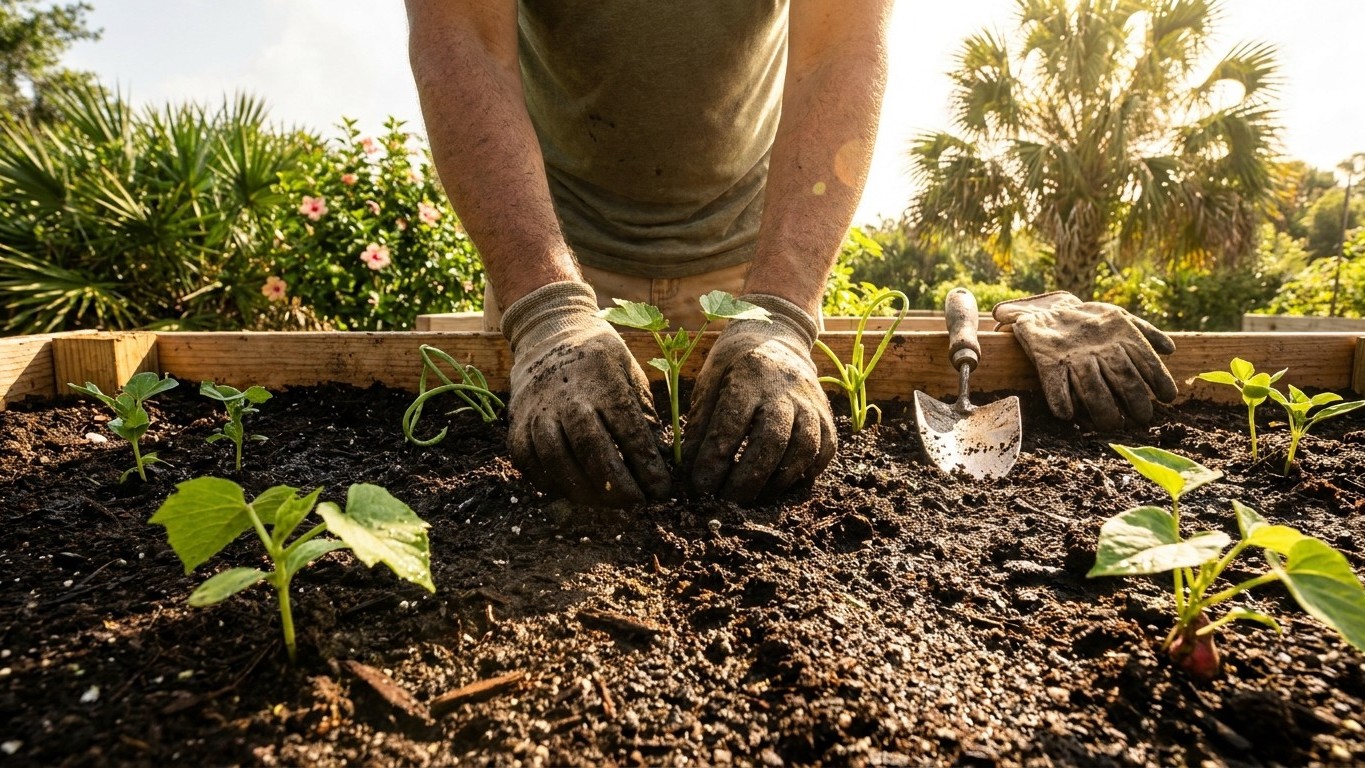

August is Florida’s hardest gardening month to get right: soil and air are too hot for most direct-sown vegetables almost everywhere in the state, so the real work is starting fall crops under cover and keeping heat-tolerant southern staples alive in the ground. The state spans USDA zones 8b to 11b, so what applies in the Panhandle is close to irrelevant in the Keys.
What goes in the ground in August

Soil temperature decides this month, not the calendar. Across most of Florida, August soil runs into the high 80s and 90s Fahrenheit at seed depth, and that heat, combined with the wettest stretch of hurricane season, makes germination unreliable for anything but the toughest crops. Tomatoes, peppers, and lettuce dropped into that soil now mostly stall, drop blossoms, or rot before they establish.
What actually tolerates it: sweet potato slips, okra, southern peas (cowpeas), yardlong beans, eggplant, Malabar spinach, and Seminole pumpkin all keep growing through August heat because they evolved for exactly this climate. Basil and other heat-loving herbs also do fine in the ground, provided watering keeps pace with evaporation. These are the direct-sow and transplant options worth trusting this month, statewide.
North versus south changes the math
In north Florida, represented by the Jacksonville station data, the last spring frost falls in the window of February 16 to March 7 and the first fall frost arrives November 26 to December 13 (source: NOAA NCEI 1991-2020 Climate Normals, 32°F freeze probabilities, station USW00013889). That gives north Florida gardeners a real frost-free growing season to plan the fall garden around. Central and south Florida, though, are effectively frost-free, and there the seasonal logic flips: winter is the prime growing window and summer, including August, is the stress season to survive rather than the season to plant into heavily. Applying Jacksonville’s frost dates to Orlando or Miami would be a mistake; those cities need to think in terms of heat stress and rain, not freeze risk.
What to start under cover
This is the month’s real planting task: starting fall-garden seedlings indoors, under shade cloth, or in a screened space where the air is a few degrees cooler and out of direct sun. Broccoli, cabbage, collards, and kale seeded now have time to build strong root systems before they move outside as temperatures ease.
For north Florida, count backward from that first fall frost window of November 26 to December 13. A brassica seedling generally needs several weeks indoors before it is sturdy enough to transplant, and it needs another stretch of weeks in the ground before frost risk returns, so August starts fit that arithmetic when the goal is a fall harvest ahead of the season’s first hard cold. Central and south Florida gardeners do the same seed-starting now, but they count toward the point when daytime highs finally drop out of the 90s, typically as fall progresses, rather than toward any frost date, because their season doesn’t hinge on freezing weather at all.
The two failure modes are predictable. Start too early under cover and the seedlings turn leggy and rootbound waiting out weeks of heat that hasn’t broken yet, stretching thin toward whatever light they can find indoors. Start too late and the plants miss the cooler window entirely, arriving outside just as the next heat wave or, in the north, the next frost threat closes the door.
What is ready to pick
August harvests skew toward the crops built for heat. Okra picked at two to four inches is tender; let the pods go longer and they turn woody fast, so daily checking during a Florida summer is not optional. Southern peas are ready once the pods dry and rattle, a sound worth learning by ear because it saves a lot of guessing.
Eggplant and hot peppers keep producing steadily through the month if they’re watered consistently, and sweet potato vines, while not yet at harvest, are filling out underground and should be left alone until the foliage starts yellowing later in the season. In north Florida, muscadine grapes often ripen through August, giving backyard growers one of the few sweet, low-effort harvests of the month.
Spring tomatoes are largely finished statewide by this point, done in by the same heat that stresses everything else, so gardeners hoping for a tomato harvest in August are usually looking at stored green tomatoes ripened indoors rather than anything still on the vine.
The jobs that matter this month
Soil preparation for the fall garden pays off disproportionately if it happens now rather than in September. Beds that finished their spring crop can be solarized under clear plastic through the hottest weeks, which knocks back weed seed and some soil pathogens using heat that’s already free and abundant. Working compost or other organic matter into those same beds while the ground is workable, before fall transplants go in, saves a scramble later.
Mulching matters more in August than almost any other month, since a few inches of straw or leaf mulch cuts soil temperature and slows the moisture loss that heat and wind create even between the frequent summer storms. Watering rhythm deserves attention too: morning watering, deep and infrequent rather than light and daily, keeps roots resilient and reduces the fungal disease pressure that Florida’s humidity and afternoon storms practically guarantee if foliage stays wet overnight.
Hurricane season peaks through August into October, so staking tomatoes, trellising beans, and securing anything tall against wind gusts is not optional garden housekeeping, it’s storm prep. Clearing drainage paths around beds before a heavy rain event arrives prevents standing water from drowning roots that heat has already stressed. Pest scouting rounds out the list: whiteflies, aphids, and fungal leaf spots all multiply fast in heat and humidity, and catching an infestation in its first week is far easier than fighting it in its third.
What not to do in August
The classic mistake is treating a warm evening as permission to plant like it’s spring. Tomato and pepper transplants set into August soil expecting steady growth usually stall out, drop blossoms in the heat, or simply cook at the root zone, since soil temperature in the high 80s and 90s doesn’t cool down just because the calendar says late summer. Heat-tolerant varieties and a shift to fall timing serve the garden better than forcing spring crops into a month built for something else.
Pulling shade cloth or row cover too early after a few mild, cloudy days is another common error, since Florida August heat spikes back hard and fast, and seedlings that adjusted to filtered light burn within a day of full exposure. Keep cover on until the trend, not a single cooler afternoon, holds.
Heavy nitrogen feeding during peak heat stress is also counterproductive: it pushes soft, leafy growth precisely when a plant’s energy needs to go toward root strength and heat tolerance instead. Save the nitrogen push for when fall transplants are actively establishing in cooler soil. Ignoring drainage before storm season is the last big miss, since waterlogged roots on top of heat stress is often what actually kills a plant that looked fine the week before.
Checking this against your own county
A statewide August calendar is a starting point, not an instruction specific to any one yard. Latitude does more work in Florida than elevation does, and the difference between a Panhandle garden and a Keys garden in August can amount to entirely different growing strategies, one still watching for a frost months away, the other with no frost concern at all. Coastal exposure and local rainfall patterns during hurricane season shift things further within short distances.
For a planting calendar built around a specific county, the UF/IFAS Extension office is the reliable next stop, since local agents adjust recommendations for the microclimate a state-wide page like this one can’t capture.
Common questions
Can tomatoes be planted in Florida in August?
Generally no, statewide. Heat this deep into summer causes blossom drop and root stress in most areas, so tomato planting is better timed to Florida’s cooler-season windows rather than August.
What vegetables tolerate Florida’s August heat?
Okra, southern peas, yardlong beans, eggplant, sweet potato, and Malabar spinach all continue growing through August heat, making them the safest direct-ground choices this month.
Is August too late to start a fall garden in Florida?
No, it’s close to the right time. Starting brassicas and other fall crops under cover in August, then transplanting as temperatures ease, is the standard approach across the state.
Does south Florida follow the same frost dates as north Florida?
No. The frost windows cited for north Florida, based on Jacksonville data, don’t apply to central and south Florida, which are effectively frost-free and follow a growing season built around summer heat rather than winter cold.