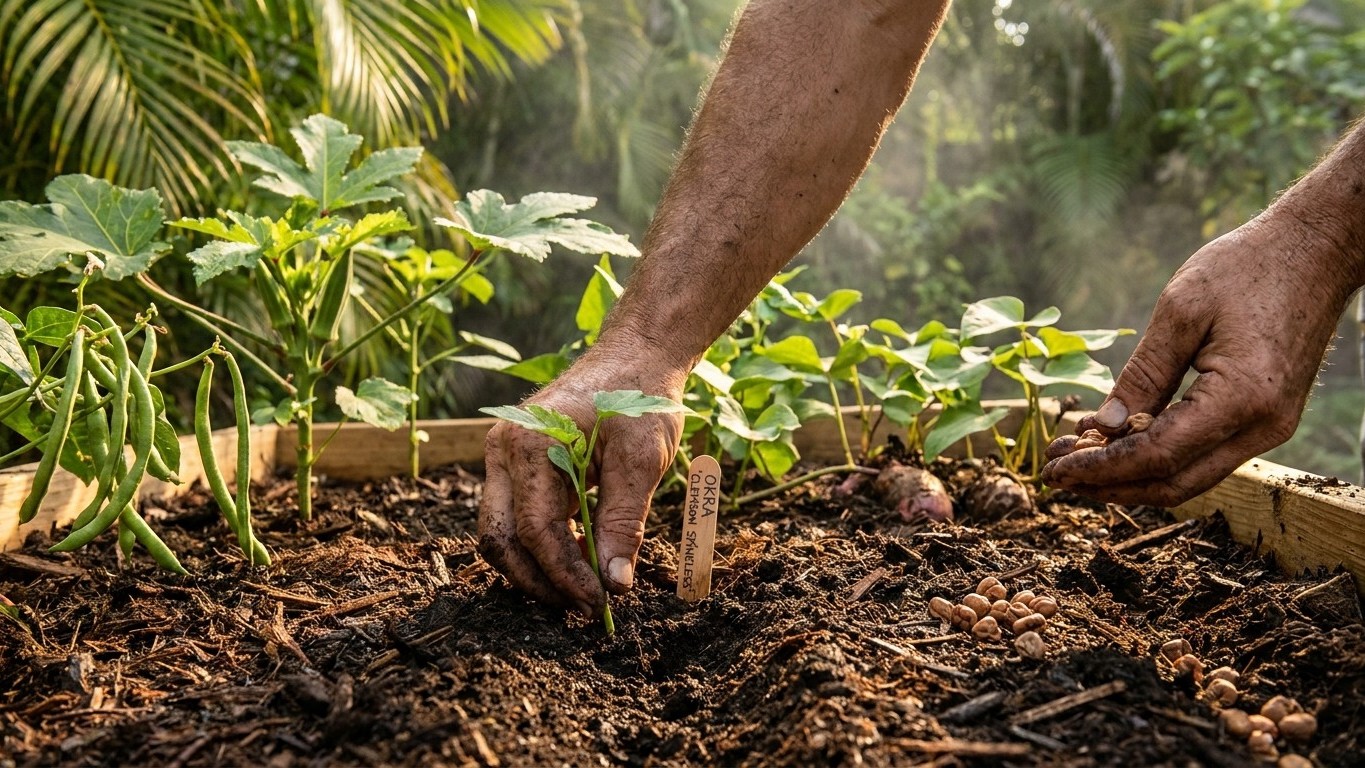

In June, Florida’s growing calendar is running on heat, not frost. North Florida sits five to six months clear of any frost risk by this point, so the frost windows that matter every winter are irrelevant now. Okra, southern peas, sweet potato slips, malanga, boniato, calabaza and roselle go in the ground. Tomatoes and snap beans are wrapping up or gambling against blossom drop. In central and south Florida, June opens the hardest stretch of the year, because much of the real growing season already happened over winter.
What goes in the ground in June

Florida spans USDA hardiness zones 8b through 11b, and that range matters more in June than at almost any other point in the calendar. Jacksonville, the reference station for north Florida, sees its last spring frost between February 16 and March 7 and its first fall frost between November 26 and December 13. June falls roughly three months past the spring window and five months ahead of the fall one. Frost is not a factor anywhere in the state this month. Soil temperature, heat stress, and the arrival of Florida’s summer rains are what decide what survives.
That shift changes the list of safe bets. Okra tolerates the heat better than almost any garden vegetable and keeps producing through the worst of summer. Southern peas (cowpeas) thrive in the same conditions and fix nitrogen while they’re at it. Sweet potato slips go in now for a fall harvest, and their tropical cousins, boniato and malanga, follow the same logic. Calabaza, the tropical pumpkin common in Caribbean and Latin cooking, and roselle, grown for its tart calyxes, both handle Florida summers that would stall a standard squash or a temperate hibiscus.
Common snap beans and tomatoes are the gamble. Daytime highs and, more importantly, nighttime lows that stay too warm cause blossom drop in both crops, so fruit set slows or stops even though the plants look healthy. Anyone planting them in June should expect a shorter, less reliable harvest than a spring planting gave.
Central and south Florida are effectively frost-free, and that flips the whole calendar: the main growing season runs through fall, winter, and spring, and summer becomes the difficult season instead. By June, gardeners there have usually already harvested the bulk of their cool- and warm-season crops from the winter growing window. What goes in now is limited to the same heat-tolerant, humidity-tolerant group that works in north Florida, with tropical root crops and okra doing most of the work.
| Region | June status | What actually goes in |
|---|---|---|
| North Florida (Jacksonville and similar) | Well past frost, entering peak heat and rain | Okra, southern peas, sweet potato slips, calabaza, roselle |
| Central Florida | Frost-free; main season already past its peak | Okra, southern peas, boniato, malanga, heat-tolerant amaranth |
| South Florida | Frost-free; deep into the hard summer stretch | Okra, southern peas, calabaza, roselle, tropical root crops |
What to start under cover
With frost off the table, “under cover” in June means shelter from heat and rain rather than shelter from cold. Cool-season crops for the fall garden, broccoli, cabbage, lettuce, need to be started indoors or in a shaded, air-conditioned space now, because outdoor soil temperatures in June are far above what those seeds will germinate in reliably.
The arithmetic runs backward from the first fall frost window rather than from any fixed date. For north Florida, that window sits between November 26 and December 13. Take the weeks-to-transplant listed on the seed packet for the fall crop in question, count back from the start of that frost window, and that’s the starting point for seed trays indoors. A cabbage that needs six weeks to reach transplant size, for instance, gets started well before the frost window opens, so it can go into the ground while the soil is still warm enough for the roots to establish before real cold arrives.
Two mistakes show up every year. Starting too early, especially in a hot, un-air-conditioned space, produces leggy, stressed seedlings that struggle once transplanted. Starting too late means the seedlings are still small when the transplant window opens, and they run out of cool weather before they mature. Central and south Florida gardeners run the same backward math using their own fall frost expectations, which for most of those regions means essentially no hard frost at all, so the deadline is really set by cooling temperatures and shortening humidity rather than by frost itself.
What is ready to pick
Whatever went in during the spring window is finishing up now. Tomatoes and peppers planted in late winter or early spring are producing their last strong flush before heat shuts fruit set down. Watermelon and cantaloupe planted early are ripening, and the surest sign of readiness on a watermelon is the pale spot where it rests on the ground turning from white to a deeper yellow, along with a dull, hollow-sounding thump rather than a bright ring.
Beans and cucumbers from a spring planting are still coming in but slowing, and the harvest often turns bitter or tough on cucumbers left too long in the heat, so picking a little early is the safer habit through June.
In central and south Florida, the vegetable garden is quieter by this point, since most of the winter-planted crops finished earlier in the year. The practical task is checking whatever got stored, cured winter squash, onions, and any root crops held over, for soft spots or sprouting, because Florida’s summer humidity accelerates rot in storage far faster than a drier climate would. Anything showing softness gets used first rather than left to spread to the rest of the batch.
The jobs that matter this month
Mulch does more work in June than in almost any other month. A thick layer, three to four inches, over the root zone slows evaporation and buffers soil temperature swings just as the sun gets most intense, and it also cuts down on splash-borne fungal disease once the rains pick up.
Watering rhythm needs a rethink as Florida’s wet season gets underway. The goal shifts from adding water to managing drainage, since raised beds and containers that drained fine in a dry spring can sit waterlogged after a heavy June downpour, and root rot follows quickly in that heat. Checking that beds actually drain, and adjusting mulch or grading if they don’t, pays off more than any watering schedule.
Okra, southern peas, and other vining or tall summer crops need staking or support put in place before they sprawl, not after, since disturbing established roots to add a stake later sets the plant back.
Pest pressure peaks alongside the heat. Fall armyworm, whiteflies, and various fungal diseases favored by warm, wet conditions all show up more aggressively in June, so a weekly walk through the garden checking undersides of leaves catches problems while they’re still small.
Succession sowing keeps okra and southern peas producing steadily, since a single planting tends to peak and taper rather than holding a long, even harvest. And working compost into beds destined for the fall garden now gives it time to break down before those cool-season transplants go in later.
What not to do in June
Planting cool-season crops, lettuce, English peas, spinach, because a stretch of clouds made the air feel mild is one of the most common June mistakes. Florida heat returns fast, and those crops bolt or collapse within days once it does. The fix is patience: hold cool-season seed for the fall starting window described above.
Overwatering as the rainy season begins is another frequent error, especially from gardeners used to a drier spring. Beds that needed daily watering in April can drown in June if watered on the same schedule once the rains start doing the work. Checking soil moisture before watering, rather than watering on autopilot, avoids root rot.
Heavy nitrogen feeding at this point in the season pushes leafy growth on plants that are already heat-stressed, at the expense of fruit set, and it can also feed fungal problems that thrive on soft, lush growth in humid conditions. A lighter hand, or holding fertilizer until the fall crops go in, generally serves better.
Pulling mulch back or removing shade cloth after a mild or rainy stretch, assuming the worst of summer has passed, is premature almost every year. Florida’s heat settles back in quickly, and uncovered soil and plants take the hit.
Checking this against your own county
A statewide picture of June is a starting point, not an instruction for a specific yard. Florida stretches from a temperate-adjacent north to a tropical south, and that distance moves growing conditions by far more than a few weeks, unlike smaller states where elevation or lake effect does the shifting. A north Florida garden and a south Florida garden are effectively operating on different calendars in June.
The University of Florida’s IFAS Extension network runs county offices across the state and publishes planting guidance tuned to local conditions. Checking with the county office, through UF/IFAS Solutions for Your Life, before committing a bed to any June crop is worth the few minutes it takes.
Common questions
Is it too hot to plant tomatoes in Florida in June?
Tomatoes can be planted, but blossom drop from high nighttime temperatures usually cuts fruit set well below what a spring planting produces. Many gardeners treat June tomatoes as a lower-yield gamble rather than a main planting.
Why does Florida’s growing calendar work backward from most states?
North Florida has a real, if short, frost season running roughly from late November to early March. Central and south Florida are largely frost-free, so their main growing season runs through the cooler months, and summer, with its extreme heat and heavy rain, becomes the difficult stretch instead of winter.
What is the easiest crop to start in a Florida garden in June?
Okra and southern peas are the most forgiving choices. Both tolerate high heat and humidity better than most garden vegetables and keep producing through the summer with minimal fuss.
Should I start fall vegetable seeds indoors during June in Florida?
Yes, for cool-season crops like broccoli and cabbage. Starting them indoors or in a shaded, cooler spot in June, counted backward from the local first fall frost window, avoids the failed germination that outdoor summer soil temperatures usually cause.