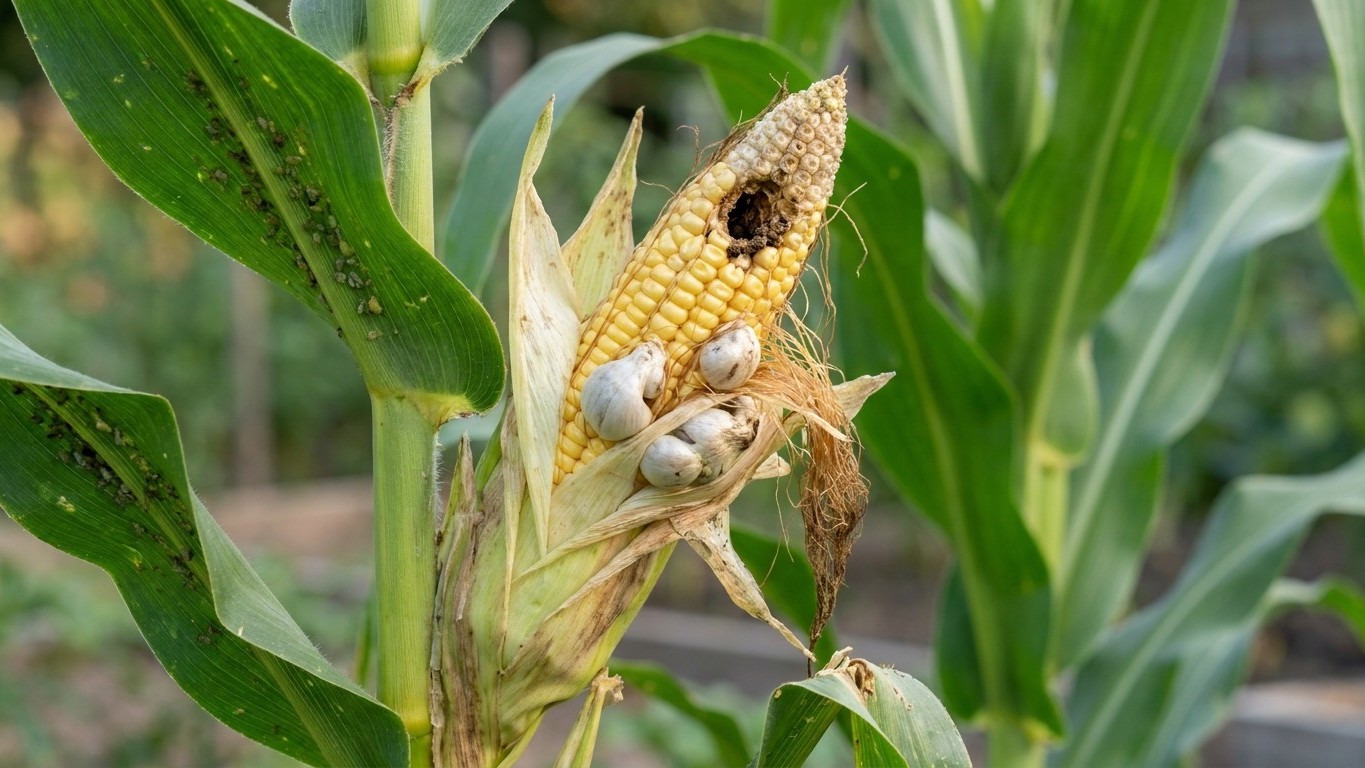

Florida gardeners lose sweet corn mostly to fall armyworm, aphids, eastern lubber grasshoppers, fire ants and root-knot nematodes, the species UF/IFAS Extension actually documents on this crop. Which one shows up first depends less on the calendar month than on where the planting sits between the last spring frost and the first heat of summer, and that window shifts a lot across the state.
Which pests attack corn in Florida
UF/IFAS Extension documents eleven pests across Florida landscapes and gardens: Aphids, Chilli thrips (Scirtothrips dorsalis), Cycad aulacaspis scale, Eastern lubber grasshopper (Romalea microptera), Fall armyworm, Fire ants, Hornworm caterpillars, Melonworm, Pickleworm, Root-knot nematodes, and Whiteflies. Not all of them have any business on a corn planting, and treating a corn patch for the wrong insect wastes a season.
Start with what to rule out. Chilli thrips feed on peppers, strawberries and a long list of ornamentals, not on grasses like corn. Cycad aulacaspis scale is a specialist that attacks sago palms and other cycads exclusively, it has no biological reason to touch a corn stalk. Hornworm caterpillars are built for tomato-family plants (tobacco, tomato, pepper), and corn’s leaf chemistry doesn’t attract them. Melonworm and pickleworm both target cucurbits, squash, cucumber, melon, and stay on those vines. Whiteflies prefer broad, soft leaves on vegetables and ornamentals; corn’s narrow, upright grass leaves aren’t a host they favor. Five names, five reasons they don’t belong on this page.
That leaves five that do. Fall armyworm is the one most gardeners eventually meet, it feeds directly inside the whorl and later inside the developing ear. Aphids cluster on new growth and around the tassel, and their sticky honeydew is often the first clue before the insects themselves are spotted. Eastern lubber grasshopper is a generalist chewer, large and slow-moving, that strips leaf tissue from corn along with whatever else is nearby. Fire ants aren’t foliage feeders, but colonies nesting near a row will tend aphid clusters for honeydew and can damage germinating seed and young seedlings while doing it. Root-knot nematodes live in the soil and attack roots directly, showing up as stunted, wilting plants rather than visible chewing.
Five documented pests, not eleven. If a symptom on a corn plant doesn’t match one of these five, the cause is more likely something other than a UF/IFAS-documented insect on this crop, and that’s worth confirming before reaching for any treatment.
When each one shows up, and what it does first
North Florida’s frost calendar sets the clock. The last spring frost for the Jacksonville reference station falls **between February 16 and March 7**, and corn can’t go in the ground until soil temperature climbs above 60 F, which arrives well after that frost date, not on it. The first fall frost then lands **between November 26 and December 13**, giving the season its outer edge. Central and south Florida don’t share this pattern at all: those areas run largely frost-free, so their corn calendar inverts and summer becomes the hard season rather than winter. Everything below describes the north Florida pattern tied to that station.
Once soil hits planting temperature, fire ants are often the first problem, working on the seed itself or on tender seedlings within the first couple of weeks. A row that germinates unevenly, with gaps where seed simply vanished, points here before anything else.
Aphids build gradually as the plant grows taller, showing up first as a shine or tackiness on upper leaves and around the developing tassel, sometimes with a black sooty film growing on the honeydew before the insects themselves are obvious.
Eastern lubber grasshoppers become more damaging as the season warms, since their feeding activity tracks the region’s heat load. That reference station averages 73.2 days a year at 90 F or hotter, and that stretch of heat is when lubbers are most active and most destructive, chewing ragged, irregular holes along leaf margins rather than tunneling into any one spot.
Fall armyworm tends to appear once the whorl is fully formed, leaving ragged windowpane feeding and dark frass (droppings) packed down in the funnel of leaves. Left alone, the same insect moves on to the ear once silks emerge, feeding from the tip downward.
Root-knot nematode damage is the slowest to show and the easiest to miss early. Plants look fine at first, then wilt on hot afternoons even with adequate water, and growth lags behind the rest of the row. That symptom tends to become obvious as the days-above-90 stretch sets in and root systems already weakened by nematodes can’t keep up with water demand.
Telling the damage apart from everything else
Corn throws a lot of symptoms that look like insect damage but aren’t. Nitrogen deficiency yellows the older, lower leaves first while the plant keeps growing, no chewing marks, no frass, no visible insects. Drought stress rolls leaves lengthwise and dulls their color across the whole plant evenly, rather than concentrating damage in the whorl or on one leaf edge. Wind and mechanical damage (a mower blade, a pet running through) tears leaves at random angles and heights, with no pattern tied to the plant’s growth stage. Fungal and bacterial leaf diseases produce spots or streaks with defined borders, sometimes with a halo, and they spread across a field in patches rather than plant by plant.
| Symptom | Likely cause | What tells them apart |
|---|---|---|
| Ragged holes, dark droppings in the whorl | Fall armyworm | Frass packed in the leaf funnel, feeding concentrated at the growing point |
| Sticky residue, black film on leaves | Aphids | Cluster of small soft insects visible on close inspection, near tassel or new growth |
| Wilting despite watering, stunted growth | Root-knot nematodes or drought | Dig a root: nematodes leave visible knots and swellings, drought stress does not |
| Uniform yellowing, lower leaves first | Nitrogen deficiency | No chewing marks, no insects present, whole plant still upright |
| Torn leaves at odd angles | Mechanical or wind damage | Damage pattern doesn’t match plant growth stage, often isolated to one side |
The one move that saves the most guesswork is digging a root before assuming any leaf symptom is the whole story. Knotted, swollen roots confirm nematodes on the spot; clean roots point the search back up to the leaves and stalk, where insect feeding usually leaves a clearer signature.
What actually works here, and what is a waste of time
Timing beats treatment on a season this compressed. A physical barrier such as row cover, put down at planting and kept on through early growth, blocks fire ants from reaching germinating seed and keeps early aphid colonies from establishing, and it costs nothing in chemical decisions. Cover needs to come off before tasseling, since corn depends on wind for pollination and a sealed row won’t set ears.
Checking the whorl by hand every few days once plants are knee-high catches fall armyworm while it’s still contained to a few plants, rather than after it has spread down the row. Pulling and destroying a heavily nematode-damaged plant, rather than leaving it to decline in place, also limits how much the soil population builds up for whatever gets planted there next season.
The layout choice that matters most for flavor, not for pests, is keeping su, se and sh2 types from tasseling at the same time; **the sweetness of the sweeter types collapses if pollen from a starchier type reaches them while both are shedding**. Planting in blocks of three or more rows, rather than a single thin row, also improves pollination regardless of which type is grown. Neither of these is a pest control measure, but a poorly pollinated, badly timed planting is far more vulnerable to whatever insect finds it.
What doesn’t help: spraying on a fixed schedule regardless of what’s actually present, since it burns time and money on pests that were never there and does nothing for nematodes living in the soil. Continuous corn in the same bed season after season also builds up root-knot nematode populations rather than starving them out. This site doesn’t recommend specific products or active ingredients, since only the state’s extension service can confirm what’s currently labeled for use on corn in Florida gardens.
Where to check this for your own county
UF/IFAS Extension is the source for every pest named on this page, and it’s also the right place to confirm what’s actually active in a specific yard. A statewide list documents what’s known to occur across Florida, it doesn’t say what’s present in any one garden this week. The single most useful step before treating anything is contacting the county extension office, since agents there see local pest pressure directly and can confirm an identification from a photo or a sample far more reliably than a general description.
This matters more in Florida than in most states, because the growing calendar itself splits by region. The frost dates on this page come from a north Florida reference station, and central and south Florida run frost-free with an inverted calendar where winter is the main season. A county office in Jacksonville and one in Orlando or Miami are working from different growing windows entirely, even though both fall under the same statewide pest list.
Before planting the next round of sweet corn, or before treating anything already in the ground, the extension office covering that specific county is the next call to make.
Common questions
Do all five documented pests show up in every Florida garden?
No. UF/IFAS Extension documents these five as occurring on corn statewide, but presence in any single garden depends on local conditions, nearby host plants and soil history. A county extension office can confirm what’s active locally.
Can corn planted in central or south Florida use the same frost dates as north Florida?
No. The frost window given here comes from a north Florida reference station. Central and south Florida are largely frost-free, and their growing calendar runs opposite, with the main season through winter and summer as the harder stretch.
How soon after planting should a gardener start checking for pests?
Fire ants can affect seed and seedlings within the first couple of weeks after planting, before soil temperature and germination are even fully settled, so early checks matter more than waiting for visible plant damage later.
Is a single wilted plant enough to confirm root-knot nematodes?
Not on its own. Wilting on hot afternoons also happens with drought stress. Digging up a root and checking for visible knots and swellings is what actually distinguishes nematode damage from simple water stress.