
Winter squash goes in the ground in north Florida once the last frost has passed, roughly February 16 to March 7 at the Jacksonville reference station. But that window only applies to the northern third of the state. Farther south, Florida stops behaving like a normal growing region altogether, and the whole calendar flips.
The short answer for Florida
Start with what the frost data actually says. At station USW00013889, the last spring freeze at 32°F falls somewhere between February 16 and March 7 in a typical year, and that’s not a single date but a 30 to 70 percent probability band pulled from three decades of NOAA records. In plain terms, a freeze after March 7 happens less than a third of the time, and one after February 16 is still a real possibility in three or four years out of ten. Winter squash seed doesn’t germinate reliably below soil temperatures in the mid-60s anyway, so most north Florida gardeners aren’t racing the frost date so much as waiting for the ground itself to warm.
Fall works the same way in reverse. The first freeze at that same station lands between November 26 and December 13, which sets the outer edge for a fall-planted crop or for stretching a spring planting into a second harvest. Between those two windows sits a frost-free stretch of roughly eight and a half to nine months at the Jacksonville site, which is generous by national standards but gets eaten quickly once you account for the summer heat problem covered below.
Here’s the catch, and it’s a big one for anyone gardening outside the Jacksonville area: those frost dates come from a single inland station in the northeastern part of the state. Central Florida (Orlando and south) and the southern peninsula rarely see a freeze at all, and three of the thirty years in that NOAA dataset recorded no freeze whatsoever even at the northern station. In those regions, growers plant winter squash through the cooler months, roughly October through February, and treat summer as the season to avoid, not the season to plant in. That’s the opposite of how the calendar reads in north Florida, and conflating the two is the single most common mistake gardeners make when they borrow a planting date from the wrong part of the state.
What will not work here
The instinct to Plant Winter Squash in June, the way a gardener in Ohio or Pennsylvania might, runs straight into Florida’s heat load. The Jacksonville reference station averages 73.2 days a year at or above 90°F, and that’s the northern, cooler part of the state. Squash blossoms drop and pollen goes sterile once daytime highs push consistently past the low 90s, so a June or July planting anywhere in Florida is fighting the plant’s own biology, not just the gardener’s patience. Long-season winter squash varieties that need 100 to 120 days to mature are especially vulnerable, because their fruiting window lands squarely inside the hottest stretch of summer.
Watering on a weekly schedule is the second trap, and it’s a trap built from two facts stacking on top of each other. Summer rainfall at the reference station averages about 21.2 inches across June, July, and August, with July the driest of the three months at 6.77 inches. That sounds like plenty of water until you remember the 90-degree days driving evaporation, and the fact that Florida’s sandy soils let rain pass through within hours rather than holding it the way clay would. A single weekly watering on sand, even in a summer that’s getting close to seven inches of rain a month, still leaves the root zone dry for days at a stretch. Squash roots sitting in fast-draining sand need shorter, more frequent watering, not a deep soak once a week.
Tight spacing is the third failure point, and it’s a humidity problem more than a heat problem. Florida summers combine that same rainfall with heavy air moisture, and winter squash planted close together, the way a spacing chart written for a drier climate might suggest, traps moisture in the canopy long enough for powdery mildew and downy mildew to take hold. Wider spacing than a seed packet recommends, plus morning watering that lets foliage dry by afternoon, does more to prevent disease in a Florida summer than any fungicide schedule.
What changes across Florida
Florida’s USDA Plant Hardiness Zone range runs from 8b up through 11b, and that spread alone tells you there’s no single planting date for the state. Zone 8b, in the Panhandle and parts of north Florida, still sees a real winter with occasional hard freezes, which is why the frost-based calendar above applies there. Zone 11b, at the southern tip of the peninsula and the Keys, essentially never freezes. That’s not a minor variation. It’s the difference between a state where winter squash is a spring-through-fall crop and one where winter is the growing season.
Remember that the USDA system measures exactly one thing: the average annual extreme minimum temperature. It says nothing about summer heat, rainfall, or day length, all of which also shift substantially as you move down the peninsula. A grower in the northern tier is managing frost risk and a compressed frost-free season; a grower near Naples or Homestead is managing which months are simply too hot for squash to set fruit at all, frost never entering the conversation.
Elevation barely factors into this picture. Florida’s highest point sits a little over 300 feet above sea level, so altitude isn’t going to shift anyone’s planting date the way it would in a mountain state. Latitude does all the work here. A reader gardening near the Georgia line is working with a genuinely different plant calendar than one near Fort Myers, even though both are technically in the same state and looking at the same seed rack.
None of this can tell an individual reader which zone applies to their own yard. The right move is to check the current USDA Plant Hardiness Zone Map directly and confirm the zone for a specific address before treating any frost date as a personal planting deadline.
Where to check this for your own county
The state-level picture here is a starting point, not a final answer. Florida’s counties differ enough, in both climate and in which squash varieties actually perform well locally, that the University of Florida’s IFAS Extension is the source built specifically to close that gap. Their county offices are reachable through the UF/IFAS Solutions for Your Life portal at sfyl.ifas.ufl.edu, and each county office publishes its own planting guidance rather than a single statewide sheet.
Two things are worth pulling from that site specifically. The first is the local planting calendar for vegetables, which most county extension offices publish as a month-by-month chart and which will reflect the actual frost pattern and heat timing for that county rather than the Jacksonville reference station used above. The second is any list of squash varieties the local office has trialled or recommends, since Florida’s humidity and pest pressure (squash vine borer and pickleworm both show up statewide, but with different intensity by region) mean some varieties bred for other climates simply underperform here regardless of what the seed catalog promises.
A county recommendation will always beat a state-level one, because it’s built from conditions closer to the reader’s actual soil and microclimate. Statewide and single-station data is useful for understanding why Florida’s calendar behaves the way it does, but it isn’t a substitute for the county-specific numbers UF/IFAS maintains for exactly this reason.
Some gardeners also time this by the Moon: when to plant winter squash by the moon, as almanac tradition rather than fact.
Checking this against your own garden
Every date here is a regional average built from thirty years of weather records. A reader’s own soil and yard will confirm or override it faster than any calendar can. Three signs matter more than the calendar once seed is actually going in the ground.
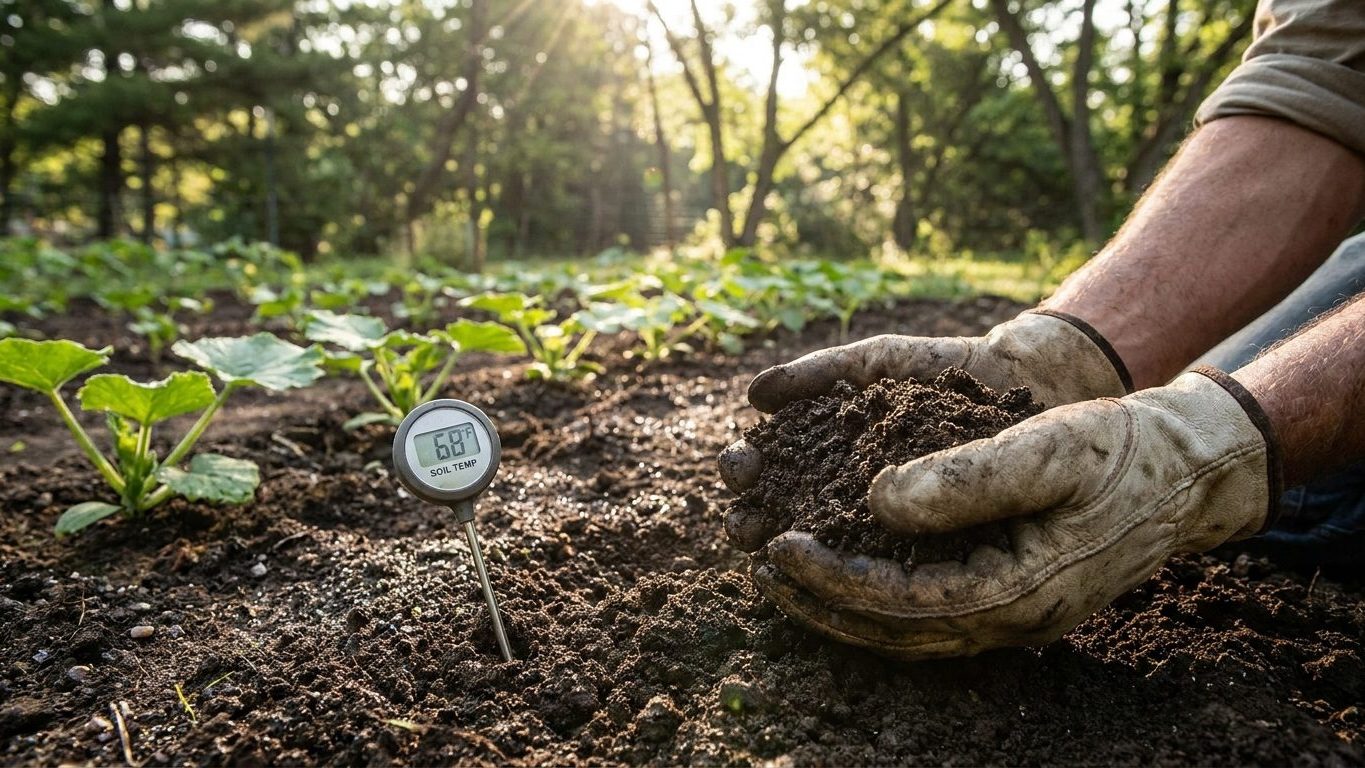
Soil warmth by feel is the first and most direct check. Cold, damp soil that feels chilly to the back of a hand an inch or two down means squash seed will sit and rot rather than germinate, regardless of what the frost date suggests. Warm, slightly dry-feeling soil at that same depth is the real green light, and it can arrive earlier or later than the regional average depending on how much sun a particular bed gets and whether it’s raised or in-ground.
The first flush of male flowers is the second signal, and it shows up before the plant is ready to fruit. Squash plants produce male blossoms first, often for a week or two before any female flowers (recognizable by the tiny bulge at the base) appear. Seeing male flowers only, with no fruit set yet, is normal and not a sign of a problem.
The appearance of the first true leaves, the second set that emerges after the rounded seed leaves, marks the point where a plant has moved past its most vulnerable stage and is establishing a real root system. A garden where true leaves show up faster than a neighbor’s, even under the same regional frost dates, is simply running a warmer or more sheltered microclimate, and that’s worth noting for every planting decision that follows.