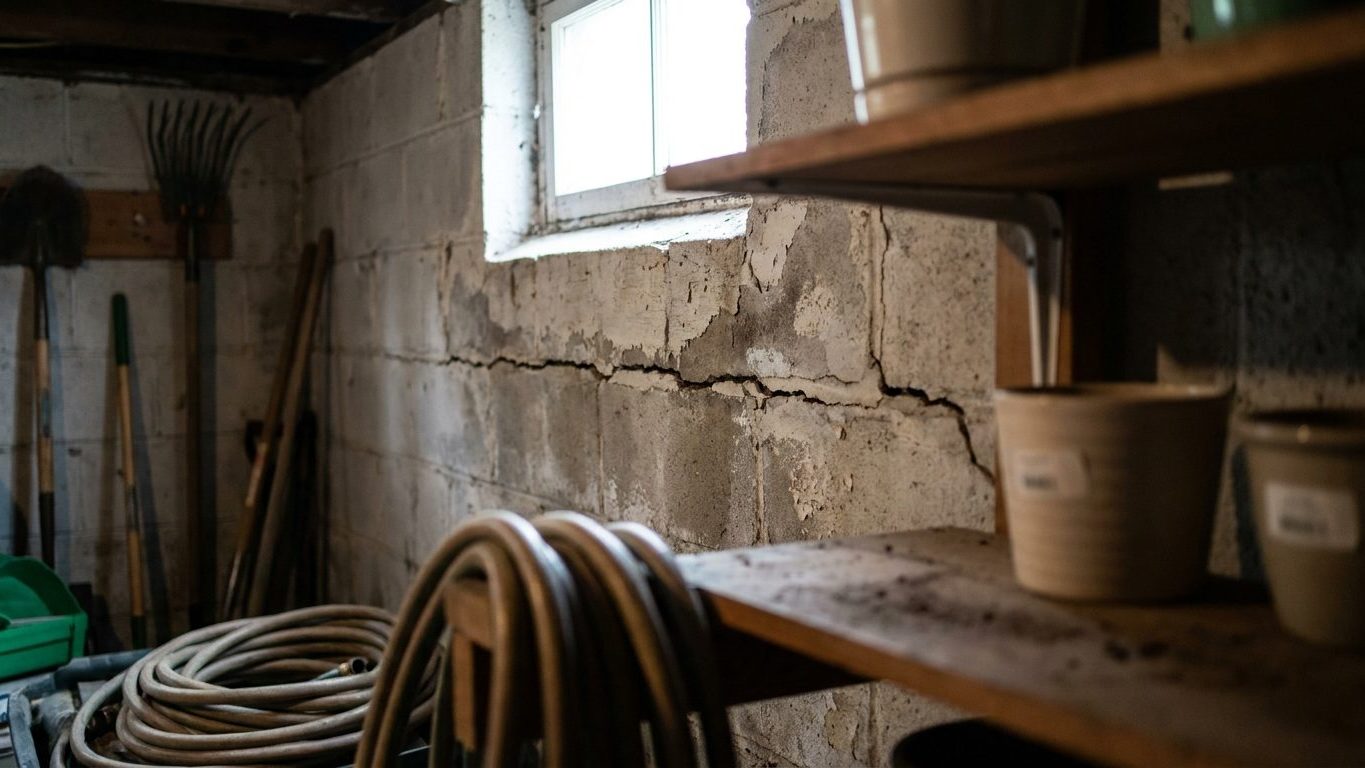

A horizontal crack in a basement wall means the wall is being pushed in from outside, not settling under its own weight the way a vertical crack usually does. That distinction matters because a horizontal crack often shows up right where the wall has started to bow, and a bowed wall does not straighten itself out. Call a structural engineer before you patch it, paint it, or add drainage around it.
What is actually going on

A basement wall is not just a barrier holding back dirt. It behaves like a beam standing on end, fixed at the bottom where it meets the footing and braced at the top where it meets the floor framing. Soil pushes against that beam from the outside. Wet clay swells and pushes harder. Water that has nowhere to drain builds up hydrostatic pressure against the wall like a dam holding back a lake. In cold climates, soil that freezes and heaves adds another shove. All of that force is called lateral pressure, and it is the reason a basement wall cracks in the first place.
A wall resists that pressure until it can’t. When it starts to give, it doesn’t crumble all at once, it bends. Concrete block and poured concrete crack differently, but in both cases a horizontal crack usually shows up near the point where the wall is bending hardest, often somewhere around the middle third of the wall’s height rather than right at the top or bottom. That is a different pattern from the diagonal, stair-step crack that follows the mortar joints in a block wall, which usually points to uneven settling of the footing rather than lateral pressure. That pattern is worth understanding on its own, covered separately in Cracks That Follow the Mortar in a Block Wall.
A horizontal crack by itself tells you the wall has been stressed. It does not tell you how much, or whether the movement has stopped. That’s the part a homeowner cannot judge by eye. A crack accompanied by the wall leaning inward, by a visible curve when you sight down its length, or by displacement between the top and bottom of the wall, is a different situation than a hairline crack on a wall that still reads flat and plumb. Only a structural engineer can tell the difference between a wall that cracked once and stopped, and a wall that is still moving. The basics of how water behaves around a foundation are covered in Foundations and Basements: Almost Everything Here Is Water, and this picks up specifically where a crack has already appeared.
What you should not do is treat the crack as cosmetic. Filling it with hydraulic cement or a caulk made for concrete might stop water from coming through in the short term, but it also erases the one piece of evidence that tells an engineer, and you, whether the wall is still moving. A crack that has been filled cannot be watched.
What to look at, and in what order
Before calling anyone, there’s a sequence of checks that cost nothing but time, and each one narrows down what you’re dealing with. Do them in order, because each step rules something out before the next one adds information.
- Walk the perimeter outside. Look at how the ground slopes near the wall with the crack, and where the downspouts discharge. Water pooling against the foundation, or a downspout dumping right at the wall, points to a surface water source adding to the pressure. This doesn’t rule out structural movement, but it tells you whether you have an easy contributing cause to address once the wall itself is cleared.
- Sight down the wall. Stand at one end and look along its face, or hold a long straightedge against it. A wall that reads flat along its whole height, with the crack simply running across it, is a different situation from one with a visible inward curve centered on the crack. A curve rules out “it’s just a surface crack” and points toward active bowing.
- Mark the crack and date it. A pencil line across the crack, or a strip of tape with the date written on it, lets you see later whether the crack has widened or the tape has torn. This step rules out nothing on its own, but it builds the record an engineer will want to see, and it’s the only way you or anyone else can say whether the crack is active.
- Check the rest of the room. Doors and windows near the affected wall that have started sticking, new gaps where the wall meets the framing above it, or a similar crack appearing on the opposite wall, all suggest the movement isn’t confined to one isolated spot. Their absence doesn’t clear the wall, but their presence raises the urgency.
- Bring in a structural engineer. This is the only step on the list that produces an actual diagnosis rather than a clue. Everything above gives an engineer a head start. None of it replaces one.
Notice what’s missing from that list: nothing here involves digging alongside the wall. Exposing a foundation wall from outside changes the pressure acting on it while the work is underway, and it is not a homeowner task. If drainage around the wall turns out to be part of the problem, that gets addressed as its own project once a professional is involved, not as a weekend project undertaken to “see what’s going on down there.”
Watch it, or get someone in
A homeowner can reasonably monitor a horizontal crack under narrow conditions: the wall reads flat with no visible bow, the crack hasn’t changed against the pencil mark or tape over several weeks to a few months, there’s no active water coming through it, and nothing else in the house has changed alongside it. Under those conditions, checking the mark periodically while dealing with anything obvious on the drainage side is a reasonable approach.
Everything else means get someone in now, not after the next heavy rain. A crack widening against your mark, a wall showing any inward curve when you sight down it, horizontal displacement between the top and bottom of the wall, or a crack that is actively weeping or spraying water, are not homeowner-monitoring situations. Neither is a horizontal crack that runs the full width of the wall, or one with a shorter vertical or diagonal crack branching off it.
Which professional, and why it matters
The call to make first is to a structural engineer, not a waterproofing company and not a general contractor. An engineer’s job is to assess the wall and tell you whether it’s safe, whether it needs reinforcement, and what kind, without also being the one who profits from the repair. That separation matters because a waterproofing salesman’s estimate is not a neutral diagnosis, it’s a quote for a specific product line, and the incentive runs toward finding a problem that product solves.
A drainage contractor is a third, separate call, and it comes after the engineer, not instead of one. If the engineer determines the wall is structurally sound and the crack is old and dormant, but water is still getting in, that’s when addressing grading, gutters, or a drain system around the foundation makes sense. Fixing drainage does nothing for a wall that’s actively bowing, and reinforcing a wall does nothing to stop water intrusion if the source out back was never addressed.
If it takes time to get a structural engineer scheduled, keep the crack marked and check it weekly rather than monthly in the interim, and note any heavy rain or freeze that coincides with a change. That record is genuinely useful to whoever assesses the wall, and it costs a few minutes.
What has to happen first
The order of operations here is where money gets wasted. Diagnosis has to come before repair, and outside water management has to come before anything done to the inside of the wall. Skipping that order means paying for finished walls or waterproofing that has to be torn out again once the real problem surfaces. That single mistake, in one form or another, is the most common reason a basement gets worked on twice.
Once a structural engineer has assessed the wall and said what, if anything, needs to be done to it, the next thing to settle is where the water causing the pressure is coming from and where it’s going. That’s usually an exterior drainage question, sometimes solved with grading and gutter work, sometimes needing a dedicated drain system around the foundation. What a drain system can and can’t fix on its own is covered in Exterior Drains: What They Do and Do Not Solve.
Gutters and downspouts come first among the outside work, since a downspout dumping water right against the foundation can undo whatever else gets done, and that’s a roofing task rather than a foundation one. Inside the basement, a sump pump that’s undersized or not working does nothing to stop pressure on the wall itself, but it matters for anything sitting on the floor once water does get in, and getting the pump right is a plumbing question, not a foundation one. Insulation on a basement wall should wait until the wall has been assessed and any water issue addressed, since insulating over a wall that’s still wet or still moving just hides both problems until they’re worse. Flooring is last on the list for the same reason: whatever goes down on a basement slab should go down once the slab and the walls around it are confirmed dry, not before.
Treat the crack itself as the signal that started this process, not the thing being fixed directly. The wall gets reinforced or it doesn’t, based on what the engineer finds. The water gets managed, based on what the drainage check found. Only after both of those are settled does it make sense to think about what the finished room looks like.
Common questions
Is a horizontal crack in a basement wall always serious?
Not always, but it always needs an engineer’s opinion rather than a guess. A hairline horizontal crack on a wall that still reads flat and plumb can turn out to be old and stable, but the pattern that’s fine and the pattern that isn’t can look almost identical to an untrained eye, which is why assessment matters more than appearance here.
Can I just fill a horizontal crack with hydraulic cement myself?
Not before it’s been assessed. Sealing the crack removes the evidence a structural engineer needs to judge whether the wall has stopped moving, and it does nothing about whatever pressure caused the crack in the first place. If an engineer confirms the wall is sound and the crack is dormant, sealing a hairline surface crack afterward is a reasonable finishing step, not a diagnosis.
Why does the crack sit in the middle of the wall instead of near the top or the corners?
Because a basement wall braced at the top and bottom bends hardest somewhere between those two points, and that’s usually where a horizontal crack forms. Exactly where along the height depends on how tall the wall is and how deep the backfill against it runs, which is one more reason a general rule doesn’t substitute for someone looking at your actual wall.
Will homeowners insurance cover a horizontal foundation crack?
Usually not, though this depends entirely on the policy. Most standard homeowner policies exclude gradual earth movement and settling, which is how a lateral-pressure crack typically gets classified, but coverage language varies by carrier and by state. Check the actual policy wording with your agent rather than assuming either way, and do this before an engineer’s report is in hand, since some carriers want to see damage before repairs begin.