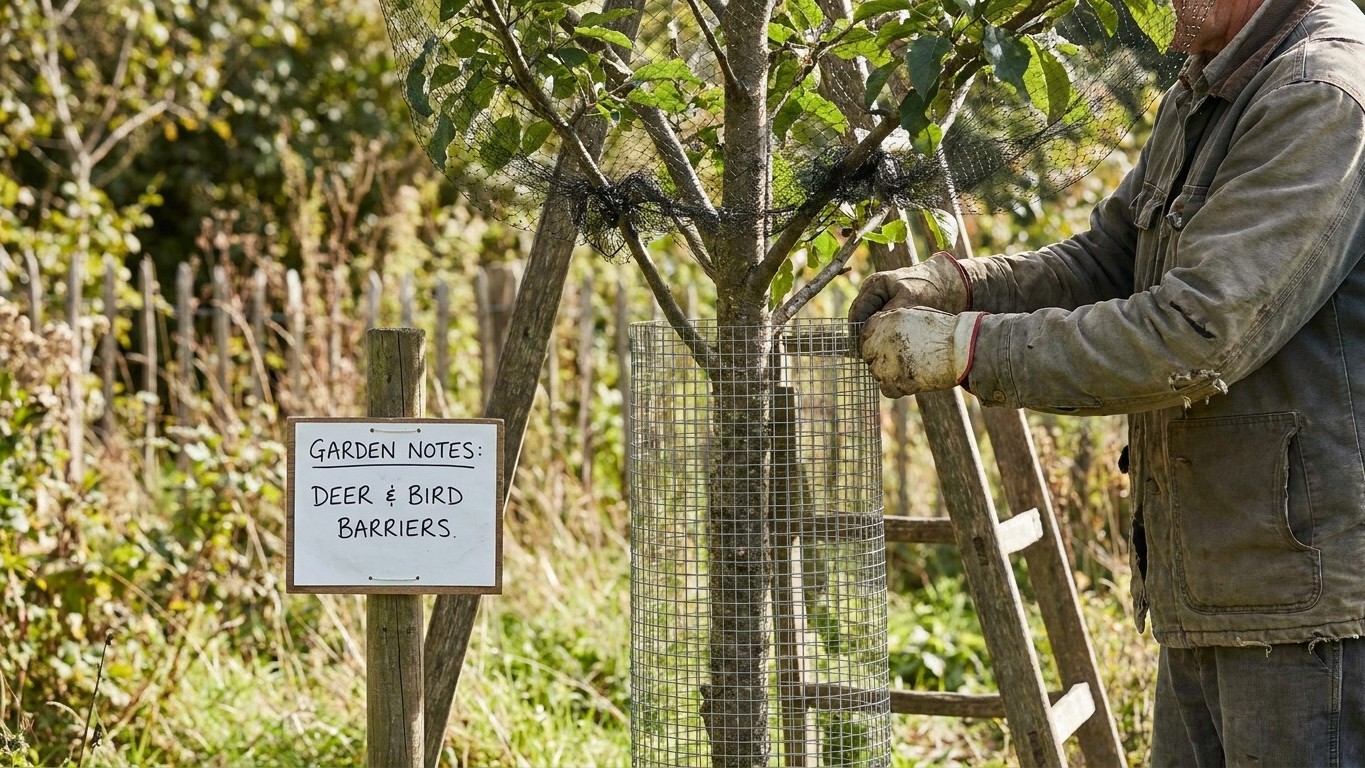

Netting is the surest way to stop birds from stripping an apple crop, and a fence or trunk guard handles the browsing damage netting alone won’t fix. USU Extension’s mature-height figures explain why rootstock matters here: a tree on M.9 rootstock tops out at 8-12 feet, small enough to net by hand from a stepladder, while one on seedling rootstock can reach 35-40 feet, well past what draped netting will ever cover. Find out which rootstock your tree is grafted onto before you buy netting, because that number decides your whole strategy.
Why it matters
Birds go after apples from the point the fruit starts to color, and they will work a tree from petal fall right through harvest if nothing stops them. A robin or starling doesn’t need a ripe apple to do damage. A single peck opens the skin, and that wound rots and draws wasps long before the fruit would have been picked. Deer cause a different kind of loss: they browse young shoots and flower buds in late winter and early spring, and bucks rub bark off trunks during the fall breeding season, which can girdle a young tree outright.
The two problems don’t share a calendar. Bird protection matters from petal fall through harvest, when there’s fruit on the tree to steal. Deer protection matters almost year-round on a young planting, starting at the dormancy stage right after transplant and continuing until the trunk is thick enough, and the tree tall enough, that browsing and rubbing stop being a real threat.
Rootstock decides how long that second window stays open and how hard the first one is to manage. A tree on seedling rootstock, per USU Extension, keeps growing for years before it clears deer-browse height, and once mature it is tall enough that full netting stops being a one-person job. A tree on M.9 or M.26 rootstock (8-12 feet and 12-15 feet respectively, USU Extension) reaches a manageable height quickly and stays there, which is why most home orchards planted for netting convenience lean dwarf. If you’re still choosing a tree, this is worth deciding before you plant, not after the first bird strips your first real crop. Growing Apples covers rootstock selection at the planting stage, which is the cheapest point to get this right.
When to do it
Netting goes up at petal fall, not before. Covering a tree while it’s still in bloom shuts out the bees and other pollinators the flowers need, and a net that excludes birds excludes pollinators just as effectively. Wait until the petals have dropped and small fruit has set before you drape or drop any netting over the canopy.
Timing gets more complicated in a garden with more than one apple variety, because they don’t bloom on the same day. Clemson Cooperative Extension’s HGIC 1350 groups apple varieties into three relative bloom windows: group A (Anna, Dorsett Golden) flowers first, group B (Fuji, Gala, Ginger Gold, Granny Smith, Jerseymac, Mollie’s Delicious, Mutsu, Red Delicious, Yates) follows, and group C (Arkansas Black, Golden Delicious, Jonagold, Ozark Gold, Priscilla, Rome Beauty, Stayman) blooms last. That order holds everywhere, though the actual calendar dates shift with climate, so treat it as a sequence rather than a schedule.
If you’re relying on a group B tree to pollinate a group C tree standing nearby, don’t net either one until the later bloomer has finished and dropped its petals. Netting the earlier tree first is fine. Netting the later one before pollinators finish their work on it is not, and the mistake doesn’t show up until harvest, when that tree carries far less fruit than its neighbor. This matters even more with the varieties that carry sterile pollen. Jonagold, Mutsu, Stayman, and Winesap can all be pollinated, but per Clemson HGIC 1350, UGA Extension’s Circular 740, and USU Extension, none of them can pollinate another tree. A garden that holds only two of these varieties sets no fruit at all regardless of netting, because neither tree can do the other any good. Cutting a bloom’s pollinator visits short by netting early just compounds a pollination problem that variety choice already created.
A late spring freeze during bloom is a separate risk that netting does nothing for. That threat is covered on Protecting Apple Blossom From a Late Frost, and it’s worth reading before bloom starts, since the two tasks get confused and a frost cloth left on too long can shut out pollinators the same way a bird net can.
How to do it

Sizing the job to the tree
Start with the rootstock height, because it decides whether you’re netting a whole tree by hand or fencing off the ground beneath a canopy you can no longer reach.
| Rootstock | Mature height (USU Extension) | Netting approach |
|---|---|---|
| M.9 | 8-12 ft | Full drape, no ladder needed |
| M.26 | 12-15 ft | Full drape from a stepladder |
| G.11 | 12-15 ft | Full drape from a stepladder |
| G.30 | 18-20 ft | Framed netting or extension pole needed |
| M.7 | 18-20 ft | Framed netting or extension pole needed |
| M.106 | 25-30 ft | Netting limited to lower scaffold branches |
| MM.111 | 30-35 ft | Full netting impractical, target fruiting wood |
| Seedling | 35-40 ft | Full netting impractical, target fruiting wood |
For bird protection, work at petal fall as described above:
- Build a light frame of poles or a cage of PVC or electrical conduit over the canopy so the net doesn’t rest directly on fruit or foliage.
- Drape fine-mesh netting over the frame, not the tree itself, and let it hang loose enough that birds landing on top can’t reach fruit through the mesh.
- Gather and secure the net at the trunk or tie it off at the base, closing any gap a bird could walk in through.
- Check the net every week or two for tears, and remove it promptly once the crop is picked so it isn’t sitting on the tree through winter.
For deer, the job runs on a different clock. A young tree needs protection starting at the dormancy stage right after transplant, since deer will browse buds and bark on a leafless tree just as readily as on one in leaf. A cylinder of hardware cloth or a rigid trunk guard wrapped around the lower trunk stops rubbing damage, and a taller perimeter fence around a young planting stops browsing on the canopy itself, since deer will stand and reach well above where a low wrap alone would protect. Once a tree has grown past reach and developed thick, mature bark, the risk drops off, but on a dwarf rootstock like M.9 that day is a long way off, since the whole tree may never clear typical deer-browse height on its own.
What goes wrong
The most common failure is netting draped straight onto the branches instead of over a frame. Wherever the mesh touches a fruit, a bird can perch on the outside and peck straight through, and the damage looks identical to an unprotected tree except it’s concentrated on the outer canopy where the net sagged into contact. By the time you notice, the fruit closest to the surface is already ruined.
A second failure shows up at the ground. Netting that isn’t gathered and closed at the trunk leaves a gap birds walk or hop through, and once inside a bird has more trouble finding its way back out than it did getting in, which means you’ll sometimes find one trapped against the canopy rather than deterred by it. Loose netting left flapping in wind can tangle around branches and small birds both, and a snagged bird left overnight is a bad outcome for everyone involved.
On the deer side, the recurring mistake is a fence or frame that’s sturdy enough to look secure but not tall or firm enough to actually stop a determined animal. A deer that’s pushed through a flimsy barrier once will keep testing it, and a fence that leans rather than stands upright invites exactly that. Trunk guards cause their own problem if they’re left on too long. A guard that traps moisture against the bark through a wet season creates conditions for rot and gives insects a hidden place to work, and a rubbing wound that isn’t caught early can become an entry point for the kind of bark and canker problems covered on Apple Diseases: Telling Them Apart Before You Treat. Checking under a trunk guard once a season costs a minute and catches this before it becomes a tree-killing problem.
The bloom-stage mistake is the costliest because it’s invisible until harvest. Net a tree too early, cutting off pollinator access during bloom, and the tree looks completely normal all summer. The shortfall only shows up as a smaller crop at picking time, by which point there’s no way to fix that season’s loss.
What changes where you are
Bird pressure, deer density, and the length of the bloom-to-harvest window all vary by region, and none of that is a fixed national figure the way rootstock height or bloom-group order is. A tree that needs netting for six weeks in one climate might need it for ten in another, simply because the fruit hangs longer before it’s ready to pick. The relative order of bloom groups set out by Clemson HGIC 1350 holds everywhere, but the calendar dates those groups land on shift from one climate to the next, so use the group order to plan sequence and your own observation of petal fall to time the actual netting.
Deer pressure is even more local, tied to population density and what other browse is available nearby, and there’s no single figure that applies across a state. The same goes for the length of time young bark stays vulnerable to rubbing, since that depends on how fast a tree grows in local conditions on its particular rootstock. Your state or county extension office is the right place to ask about regional bird and deer pressure and about any local guidance on netting materials or fencing height, since those recommendations are set locally and don’t belong in a national figure. If you haven’t settled on rootstock and variety yet, working through that decision on Growing Apples first will save you from designing a netting plan around a tree that outgrows it in five years.
Common questions
Do I need to net the whole tree or just the fruiting branches?
On a small tree, netting the whole canopy is usually easier than trying to isolate branches. On a large tree where full netting isn’t practical, given the mature heights USU Extension lists for rootstocks like MM.111 or seedling, it’s more realistic to net the lower scaffold branches you can reach and accept some loss higher up.
Will leaving the net on too long hurt the tree?
Netting left on through winter can trap moisture against bark and catch falling branches or ice, and it stops doing any useful job once the crop is picked. Take it down at harvest rather than leaving it up year-round.
Can the same fence keep out both deer and birds?
Not effectively. A perimeter deer fence is built tall and rigid to block a large animal at ground level, while bird netting needs to cover the canopy itself and hang clear of the fruit. Most home orchards run both, a fence around the planting and netting over individual trees, rather than trying to make one barrier do both jobs.
What mesh size keeps birds out but still lets bees in to pollinate?
This is worth checking with a garden center or your local extension office, since mesh sizing recommendations aren’t a national figure. The bigger safeguard is timing: as long as netting goes up after petal fall, pollinator access during bloom isn’t affected by mesh size at all, because the flowers are already finished by the time the net goes on.