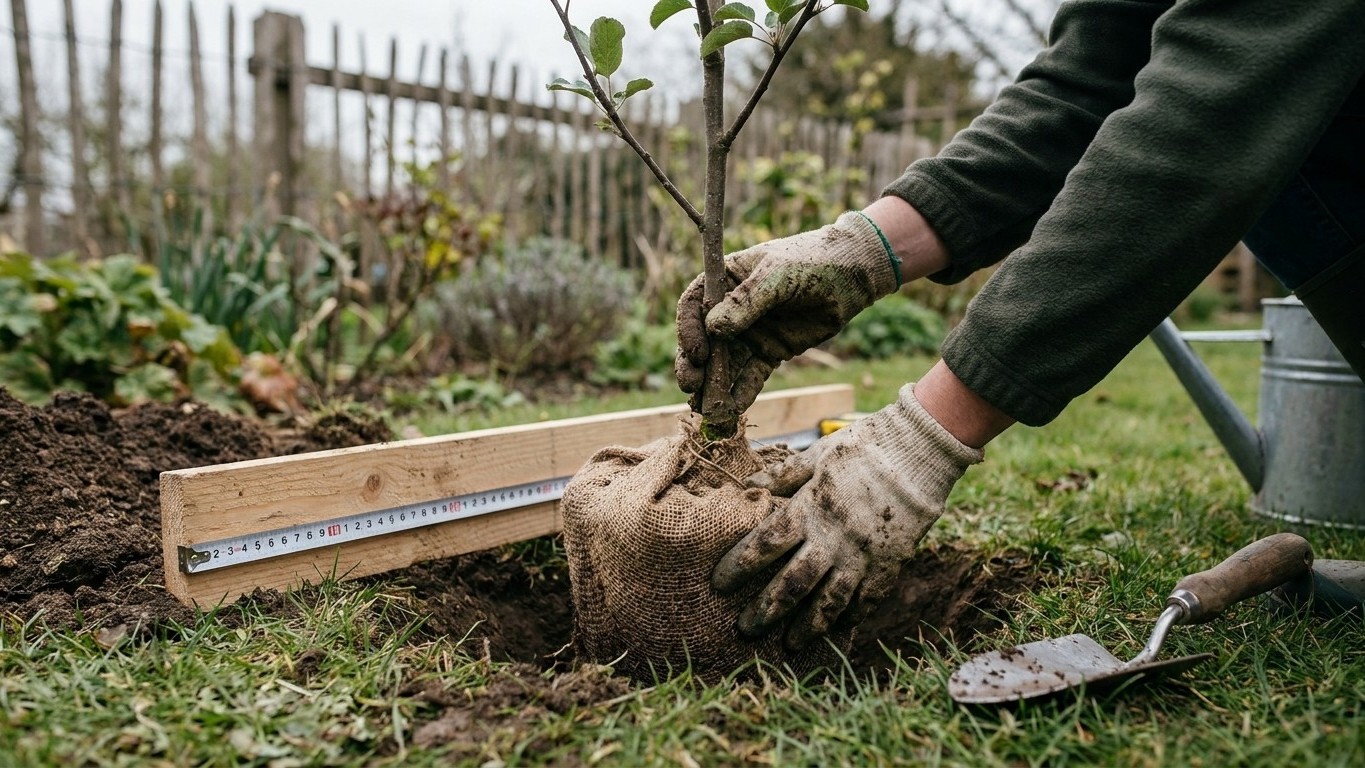

Plant it exactly as deep as it sat in the pot, no deeper. That one graft knob near the base of the trunk needs to end up sitting clearly above the finished soil line once you’ve backfilled and it’s settled, because that’s the joint controlling how big this tree will ever get. Before you dig anything, go check the tag on your tree for the rootstock name, and size your hole, and the whole spot you’re putting it in, around that.
Why it matters
The graft union is doing the work
Every named apple variety, from Fuji to Golden Delicious, is a clone grafted onto a rootstock chosen for a specific job: dwarfing the tree, anchoring it, or resisting a particular soil problem. Bury the graft union below grade and the scion variety can throw its own roots directly into the soil, bypassing the rootstock entirely. Once that happens the size control you paid for is gone, and a tree sold as a compact M.26 (12-15 feet at maturity, per USU Extension) can eventually grow like the seedling stock it was never meant to be.
Planting depth is a dormancy-stage decision
A bare-root or container tree goes into the ground at the dormant stage, before any bud has swollen, because that is the only window where roots can settle into new soil without competing against leaf growth for water. Get the depth right at that single moment and you are done. Get it wrong, and you are either digging the tree back up in year two to fix a buried union, or watching a supposedly dwarf tree outgrow the spot you gave it. Watering habits in that first season, covered in Watering a Young Apple Tree: How Much and How Often, only work as intended if the root system was set at the correct depth to begin with.
When to do it
Dormancy, not a date on the calendar
Plant while the tree is fully dormant: no leaves out, no bud swell, no green tip showing at the growing points. That stage is what to look for, not a month, because dormancy breaks at a different point on the calendar depending on where you garden and how the winter ran. What moves the window is soil condition, not air temperature alone: the ground has to be workable, not frozen solid and not waterlogged from snowmelt or spring rain.
What pushes the window later
A late cold snap after you have already planted is rarely the problem, since a dormant, unplanted tree tolerates far more cold than one already pushing new growth. The real risk runs the other way: planting into soil that is still too wet to dig without smearing the sides of the hole into a glazed, root-choking wall. If your soil stays sodden into what would normally be your planting stretch, wait. A few extra days of dormancy costs nothing. A tree planted into mud can sit stunted all season.
Bloom group is a planning decision made now
If you are planting a second tree for pollination, decide the pairing before you dig, not after the first one blooms. Clemson Cooperative Extension (HGIC 1350) groups varieties by how closely their bloom times overlap: group A includes Anna and Dorsett Golden; group B includes Fuji, Gala, Ginger Gold, Granny Smith, Jerseymac, Mollie’s Delicious, Mutsu, Red Delicious and Yates; group C includes Arkansas Black, Golden Delicious, Jonagold, Ozark Gold, Priscilla, Rome Beauty and Stayman. The order is fixed everywhere, but the actual calendar dates for each group shift with your climate, so use the group letters to pick companions, not a date off a chart.
How to do it

Size the hole to the rootstock, not the pot
Dig the hole wide enough to spread the roots out fully without bending them back on themselves, and no deeper than the root system needs. The depth is fixed by the graft union, which must sit above the soil line once backfilled and settled. This is the step most often rushed: it takes thirty seconds to find the union and hold the tree at the right height before you start shoveling soil back in, and it is nearly impossible to fix later without digging the whole tree back out.
Match spacing to the mature footprint
Rootstock also decides how far apart to plant multiple trees, since two dwarf trees can share a spot that would crowd one full-size tree within a decade. USU Extension’s mature height figures by rootstock:
| Rootstock | Mature height (USU Extension) |
|---|---|
| M.9 | 8-12 feet |
| M.26 | 12-15 feet |
| G.11 | 12-15 feet |
| G.30 | 18-20 feet |
| M.7 | 18-20 feet |
| M.106 | 25-30 feet |
| MM.111 | 30-35 feet |
| Seedling | 35-40 feet |
Use the top of that range, not the low end, when deciding how far to set a tree from a fence line, a walkway or another tree, since height and eventual canopy spread run together.
Steps for the planting itself
- Locate the graft union on the trunk before digging anything.
- Dig a hole as deep as the root mass and roughly twice as wide.
- Set the tree so the union sits clearly above final soil level, allowing for a little settling.
- Spread roots outward, backfill with the native soil you dug out, and firm gently by hand rather than stamping.
- Water in immediately to settle soil around the roots and remove air pockets.
- Stake only if the rootstock is a dwarfing type with a shallow root system, since these often need support in windy sites.
Choose the pollinizer at the same time
If you are planting for fruit rather than for a single ornamental tree, make sure at least two varieties from overlapping bloom groups (per Clemson HGIC 1350) end up in the ground. Skip the varieties with sterile pollen, Jonagold, Mutsu, Stayman and Winesap according to Clemson HGIC 1350, UGA Circular 740 and USU Extension, when picking a pair for each other. Sterility runs one way: a garden holding only two of these four varieties can accept pollen but produce none, and neither tree sets fruit. Pair a sterile-pollen variety with a fertile one from the same or an adjacent bloom group instead. The general planning steps for a home planting are covered in Growing Apples.
What goes wrong
Planted too deep
The most common mistake is burying the graft union, either at planting or gradually through years of adding mulch and topsoil around the trunk. The symptom shows up slowly: a tree that was sold as dwarf or semi-dwarf starts putting on far more growth than its rootstock figure suggests it should, and suckers appear from below the union, sometimes years after planting. By the time the tree’s actual size makes the mistake obvious, the roots below the union have already taken over.
Planted too shallow, or staked wrong
The opposite error, leaving too much of the root flare exposed above grade, dries the top roots out and can rock the tree in wind before it anchors. This shows up fast, within the first season, as a tree that leans, or as bark damage where an exposed root flare gets scraped by mowers and trimmers. A stake set too tight against the trunk causes its own damage: girdled bark exactly where the tie was wrapped.
No pollinizer, or the wrong one
A tree that blooms heavily but sets little or no fruit is often a pollination problem, not a disease or a watering issue. This shows up at bloom and again at harvest: flowers open and drop without swelling into fruit. Pairing two varieties from bloom groups that do not overlap, per Clemson HGIC 1350, or pairing two sterile-pollen varieties together, is the usual cause. A late frost at bloom can cause the identical symptom for an entirely different reason, which is why it is worth ruling out cold damage using Protecting Apple Blossom From a Late Frost before assuming the problem is pollination.
Ignoring the rootstock’s real footprint
Planting a tree that will reach 30-35 feet on MM.111 rootstock, per USU Extension, in a spot sized for an 8-12 foot M.9 tree does not show up as a problem for several years. By the time it does, the fix is removal, not pruning. Read the rootstock label before you dig, not after the tree has outgrown the space.
What changes where you are
Bloom timing moves, the order does not
The bloom groups from Clemson HGIC 1350 give a relative order of flowering, group A before B before C, and that order holds in every climate. The actual dates each group blooms shift considerably depending on your local spring, so a group B variety in one region may open its flowers well ahead of a group C variety planted a few states over. What stays useful anywhere is the grouping itself, used to pick a companion tree that overlaps with the one you already have.
Frost risk and chill hours are local
How much frost risk your blossoms face at bloom, and how many winter chill hours your region typically delivers, both vary by county and by elevation, and neither figure belongs in a general planting guide. Your state or county extension service publishes both for your area, along with the planting window that follows from your last average frost date. Check that office before finalizing when in the dormant season to plant, and see Growing Apples for how these regional factors fit into the rest of the tree’s first year.
Common questions
Can I plant an apple tree in fall instead of spring?
Fall planting works in many climates because the tree is still dormant and the soil is often easier to dig than in early spring. Check with your local extension service on how much time your ground stays workable before hard freeze, since a tree needs some weeks of root growth before winter sets in fully.
What if I can’t find the graft union on my tree?
Look for a slight kink, bulge, or change in bark texture a few inches above the root system, usually within the bottom foot of the trunk. If you genuinely cannot find one, the tree may be own-rooted rather than grafted, which is common for a few seedling and heirloom sources, and the depth rule about keeping the union exposed simply does not apply.
Do I need two different apple trees to get fruit?
Most apple varieties need pollen from a different variety to set fruit reliably, so a single tree alone often blooms without producing much. Check whether a neighbor’s yard already has a compatible variety in bloom-group range before assuming you must plant a second tree yourself.
How wide should the planting hole be compared to the root ball?
Dig it roughly twice the width of the spread roots so you can fan them out without bending them back on themselves, and no deeper than the root mass itself. A hole that is too deep encourages the tree to settle lower than intended after the first watering, which is exactly the depth mistake that causes trouble later.