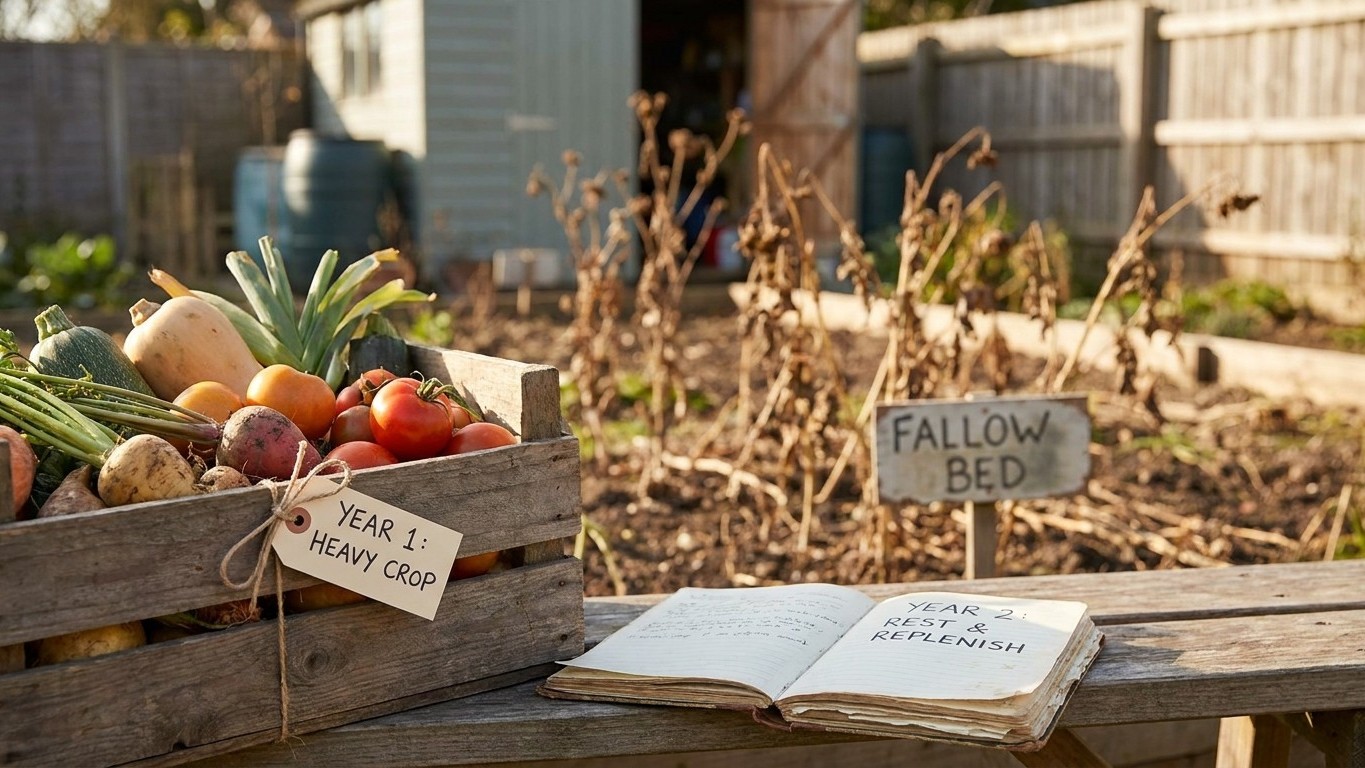

A tree that buries you in apples one year and gives almost nothing the next isn’t sick. It is alternate bearing, also called biennial bearing, a pattern where a heavy crop uses up the tree’s ability to form flower buds for the following spring. The fix starts in the heavy year: thin the young fruit hard, right after petal fall, so the tree has energy left to build next year’s blossoms instead of spending it all ripening this year’s.
What you are seeing

One spring the tree is covered in blossom, and by late summer the branches are bending under more fruit than you can use. The following spring there is almost no bloom at all, or a scattering of flowers that sets only a handful of fruit. Then the year after that, the tree loads up again. This swing between a heavy “on” year and a bare “off” year is called alternate bearing, and once a tree settles into it, the pattern tends to repeat on its own unless something interrupts it.
The fruit itself often looks different between the two years too. In the on year, apples tend to run smaller than the same variety usually produces, simply because the tree is carrying far more of them than it can size properly. If undersized fruit is what brought you here, it’s worth checking against Apples That Stay Small, since overcropping is one of the more common reasons behind it. In the off year, the few apples that do form are often oversized, because a tree carrying a light load pours everything into a small number of fruit.
None of this means the tree is diseased, nutrient-starved, or dying. A tree can alternate bear for years and still be perfectly healthy, and some varieties settle into the habit almost as soon as they carry their first heavy crop. It is a management pattern, not a symptom of decline, and it responds to changes in how the crop is handled rather than to a spray or a soil amendment.
What it is not
A single failed-bloom year makes people suspect the tree wasn’t pollinated. If that were the real problem, though, it would show up every year, not every other year. Poor pollination is usually a compatibility issue, it happens when a self-sterile variety has no suitable partner blooming at the same time, or when a variety with sterile pollen, such as Jonagold, Mutsu, Stayman or Winesap (Clemson HGIC 1350, UGA Circular 740, and USU Extension), is expected to pollinate another tree rather than only receive pollen. Clemson HGIC 1350 sorts varieties into bloom groups, group A (Anna, Dorsett Golden), group B (Fuji, Gala, Ginger Gold, Granny Smith, Jerseymac, Mollie’s Delicious, Mutsu, Red Delicious, Yates), and group C (Arkansas Black, Golden Delicious, Jonagold, Ozark Gold, Priscilla, Rome Beauty, Stayman), and a mismatch between groups can thin a crop out in a way that resembles alternate bearing without ever swinging from heavy to bare and back.
A late freeze that kills the blossoms in a single spring can also mimic the bare half of the cycle, but it’s a one-time weather event tied to that season, not a repeating pattern, and it won’t necessarily be followed by a heavy year unless the timing happens to line up that way.
Nutrient deficiency and disease can reduce a crop too, but they usually show other signs at the same time, thin foliage, discolored leaves, or fruit that looks abnormal rather than just scarce, and they don’t typically alternate on a clean yearly schedule the way this does.
What actually causes it
Apple trees form the flower buds for next year’s bloom during the current summer, while this year’s fruit is still hanging on the branch and building seed. The seeds inside a heavy crop produce hormones that suppress flower bud formation nearby, so a branch that goes into fall carrying a full load of seeded fruit often comes out of winter with few flower buds to show for it. That single mechanism accounts for most cases of alternate bearing, and it’s why the fix has to happen in summer, not the following spring.
Three things that set the pattern in motion
- Not thinning a heavy crop. Left alone, a tree that sets fruit on nearly every spur carries far more seeded apples than it can support without cutting into next year’s flower buds.
- A frost, hail, or late freeze that wipes out one year’s bloom. With no crop to compete for the tree’s resources that summer, it swings hard the other way and sets an unusually heavy bloom the following spring, starting the cycle from the opposite direction.
- Variety-level tendency. Some cultivars settle into the on-off rhythm more readily than others once it starts, which is one more reason to thin every year rather than only in years the crop looks obviously heavy.
A heavy on-year crop carries its own separate risks that can look like part of the same problem but need their own fix. Fruit that develops sunken brown flecks under the skin toward the end of a heavy season is usually Bitter Pit: Sunken Brown Specks Under the Skin, a calcium-related disorder that shows up more often on overcropped trees because the available calcium gets spread across too many fruit. Neither that page nor the small-fruit page will fix the alternating pattern itself, but they’re worth ruling in or out while you’re already looking closely at the crop.
What to do this season
What you can actually change right now depends on which half of the cycle the tree is in.
If this is the heavy year
Thin the fruit as early as you can reach it, ideally not long after petal fall while the apples are still small. Removing the excess now, rather than waiting until they’re full-sized, is what actually reduces the hormone signal coming from the seeds and gives the tree a chance to lay down flower buds for next spring instead of spending the whole season just ripening what’s already set. Thinning after midsummer does far less good, because by then next year’s flower buds have largely already failed to form.
If this is the bare year
There is genuinely little to do here. A tree with few or no flowers cannot be coaxed into blooming through feeding, watering, or spraying, and trying to force it usually just wastes fertilizer and worries you for nothing. The useful work for a bare year happens during the next dormant season, when you prune to open up the canopy and set the tree up to carry a more moderate crop the following summer instead of another extreme swing.
Either way, resist the urge to judge the tree’s health from a single season. One heavy year followed by one bare year doesn’t confirm alternate bearing on its own. If the pattern repeats a third time, treat it as established and start the annual thinning routine below, not just in years the crop looks obviously excessive.
Stopping it happening again
Once you’ve got the basics of Growing Apples settled, the single change that breaks alternate bearing for good is thinning every single year, not just in years the crop looks heavy. Do it at the same stage each time, shortly after petal fall, while the fruitlets are still small enough to snap off by hand. A tree thinned lightly every year never builds up the huge seed load that suppresses next year’s flower buds in the first place, so the swing between heavy and bare years gradually flattens out over two or three seasons.
Tree size decides how well you can keep up
How practical that annual thinning is depends heavily on how big the tree gets, and that’s set by the rootstock, not the variety grafted onto it. USU Extension lists these mature heights for common rootstocks:
| Rootstock | Mature height (USU Extension) | Whole tree reachable for hand thinning |
|---|---|---|
| M.9 | 8-12 ft | Yes, from ground level |
| M.26 / G.11 | 12-15 ft | Yes, with a short ladder |
| G.30 / M.7 | 18-20 ft | Lower canopy only without a tall ladder |
| M.106 | 25-30 ft | Top third generally out of reach |
| MM.111 | 30-35 ft | Top half generally out of reach |
| Seedling | 35-40 ft | Most of the canopy out of reach |
A tree on M.9 or M.26 can be thinned completely, top to bottom, every single year without much trouble. A tree on MM.111 or seedling rootstock puts a large share of its crop out of easy reach, and fruit left unthinned in the top of the canopy is enough on its own to keep the cycle going even if the lower limbs get thinned properly. If you’re planting a new tree specifically to avoid this problem, a dwarfing or semi-dwarfing rootstock is the practical choice for a home garden, because it keeps every branch within reach of pruning shears at the right stage each year.
Common questions
Will thinning this year definitely fix next year’s bloom?
Not on its own, and not always in one season. A tree that has already alternated for several years usually needs two or three consecutive years of early, consistent thinning before the swing between heavy and bare years flattens out.
My tree only alternates on some branches, not the whole tree. Is that normal?
Yes. Alternate bearing can run branch by branch before it synchronizes across the whole tree, especially on older or larger trees where one limb carried a heavy load that a neighboring limb didn’t.
Can I spray something to force bloom in the bare year?
Commercial growers do use plant growth regulators to manage bud formation, but registration, rates and legality vary by state and product. Check with your local extension service before using anything, rather than guessing at a rate.
Does putting a heavy-bearing variety on a dwarfing rootstock stop the alternating pattern?
No. Rootstock controls tree size, not the hormonal mechanism behind alternate bearing. A dwarfing rootstock just makes it far easier to reach and thin the whole tree every year, which is what actually breaks the cycle.