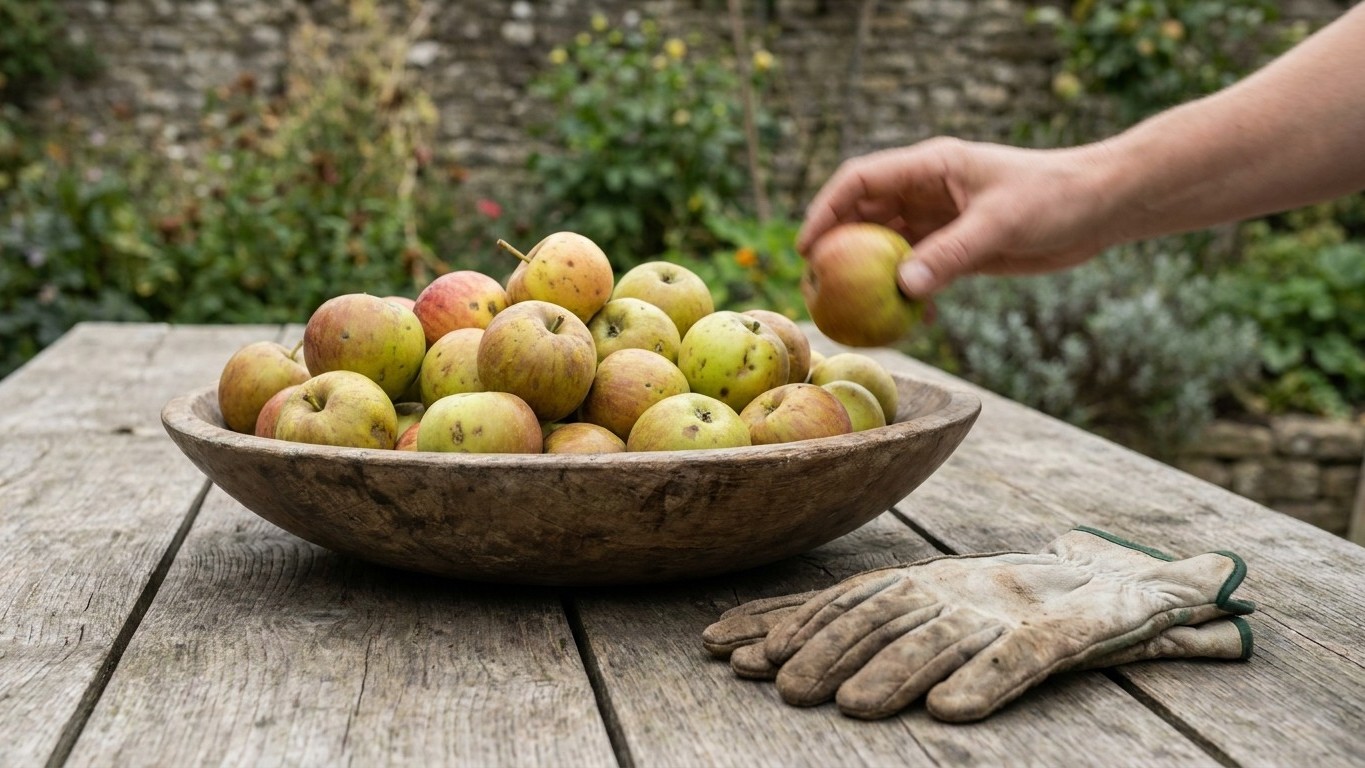

Apples that turn full color, taste ripe, and come off the tree easily, but stay noticeably smaller than they should, are almost never a sign of disease or a dying tree. In most gardens the cause is a crop-load problem: the tree set more fruit than it can size up with the water and sugar it has available. Walk the tree now and count fruit per cluster. If you see two, three, or four apples touching in a cluster, that crowding is the first thing to fix, and this season, if the fruit is still small enough to thin.
What you are seeing

The apples look right in every way except size. They color up on schedule for the variety, the background skin turns from green to yellow or the red blush deepens, the flesh tastes sweet rather than starchy, and the seeds inside are brown rather than white. The only thing off is the diameter: the fruit is running smaller across the whole tree, or across one heavily loaded limb, than the size you remember from a lighter year or from the variety’s description on the nursery tag.
This is usually most obvious in a year when the tree set an unusually heavy crop. Look up into the canopy and you’ll likely see clusters of two, three, or four apples hanging where you’d expect one. Each fruit in that cluster is pulling from the same spur, the same branch, and the same root system as the others, so none of them gets a full share.
Small fruit on an otherwise healthy tree is a crop-load signal, not a disease symptom. The leaves are green, the bark looks normal, and there’s no wilting or dieback. The tree is simply carrying more apples than it can size up properly this year.
It also does not mean the rootstock or the variety is wrong for your garden. A tree on a dwarfing rootstock like M.9 or M.26 is not destined to grow smaller apples than one on a vigorous rootstock like MM.111 or a seedling rootstock. Rootstock controls the size of the tree, not the size of the fruit, according to USU Extension’s rootstock guidance for home gardens. The two are separate questions entirely.
What it is not
Rule out a few look-alikes before deciding this is a crop-load issue.
It is not the corking or dimpling caused by disease. Apple scab and cedar-apple rust can leave fruit stunted and lopsided, with dark scabby patches or corky pits in the skin. If the small apples also show visible lesions, russeting, or a cracked, corky surface, you’re looking at a disease problem that needs its own diagnosis, not a thinning fix.
It is not the same thing as fruit dropping off the tree early. Apples that fall before they ripen, especially earlier in summer, are a separate and often normal process called June drop, the tree’s own way of shedding excess fruit. If your tree is dropping leaves as well as fruit in the middle of summer, that’s a different stress worth investigating on its own. See Leaves Falling in Summer for that symptom.
It is not a sign the tree is too young to ever produce full-size fruit. A newly bearing tree on any rootstock can throw an oversized first crop that it can’t size up, simply because it has little leaf area relative to how many flowers it set.
And it is not necessarily a watering problem, at least not the whole story. Drought stress during fruit swell shrinks apples too, but it does so evenly across the tree regardless of crop load, and it usually comes with some leaf wilting or scorch as well.
What actually causes it
Several different problems produce the same result: apples that are otherwise normal but undersized. Telling them apart matters because the fix is different for each.
Overcropping
This is the most common cause by far. A tree that sets a heavy bloom and holds most of it will ripen a larger number of smaller apples instead of a smaller number of full-size ones. You’ll see it as multiple fruit per cluster across the whole tree, rather than one or two odd branches.
Incomplete pollination
An apple flower needs pollen from a different variety blooming at roughly the same time. Clemson Cooperative Extension’s HGIC 1350 groups common varieties by bloom timing: group A includes Anna and Dorsett Golden; group B includes Fuji, Gala, Ginger Gold, Granny Smith, Jerseymac, Mollie’s Delicious, Mutsu, Red Delicious, and Yates; group C includes Arkansas Black, Golden Delicious, Jonagold, Ozark Gold, Priscilla, Rome Beauty, and Stayman. Two trees from the same group, or adjacent groups, overlap enough in bloom to pollinate each other. A tree that gets only partial pollination often sets fruit that’s smaller, lopsided, or low in seed count, since fewer fertilized seeds mean less of the growth signal that drives fruit size.
Watch for one more trap here: Jonagold, Mutsu, Stayman, and Winesap all carry sterile pollen, according to Clemson HGIC 1350, UGA Circular 740, and USU Extension. Each of these can be pollinated by another variety, but none of them can pollinate anything else. A garden holding only two of these four will bloom well and still set a light, small crop, because there’s no viable pollen source between them.
Biennial bearing
Some varieties settle into a pattern of one huge crop of small apples followed by a year of almost nothing. If this year’s undersized crop followed last year’s bare or light one, the tree may be running this two-year cycle rather than a one-off overcropping problem. See A Heavy Crop, Then Nothing: Breaking the Two-Year Cycle for how that pattern develops and how to break it.
Crowding and shade
Mature tree size depends on rootstock, and rootstocks vary enormously. USU Extension’s guidance for home gardens gives these mature heights:
| Rootstock | Mature height (USU Extension) |
|---|---|
| M.9 | 8-12 feet |
| M.26 | 12-15 feet |
| G.11 | 12-15 feet |
| G.30 | 18-20 feet |
| M.7 | 18-20 feet |
| M.106 | 25-30 feet |
| MM.111 | 30-35 feet |
| Seedling | 35-40 feet |
Trees planted without allowing for that eventual spread end up shading each other’s lower and inner branches within a few years, and shaded wood sets smaller fruit than wood in full sun. If you’re still deciding on rootstocks and spacing, Growing Apples covers that groundwork.
What to do this season
Some of this can still be fixed on the tree in front of you. Some cannot, and it’s worth being honest about which is which before spending time on it.
Thinning still helps if the fruit hasn’t finished sizing up. Go through each cluster and remove all but the best fruit, usually the largest and least blemished, so the tree’s water and sugar go into fewer apples. This works best done at or soon after petal fall, while the fruit is still small. Thinning apples that are already most of the way to full size will still help whatever’s left on the tree, but it won’t undo the smaller start those apples already had.
Watering deeply during dry spells for the rest of the season helps the remaining fruit finish sizing, since fruit swell draws heavily on stored water and sugar. Check with your local extension service for irrigation guidance suited to your soil and season, since watering needs shift in ways this page can’t predict for your garden.
What you cannot fix this season is pollination. If this year’s crop was small and lopsided from a pollination gap, that shortfall was set back at bloom time, months before the apples showed the problem. The earliest you can add a compatible pollenizer variety is next dormant season, when you plant it.
You also cannot fix a biennial bearing cycle mid-season. If this is an “on” year following a bare one, thinning now will lighten this year’s load somewhat, but breaking the cycle takes a full season of deliberate thinning at the right stage next year, not a single correction now.
Stopping it happening again
Fix the crop-load problem at the stage where it actually starts, bloom and the few weeks after petal fall, not at harvest when the apples are already small.
At bloom, check that you have a genuine pollen partner. Match varieties from the same or a neighboring bloom group using Clemson HGIC 1350’s grouping, and if either variety is Jonagold, Mutsu, Stayman, or Winesap, make sure at least one other variety in the garden isn’t also one of those four, since none of them can pollinate anything else.
At petal fall, before the fruit is bigger than the tip of your thumb, thin every cluster down to one apple, spacing the survivors out along the branch rather than leaving them bunched. Doing this every year, not just in years the crop looks obviously heavy, is what keeps fruit size consistent.
At planting, or when adding a new tree, plan spacing around the rootstock’s real mature size rather than how small the tree looks in its first year or two. A dwarfing rootstock like M.9 needs far less room than MM.111 or a seedling tree, and getting that spacing wrong is what causes the shading and crowding that shrinks fruit years down the road.
If the pattern you’re seeing is a heavy, small-fruited year followed by a bare one, treat it as a biennial bearing cycle rather than a one-time overcropping problem, and work through the multi-year thinning routine that actually resets it.
Common questions
Will small apples get bigger if I just leave them on the tree longer?
No. Fruit size is mostly determined earlier in the season, by crop load and pollination, not by how long the apple hangs on the tree afterward. Leaving undersized fruit longer adds ripeness and sugar, not diameter.
Does a dwarf rootstock make the apples themselves smaller?
No. Rootstock sets the size of the tree, not the fruit. USU Extension’s figures show M.9 topping out at 8-12 feet while a seedling rootstock reaches 35-40 feet, but a well-thinned, well-pollinated tree on either one produces full-size fruit for its variety.
Can I fix small apples by watering and fertilizing more?
It helps at the margins but won’t solve the underlying problem. Extra water and nutrients let the remaining fruit finish sizing well, but they can’t compensate for a tree that’s carrying too many apples per cluster or one that never got properly pollinated.
How do I tell if it’s a pollination problem instead of too many apples?
Cut a few of the small apples open. Fruit from a pollination gap tends to be lopsided with few or no developed seeds, while fruit from simple overcropping is usually round and even, just uniformly undersized, with a normal seed count for the variety.