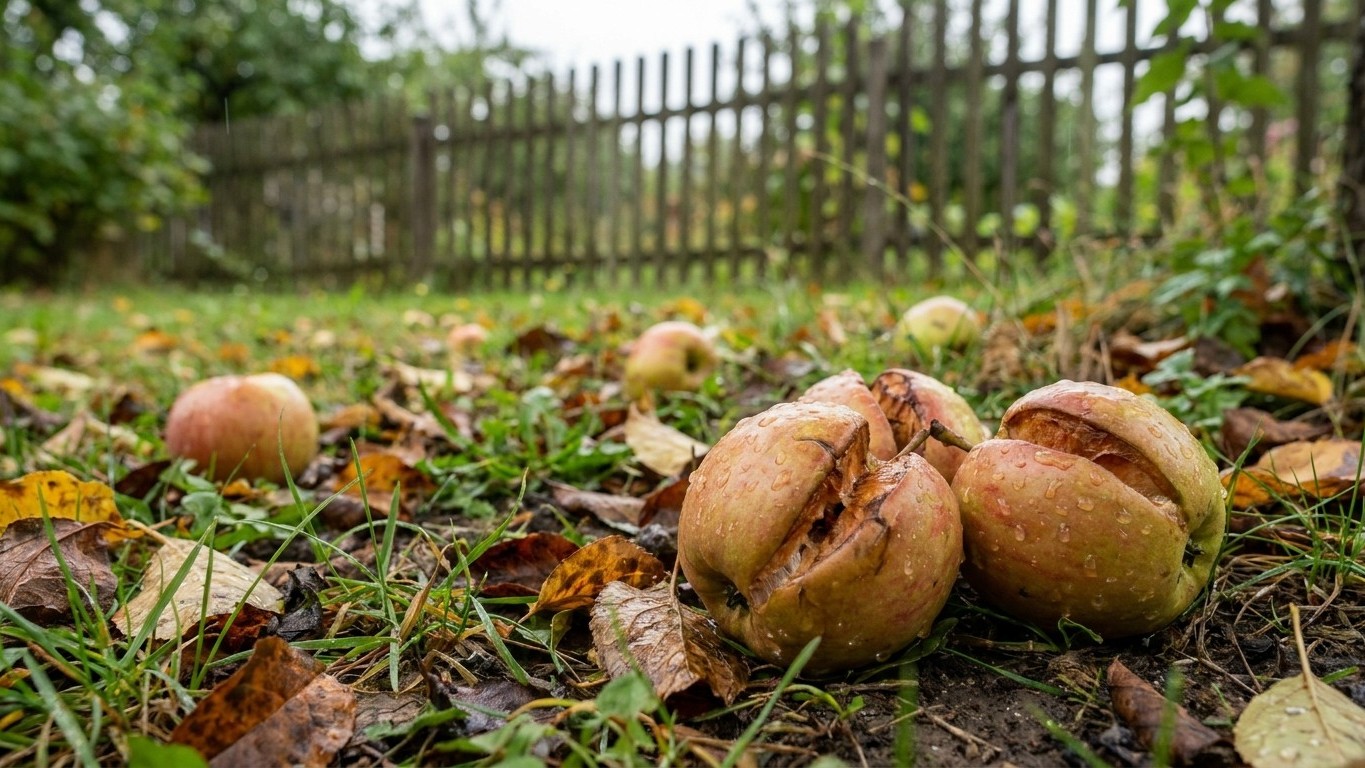

Apples split after rain because the fruit pulls in water faster than the skin can stretch to hold it, usually right after a dry stretch breaks. A single crack running from the stem down one shoulder is a growth crack, not disease and not rot. It shows up on some fruit and not others on the same tree, often the biggest or ripest ones. Check your watering log for the past two weeks before you do anything else: an uneven soil-moisture swing is the most common trigger.
What you are seeing

The crack usually starts at the stem end and runs down one side of the fruit, sometimes reaching halfway to the base. On some apples it stays shallow and closes over with rough, corky tissue as the fruit keeps growing. On others it opens wide enough to expose the flesh underneath, and that flesh will brown and eventually rot if the fruit sits on the tree in wet weather.
This is called a growth crack, and it happens because the skin has stopped stretching before the flesh underneath is done expanding. Apple skin loses elasticity as the fruit matures, while the flesh inside keeps taking up water right through to harvest. When a heavy rain follows several dry days, the roots take up a rush of water, the fruit swells fast, and the skin gives way at its weakest point, usually near the stem where the surface is already under the most tension.
Not every apple on the tree splits the same way. Fruit that’s furthest along in ripening, or that sits in full sun and has grown fastest, is usually the first to go. You’ll often see it worse on one side of the tree than the other, simply because that side caught more sun through the summer.
A cracked apple is not automatically a wasted apple. If the split is fresh, dry, and the flesh underneath is still white and firm, the fruit is fine to eat once you cut around the damaged area. It’s the cracks that sit open for days in wet weather that turn into a problem, because they let in wasps, fungal spores, and bacteria that a smooth skin would have kept out.
None of this means the tree is sick. It’s a physical response to a moisture swing, not a symptom working its way through the plant. A tree that splits fruit after a downpour this year can go through a whole season without a single split apple if the weather stays even.
What it is not
Cracking gets confused with several other things that mark up the fruit’s surface, and telling them apart matters because the fixes are different.
- Sunscald shows as a flat, leathery, tan or brown patch on the side facing the afternoon sun. It’s a burn, not a tear in the skin, and it doesn’t have the raised, torn edges of a growth crack.
- Bitter pit shows up as small sunken dimples scattered over the surface, often not visible until you cut the apple open and find brown, dry spots in the flesh below. There’s no split skin involved at all.
- Insect stings, from stink bugs or plum curculio, leave small round punctures or dimpled scars, not a long radial tear.
- Hail damage leaves scattered dents and gouges across many fruit at once, on the side that faced the storm, rather than one clean crack running from the stem.
- Fire blight and other bacterial or fungal diseases show up first as cankers, oozing, or blackened shoot tips on the wood, not as splitting confined to the fruit.
It’s also worth separating cracking from the lopsided, dimpled growth that comes from poor pollination, covered in Lopsided Apples: What Poor Pollination Looks Like. That problem shows up as an uneven, asymmetric shape from the start, with the seed cavity underdeveloped on one side. A growth crack, by contrast, starts on fruit that was shaped normally and only splits once it’s swelling toward full size.
What actually causes it
Splitting has one final cause, an uneven skin-to-flesh growth rate, but several things push a tree toward that state. Working out which one is driving it on your tree tells you whether this season’s cracks are a one-off weather event or something that will keep happening.
Moisture swings
The most common trigger is a dry spell of a week or more followed by a heavy rain or a big irrigation set. The roots have been drawing on a shrinking reserve of soil water, then suddenly take up far more than the fruit has been growing to handle, and the skin can’t keep pace. This is the cause behind most cracking that shows up right after rain, and it’s the one you can act on within the same season.
Calcium and boron shortfalls
Both minerals help build the cell walls that give skin its stretch. A tree short on either, often because of uneven watering rather than a true shortage in the soil, produces fruit with skin that’s more brittle than it should be at a given size. A soil or tissue test through your local extension office is the only reliable way to confirm this, since the fix is not something to guess at.
Fruit load and fruit size
Bigger apples split more than small ones, because a larger fruit is doing more water uptake per apple. A tree carrying a light crop of a few large apples is more prone to cracking than a heavily thinned tree carrying more, smaller fruit spread over the same leaf area.
Variety tendency
Some cultivars are simply thinner-skinned or faster-growing than others, and that’s a catalogue trait worth checking before you plant, though it isn’t something you can change on a tree you already have. If cracking is severe and happens most years regardless of the weather, that points more toward the variety and less toward a one-off dry-then-wet stretch.
What cracking isn’t connected to is pollination. A tree that sets little or no fruit at all has a different problem, worked through in Blossom But No Apples: Working Through the Causes, and fixing that won’t change whether the fruit you do get ends up split.
What to do this season
Once a fruit has split, there’s no fixing that particular apple. The skin won’t reseal, and the crack is now an open door for wasps, fungal spores, and rot organisms every time it rains again. Walk the tree every few days and pull off any fruit with an open, wet-looking crack rather than leaving it to rot in place, since it can spread rot organisms to fruit touching it nearby.
Fruit with a shallow, dry crack that’s already started to callus over into rough, corky tissue is usually still fine to eat. Use it soon rather than storing it, since a compromised skin is also a weaker barrier against the moisture loss that speeds up ripening.
What you can still influence
You can’t undo the moisture swing that already caused this round of splitting, but you can prevent the next one this same season. If the ground has dried out again since the rain that caused the split, get back onto a steady, even watering schedule rather than waiting for the next big rain to do the job. A layer of mulch over the root zone slows both the drying out and the sudden re-wetting that follow a storm.
If you haven’t thinned the crop and it’s carrying an unusually heavy load of fruit for its size, removing some of the smallest, most crowded apples now reduces competition for water among the fruit that remain, though thinning has far more effect when it’s done earlier in the season, at petal fall, than it does this late.
What you cannot fix this season is a calcium or boron shortfall. Correcting soil chemistry takes a full growing cycle to show up in fruit quality, so a test taken now through your local extension office sets you up for next year rather than for the apples already on the tree.
Stopping it happening again
The single biggest change is keeping soil moisture even rather than letting it swing between drought and flood, and that habit needs to start at green tip, before the tree has any fruit to protect, not after the first crack shows up in late summer. This is one more piece of the watering and care routine laid out in Growing Apples.
Build in a buffer before the season starts
A three- to four-inch layer of mulch over the root zone, kept a few inches back from the trunk, slows evaporation in dry weeks and slows how fast a heavy rain reaches the roots. Drip irrigation on a timer does more for even moisture than hand-watering ever will, because it delivers the same small amount on the same schedule regardless of whether you remembered.
Rootstock plays a part too, since it sets how deep and extensive the tree’s own root system gets. USU Extension’s figures for mature tree height by rootstock reflect this split in vigor: the more vigorous rootstocks generally root deeper and buffer against moisture swings better than the dwarfing types bred mainly for a smaller tree.
| Rootstock | Mature height (USU Extension) | Typical vigor |
|---|---|---|
| M.9 | 8-12 feet | Dwarfing, shallow-rooted |
| M.26 | 12-15 feet | Dwarfing, shallow-rooted |
| G.11 | 12-15 feet | Dwarfing |
| G.30 | 18-20 feet | Semi-vigorous |
| M.7 | 18-20 feet | Semi-vigorous |
| M.106 | 25-30 feet | Vigorous |
| MM.111 | 30-35 feet | Vigorous, deep-rooted |
| Seedling | 35-40 feet | Most vigorous, deep-rooted |
A dwarf tree on M.9 or M.26 needs a more disciplined watering routine precisely because it doesn’t have the deep root reach to smooth out a missed week. If your garden runs on a soaker hose you check when you remember, a dwarf rootstock will show cracked fruit sooner than a full-size tree would under the same neglect.
Thin the crop at petal fall, while the fruit is still small, rather than waiting to see which apples look biggest in late summer. A tree carrying a lighter, evenly spaced crop grows fruit at a steadier rate, and steadier growth is exactly what keeps the skin ahead of the flesh instead of behind it.
Common questions
Can I still eat an apple that’s split open?
Yes, as long as the flesh under the crack is still firm and light-colored, not brown or fermenting. Cut away the split edge and the area right around it, and use the apple soon rather than storing it, since a broken skin lets in moisture and speeds up rot.
Will the crack close up if I leave the apple on the tree?
It can callus over into rough, corky tissue, but it won’t seal shut the way a wound on a branch might. Once the skin has torn, that spot stays a weak point in the fruit’s defenses for the rest of the season.
Does watering more cause this, or watering less?
Neither on its own causes it. It’s the swing between the two, a dry stretch followed by a sudden heavy watering or downpour, that causes the fruit to take up water faster than the skin can stretch. A tree kept evenly moist all season rarely splits fruit even in a wet year.
Why does it seem to hit certain trees every single year?
That usually points to either a rootstock and irrigation setup that can’t hold even moisture, or a variety that’s simply prone to splitting regardless of care. If it happens most years and a neighboring tree of a different variety doesn’t split under the same weather, the variety is the more likely factor.