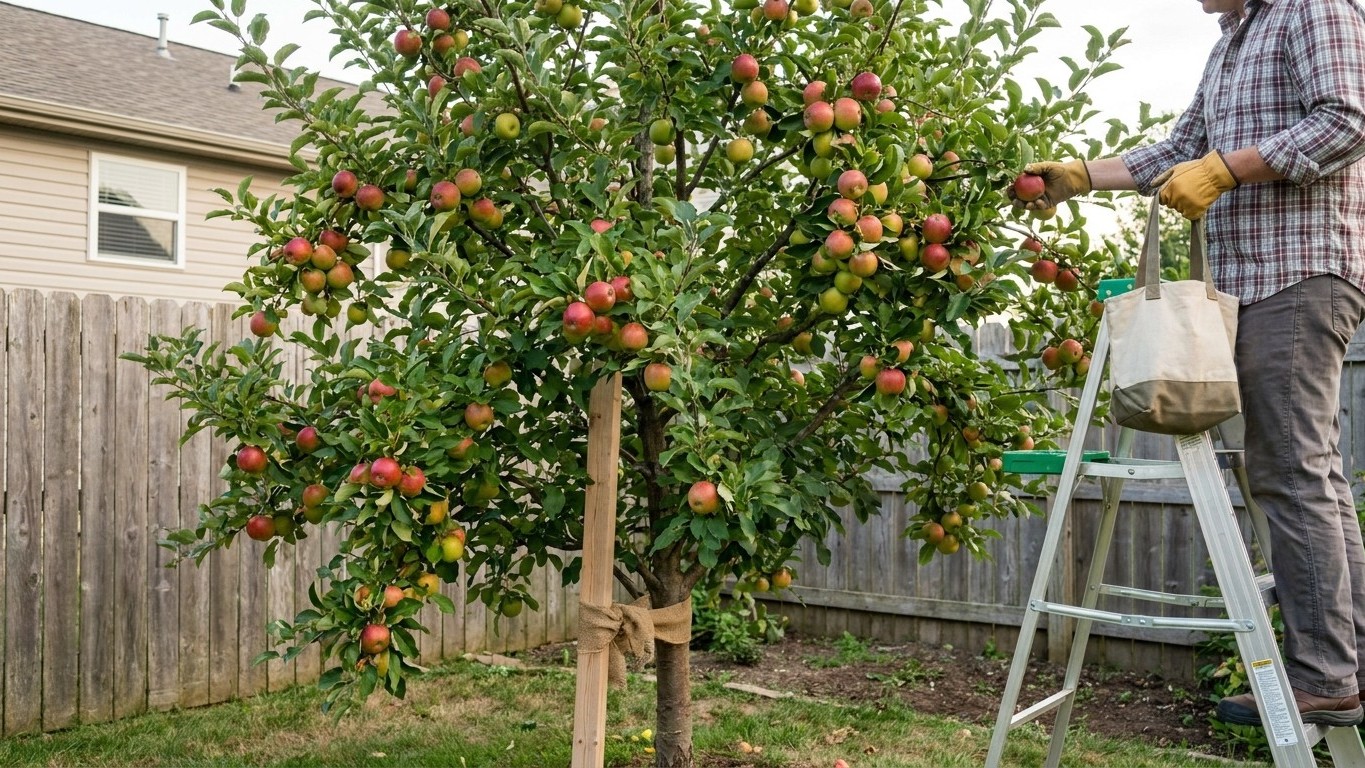

M.26 rootstock produces a mature apple tree of just 12-15 feet, according to Utah State University Extension. That’s a semi-dwarf tree small enough to prune and pick from a short ladder, but with roots shallow enough to need support and irrigation. Here’s what that trade-off means for a home orchard.
What M.26 does to the tree

The number that matters most is 12-15 feet. That’s the mature height Utah State University Extension assigns to M.26, and it’s the figure that determines nearly everything else about how the tree fits into a yard. A tree that tops out around 13 or 14 feet can be pruned, thinned, and harvested from a 6-foot step ladder, no orchard ladder required. Branches on a tree this size span maybe 10-12 feet across at maturity, so a homeowner can fit two or three M.26 trees in the footprint that a single seedling-rooted tree would demand.
What the nursery tag rarely spells out is that M.26 is one of the more widely planted semi-dwarf rootstocks in home orchards precisely because it balances a manageable size with reasonably early cropping, without the extreme fragility of the smallest dwarfing stocks. It’s a workhorse choice for a backyard, not a specialty stock for a trial plot.
That single height figure changes four practical things in the garden:
- The ladder you need (a short stepladder, not a full orchard ladder)
- The spacing between trees (tighter than a standard-size tree, looser than a true dwarf)
- The yield you can expect per tree (moderate, scaled to the tree’s smaller canopy)
- The year the tree starts bearing fruit (earlier than a large, vigorous rootstock)
Each of those follows directly from the size class. A shorter tree means less canopy to fill before the tree has the energy to set fruit, which is part of why semi-dwarf and dwarf rootstocks bear sooner than a seedling tree that spends years just building a trunk and scaffold. It also means less total fruit per tree over a season, simply because there’s less leaf surface making sugar. Growers who want a big single harvest from one tree look toward the larger end of the rootstock range instead. Growers who want several varieties in a small yard, cropping at a pace they can actually keep up with, land on something in M.26’s size class.
Staking, and for how long
Smaller rootstocks generally come with weaker root systems, and M.26 is no exception. Its root architecture is shallower and less extensive than that of a vigorous stock like MM.111 or a seedling rootstock, which means the tree can’t anchor itself against wind and crop load the way a full-size tree does. In practice, that calls for a permanent stake, not a temporary one used just to get the young tree established.
An unstaked M.26 tree carrying a full crop in a summer storm is at real risk of leaning, snapping at the graft union, or simply toppling in loose or waterlogged soil. The weight of a heavy apple crop concentrated in a relatively small root plate is exactly the scenario that exposes the trade-off of a size-controlling rootstock: the tree gives you an easy-to-manage canopy, but it never builds the deep, wide root system that lets a seedling tree stand on its own after a few years. Growers who plant M.26 and skip staking, thinking the tree will “toughen up” the way a nursery whip does, often find that out the hard way during the first heavy-bearing year.
The practical takeaway is simple: budget for a stake that stays in the ground for the life of the tree, not just for its first two or three seasons. That’s a small ongoing cost, but it’s a real one, and it should factor into the decision alongside the tree’s size and cropping habits.
How soon it fruits, how long it lives
Rootstock size and rootstock timing move in opposite directions, and M.26 illustrates the trade-off well.
Years to first crop
Dwarfing and semi-dwarfing rootstocks push a young tree toward fruiting sooner because the tree isn’t spending its early years building a massive trunk and root system before it has the energy reserves to set fruit. A tree on a size-controlling rootstock like M.26 reaches bearing age faster than the same variety grafted onto a vigorous stock such as MM.111 or a seedling rootstock, which can take considerably longer to mature enough wood before it commits energy to fruit.
Total lifespan
The flip side is longevity. Vigorous rootstocks build a larger, deeper root system and a sturdier trunk, and that structural investment tends to translate into a longer productive life for the tree. A dwarfing rootstock’s shallow, more limited root system supports a shorter working lifespan than a big seedling or MM.111 tree, which can keep producing for decades after a comparable dwarf tree has declined.
The two figures move in opposite directions because they’re both downstream of the same root system: a compact, shallow root mass gets fruit going faster but has less capacity to sustain the tree over the long haul, while an expansive, deep root system takes longer to build but keeps paying off for years longer. Neither the exact number of years to first crop nor an exact lifespan figure for M.26 appears in the source data here, so those specifics are best confirmed with a local extension office or nursery, but the direction of the trade-off is well established.
The soil and site it suits
Because M.26 carries a shallow root system, it’s more exposed to stress from poor soil and inconsistent moisture than a vigorous rootstock would be. The source material doesn’t credit M.26 specifically with fire blight resistance, so that’s not a reason to select it. Site conditions, by contrast, matter a great deal:
- Well-drained soil: if the soil stays soggy, the shallow root system is prone to rot and poor anchorage, compounding the staking issue already noted.
- Consistent irrigation during dry spells: without it, a shallow-rooted tree like this one shows drought stress faster than a deep-rooted seedling tree, since it can’t reach subsoil moisture.
- Reasonably fertile ground: in thin, poor soil, a size-controlling rootstock struggles more than a vigorous one, which can send roots further afield to compensate.
- Wind protection or staking: without it, the shallow root plate leaves the tree vulnerable to leaning or toppling, especially once it’s carrying a full crop.
None of this makes M.26 a poor choice, it just means the site needs some attention rather than being left to fend for itself the way a big seedling tree might. A home gardener with decent, well-drained soil and the willingness to water during dry stretches gets the benefits of the compact size without much added risk.
Who should choose it
The decision comes down to how much space a grower has, how tall a ladder they’re willing to climb, and how patient they are about waiting for a first harvest. M.26 sits in a comfortable middle ground: bigger than a true dwarf like M.9 (8-12 feet), but noticeably smaller than M.7 or G.30 (18-20 feet), let alone MM.111 (30-35 feet) or a seedling tree (35-40 feet), all per USU Extension.
Remember that the rootstock, not the variety, sets that mature size. A Gala or a Fuji on M.26 tops out at the same 12-15 feet as a Granny Smith or a Golden Delicious on the same rootstock. The variety pages on this site cover flavor, bloom timing, and pollination needs, but the height and vigor come from the rootstock choice made at the nursery, so pair those variety notes with the rootstock decision, not instead of it.
- Choose it if you want a tree short enough to manage from a stepladder
- Choose it if you want fruit sooner rather than waiting out a vigorous tree’s slow start
- Choose it if your yard can fit several trees rather than one giant one
- Choose it if you’re willing to keep a permanent stake in place
- Avoid it if your soil is heavy, poorly drained, or hard to irrigate consistently
- Avoid it if you want the longest possible productive lifespan from a single tree
- Avoid it if you’d rather skip staking altogether
Common questions
Does M.26 rootstock affect the flavor of the apple?
No. The rootstock controls tree size, root habit, and vigor, not the flavor, color, or texture of the fruit, which comes entirely from the grafted variety.
Can I plant just one apple tree on M.26 rootstock and expect fruit?
Nearly all varieties crop better with a compatible partner nearby, regardless of rootstock. Rootstock choice doesn’t change a variety’s pollination needs, so check whether your variety has sterile pollen (as with Jonagold, Mutsu, Stayman, or Winesap, per Clemson HGIC 1350) and whether a second variety in the same or an adjacent bloom group is planted close by.
How does M.26 compare to M.9 for a small backyard?
M.9 produces a smaller tree, 8-12 feet at maturity, versus 12-15 feet for M.26, according to USU Extension. M.9 suits the tightest spaces but generally needs even more attentive staking and irrigation than M.26 does.
Do I need to stake an M.26 tree forever?
Given its shallow root system, a permanent stake is the safer approach rather than removing support after a few years, particularly in windy sites or once the tree is carrying a full crop.