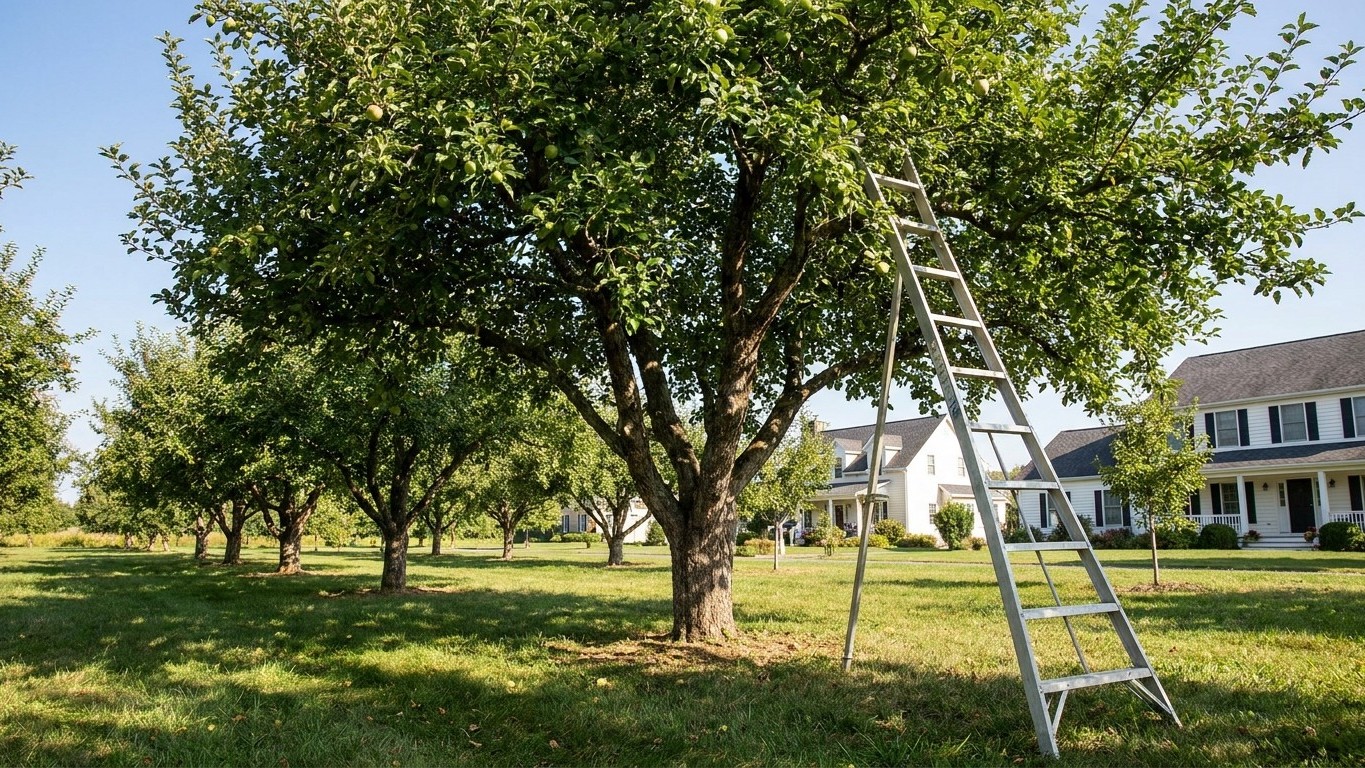

M.106 is a semi-vigorous apple rootstock that produces a mature tree of 25 to 30 feet, according to Utah State University Extension. That puts it well above the compact dwarfing stocks and just below the full-size trees grown from seedling roots, making it a rootstock for growers with real orchard space rather than a small backyard corner.
What M.106 does to the tree

Twenty-five to thirty feet is not a suggestion; it is what Utah State University Extension records as the mature size for a tree grafted onto M.106. That’s taller than a two-story house, with a canopy wide enough to shade a good part of a suburban lot once the tree matures. A tree this size changes four practical things for the person who plants it.
- The ladder needed to prune and pick the upper canopy, well past what a step-stool or a short orchard ladder can reach
- The spacing between trees, since a 25-to-30-foot canopy needs real room on both sides
- The yield per tree, which climbs with the extra wood and root volume compared to a dwarf
- The year it starts cropping, pushed later than a dwarf because the tree spends its first seasons building structure instead of fruit buds
What the nursery tag rarely spells out is where M.106 actually sits on the size scale. It’s larger than G.30 and M.7, both listed at 18 to 20 feet by the same Utah State University Extension guidance, but well short of MM.111 at 30 to 35 feet or a seedling tree at 35 to 40 feet. M.106 is the rootstock a grower reaches for when a dwarf tree feels too small for the site but a full seedling tree feels like more orchard than they want to manage.
Mature height by rootstock
| Rootstock | Mature tree height |
|---|---|
| M.9 | 8-12 feet |
| M.26 | 12-15 feet |
| G.11 | 12-15 feet |
| G.30 | 18-20 feet |
| M.7 | 18-20 feet |
| M.106 | 25-30 feet |
| MM.111 | 30-35 feet |
| Seedling | 35-40 feet |
Source: Utah State University Extension, Apple Production and Variety Recommendations for the Utah Home Garden. Notice this table lists rootstocks, not varieties. A Gala on M.9 and a Gala on M.106 are the same fruit on two very different trees.
Staking, and for how long
Anchorage tends to track with size in apple rootstocks: the smaller and shallower the root system, the more the top-heavy tree leans on a stake to stay upright. M.9 and M.26 trees usually need a permanent stake for their whole lives because their roots simply never build enough of a foundation to carry a loaded canopy in wind. M.106, sitting well up the size scale at 25 to 30 feet, has more root mass and a deeper, more spreading system than those dwarf stocks, so it doesn’t demand a stake for the tree’s entire lifespan the way a true dwarf does.
That doesn’t mean skipping support in the early years. A young M.106 tree, especially one carrying its first heavy crop, can still lean or even snap at the graft union in a strong wind before the trunk has thickened enough to hold itself and the fruit load. The practical approach growers use across the size range is a temporary stake for the first two to four seasons, removed once the trunk has developed real taper and the root system has spread into the surrounding soil. Leave a young tree of this size unstaked through its first loaded summer, and a single storm can do damage that takes years of pruning to correct, or take the tree down at the graft entirely.
How soon it fruits, how long it lives
Every rootstock trades one of these against the other. Push the tree toward earlier fruit, and you generally shorten how long that tree stays productive. Push it toward a long working life, and the grower waits longer to see the first real crop. M.106 sits in the middle of that trade-off rather than at either extreme.
Years to first crop
Dwarfing rootstocks like M.9 and M.26 are prized precisely because they force the tree into fruiting early, often while the tree is still small enough to manage from the ground. A semi-vigorous stock like M.106 asks for more patience. The tree spends more of its early seasons building trunk, scaffold branches, and root system before it commits energy to fruit buds, so the wait for a first meaningful harvest runs longer than it would on a dwarf.
Lifespan
The payoff for that wait is durability. A tree with more root volume and a larger trunk generally holds up in the orchard or backyard for more years of productive life than a dwarf, which tends to decline sooner as its limited root system ages. The two figures move in opposite directions because they’re both functions of the same thing: root mass. A small, dwarfing root system fruits fast because it has little else to do with its energy, and it wears out sooner for the same reason.
The soil and site it suits
Root size again decides most of this. Shallow-rooted dwarfing stocks like M.9 struggle the moment soil turns thin, dry, or compacted, because there simply isn’t enough root reaching for water and nutrients. M.106, with its larger and more developed root system, tolerates a wider range of soil conditions than the true dwarfs, closer in that respect to M.7 and MM.111 than to M.9 or M.26.
- Drought stretches: a dwarf stock shows stress and drops fruit quickly when soil dries out; M.106’s deeper root reach buys the grower more time before irrigation becomes urgent, though it still isn’t drought-proof
- Thin or shallow topsoil: a dwarf tree on poor ground stays stunted and struggles to anchor; M.106 handles moderate soil limitations better, but very shallow or heavily compacted ground still restricts its larger root system
- Waterlogged or poorly drained sites: any apple rootstock, dwarf or vigorous, suffers root rot in standing water, so this condition rules out M.106 just as it would rule out any other option
On fire blight, the fact sheets referenced for this guide (Utah State University Extension, Clemson Cooperative Extension HGIC 1350, and University of Georgia Extension Circular 740) don’t credit M.106 with resistance to the disease. Fire blight risk depends heavily on regional weather and bacterial pressure, so a grower in a fire-blight-prone area should check with their own state’s extension service before committing to any rootstock or variety on that basis, rather than assuming size alone offers protection.
Who should choose it
The decision comes down to how much space a grower has and how much waiting they’re willing to do before the first real harvest. M.106 fits a backyard or small orchard with real room to spare, not a patio or a tight suburban side yard. Pairing rootstock choice with variety choice matters too: the same variety grafted onto M.106 instead of M.9 is a genuinely different tree in size, cropping timeline, and staking needs, so it’s worth checking variety-specific pages for how a particular apple performs on this rootstock before ordering from a nursery.
- Choose it if the site has 25 to 30 feet of room to let a canopy spread
- Choose it if a taller tree with a longer productive life outweighs the appeal of an early first crop
- Choose it if the soil is only moderately good, not ideal, since M.106 tolerates more than a dwarf stock would
- Avoid it if the space is a small backyard or patio better suited to an 8-to-12-foot M.9 tree
- Avoid it if a fast first harvest matters more than long-term size and lifespan
- Avoid it if a permanent, no-stake tree from year one is the goal, since young M.106 trees still need temporary support
Common questions
Does M.106 need a permanent stake?
No. Its larger root system, compared to true dwarfing stocks like M.9 or M.26, generally anchors the mature tree without lifelong support. A temporary stake for the first two to four years, while the trunk and roots establish, is still the practical approach.
How does M.106 compare to M.7 in size?
M.106 grows larger. Utah State University Extension lists M.7 at 18 to 20 feet mature height, while M.106 reaches 25 to 30 feet, a meaningful difference in the space and ladder a grower needs.
Will one apple tree on M.106 produce fruit alone?
Nearly all varieties crop better with a compatible partner nearby, regardless of rootstock, since rootstock controls tree size, not pollination. Check the variety’s bloom group and whether it has sterile pollen before planting just one tree.
Is M.106 a good choice for a small backyard?
Generally not. A mature 25-to-30-foot tree needs more room than most backyard lots comfortably offer. Growers with limited space typically do better with M.9, M.26, or G.11, which top out at 8 to 15 feet.