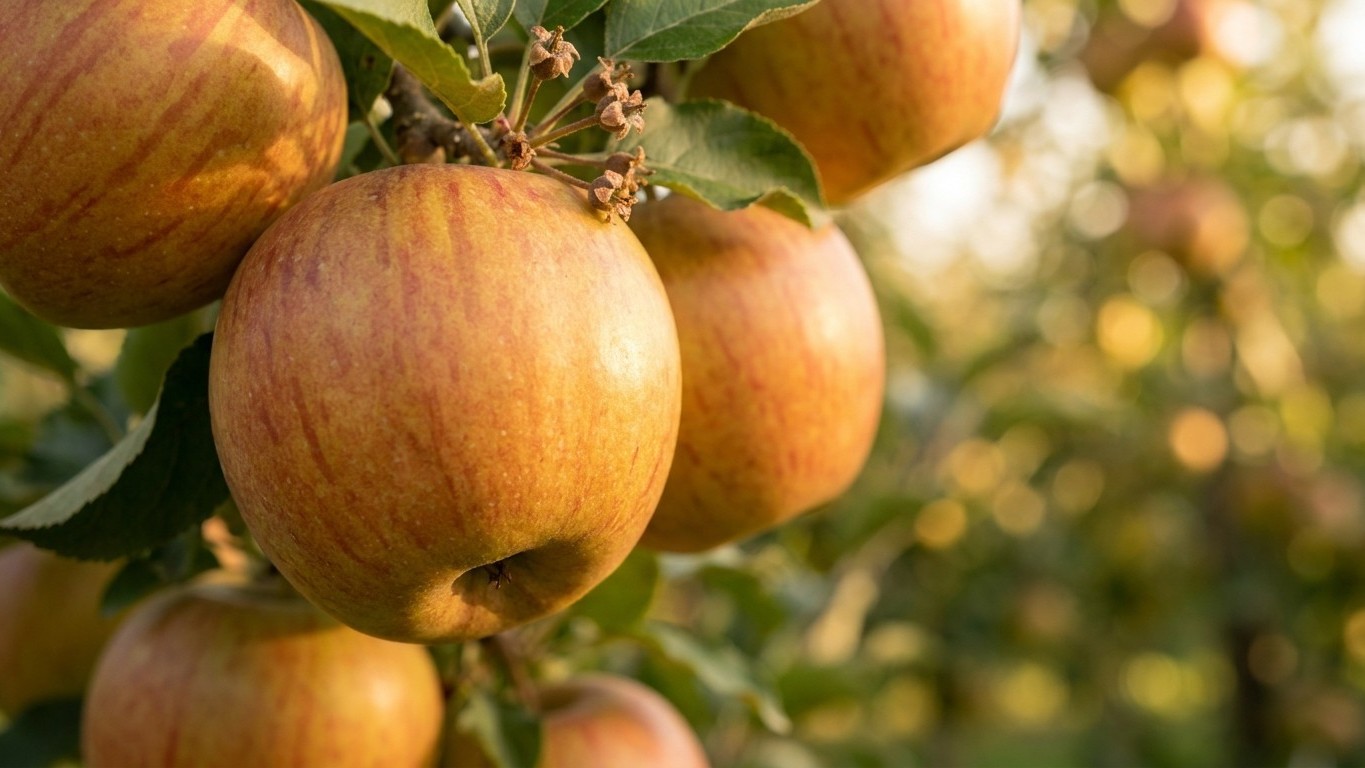

Jonagold is a large, sweet-tart dessert apple that also holds up well in cooking, but it comes with one quirk that trips up a lot of home orchards: its pollen is sterile. It can accept pollen from other varieties and produce a fine crop, but it cannot fertilize a single blossom on a neighboring tree. Plant it as one of only two varieties in a small yard, and you may get flowers with no apples to show for them.
What Jonagold actually is

- When it ripens: Late September to mid October
- What it tastes like: Sweet, juicy
- What it is good for: General purpose, eating and cooking
- How long it keeps: A solid mid-to-late-season storage apple (details below)
According to Clemson Cooperative Extension’s HGIC 1350 variety table, Jonagold is rated sweet and juicy for eating quality, and listed as a general-purpose apple in the kitchen. That “general purpose” label matters more than it sounds. A dessert apple that turns to mush in the oven and a pie apple that stays too firm to eat out of hand are not interchangeable, and the difference comes down to physical structure: flesh density that holds a slice together under heat, and acidity that survives baking instead of going flat. Jonagold’s flesh is dense enough to hold shape reasonably well in a baked dish, while its sugar-acid balance still reads as pleasant fresh off the tree, which is why it ends up in both categories rather than being pinned to one.
Utah State University Extension places the harvest window for Jonagold at late September through mid October, putting it in the second half of the apple season, well after early varieties but ahead of the latest-keeping types. USU also classifies its bloom timing as Mid, and Clemson’s HGIC 1350 (paired with UGA Extension bulletin C740) assigns it to bloom group C, a relative ranking used to line varieties up against each other for pollination timing rather than a fixed calendar date.
You may also see this variety sold or discussed under a slightly different marketing name in some nursery catalogs, the same way Mutsu sometimes appears as Crispin, or Pink Lady is sold as Cripps Pink. Whatever the label on the tag, if it says Jonagold, the facts below apply.
Will it grow where you are
Hardiness zones
USU Extension lists Jonagold as suited to USDA hardiness zones 4 through 8, which is a wide band. That range covers everything from the cold winters of the upper Midwest and northern New England down through much of the transitional South, so most home growers east of the Rockies and in a good part of the Pacific Northwest fall somewhere inside it. Zone 4 is the cold edge, where winter lows can dip to negative 20 to 30 degrees Fahrenheit; zone 8 is the warm edge, typical of coastal Georgia, the Gulf Coast fringe, or the milder parts of the Pacific Northwest. If your area sits outside that stretch on either side, hardiness alone should give you pause before planting.
Winter chill
Hardiness zone tells you whether the tree survives winter. It does not tell you whether the tree will flower and fruit reliably, and that second question depends on winter chill, the number of cold hours a variety needs before it will break dormancy properly in spring. Apples in general lean toward the higher end of the chill requirement scale compared to many other fruit trees, which is one reason the crop is associated with northern and mid-latitude growing regions rather than the Deep South or low-desert Southwest. No published chill-hour figure for Jonagold specifically turned up in the sourced Extension material used for this page, so rather than guess a number, the honest answer is that it is not published here. Growers in zones 7 and 8, where winter chill is the more common limiting factor than cold hardiness, should check with a regional Extension office or an apple nursery serving their specific climate before committing to this variety, since a zone rating that looks fine on paper can still mean disappointing bloom in an unusually mild winter.
What to plant beside it
This is the section that decides whether Jonagold produces a real crop or just a nice-looking tree with no apples. Jonagold has sterile pollen, confirmed across Clemson HGIC 1350, UGA Extension bulletin C740, and USU Extension. That means it can be fertilized by other varieties and will set fruit well when it is, but its own pollen cannot fertilize any other apple tree in the garden. A planting of only Jonagold and one other variety will not work unless that other variety can also be pollinated by something else nearby, because Jonagold contributes nothing back. Most home gardens with a single Jonagold tree need a third variety in the mix, one that flowers with the pollen source at the right time and can also cross-pollinate the Jonagold itself.
Varieties confirmed as compatible pollen sources for Jonagold include:
- Arkansas Black
- Ozark Gold
- Priscilla
- Rome Beauty
One combination to watch out for specifically: Stayman flowers at the same time as Jonagold, in the right bloom window, but Stayman also has sterile pollen. Planting only these two together gives you two trees that bloom in sync and produce no fruit, because neither can fertilize the other. Bloom timing overlap is necessary for cross-pollination, but it is not sufficient on its own.
There is also a genetic exclusion worth knowing. Golden Delicious cannot pollinate Jonagold, because Golden Delicious is one of Jonagold’s parent varieties (the cross that produced Jonagold combined Golden Delicious with Jonathan). A seedling variety generally cannot be fertilized by its own parent, which rules out an otherwise obvious-looking pairing. If you already have a Golden Delicious tree in the yard and are counting on it to pollinate a new Jonagold, that plan will not work; you will still need one of the varieties listed above, or another compatible bloom-group-C variety confirmed for your region. For a broader rundown of how apple pollination groups work and how to plan a mixed planting, see this site’s guide to apple tree pollination.
Growing it well
Fire blight
USU Extension rates Jonagold as Moderately Susceptible to fire blight, the bacterial disease that causes blossoms and young shoots to blacken and wilt as though scorched, often overnight during warm, wet spring weather. A moderate rating means this is not the most vulnerable variety on the market, but it is not resistant either. In practice, that translates to watching new growth closely during bloom and shortly after, in wet or humid springs, and pruning out any blackened shoots several inches below the visible damage as soon as they appear, disinfecting shears between cuts so the bacteria are not carried to healthy wood.
Growth habit
Jonagold is generally grown as a vigorous tree, which is one reason nursery stock is commonly offered grafted onto size-controlling rootstock rather than seedling rootstock. Keep in mind that rootstock, not the variety itself, is what determines how tall and wide the mature tree becomes, so two Jonagold trees on different rootstocks can end up very different sizes in the same yard. Ask the nursery which rootstock a given tree is grafted to before assuming anything about eventual size.
Biennial bearing and thinning
Like a number of heavy-cropping apple varieties, Jonagold can lean toward biennial bearing, producing a large crop one year followed by a light one the next, if the tree is left to carry every apple it sets. Thinning the young fruit down to one apple per cluster, spaced several inches apart along the branch, several weeks after bloom helps even out that cycle and also produces larger, better-colored apples in the current season instead of a heavy load of small ones.
Picking it and keeping it
USU Extension puts Jonagold’s harvest window at late September to mid October, but a calendar date is only a starting point. Weather shifts that window earlier or later from year to year, so the more reliable approach is checking the fruit itself.
- Lift and twist: Cup the apple in your hand, tilt it upward, and give it a slight twist. A ripe apple separates from the spur easily; one that resists and has to be pulled or pried off is not ready yet.
- Seed color: Cut one test apple open. Seeds that are still pale or greenish mean the fruit needs more time; dark brown seeds are a sign of maturity.
- Ground color: Look at the background skin color, the shade behind any red blush, on the shaded side of the apple. A shift from green toward yellow in that background color is another maturity signal worth checking alongside the first two.
Storage
Jonagold falls into the harvest window that typically produces solid mid-to-late-season keepers among apple varieties, and it stores respectably in a cold, humid environment, the kind found in a root cellar or the crisper drawer of a refrigerator set as cold as it will go without freezing. Store apples away from other fruit and vegetables, since apples give off ethylene gas that speeds up ripening and can cause stored produce nearby to spoil faster.
Common questions
Can a single Jonagold tree produce apples on its own?
Not reliably. Nearly all apple varieties crop better with a compatible partner nearby, and Jonagold’s sterile pollen makes a second variety essential rather than optional, since it cannot fertilize its own or any other tree’s blossoms.
Why can’t two Jonagold trees pollinate each other?
Because Jonagold’s pollen is sterile across the board, according to Clemson HGIC 1350, UGA C740, and USU Extension. Two trees of the same sterile-pollen variety, or even two different sterile-pollen varieties like Jonagold and Stayman, will not set fruit together no matter how well their bloom times line up.
Is Jonagold better for eating fresh or for baking?
It works for both. Clemson Cooperative Extension lists it as general purpose, with sweet, juicy flesh dense enough to hold up reasonably well in cooked dishes while still tasting good eaten out of hand.
What is the earliest sign that a Jonagold apple is ready to pick?
Try the lift-and-twist test first: if the apple separates from the branch with a gentle twist rather than resisting, follow up by checking seed color and ground color on a sample fruit before picking the whole tree.
Does Jonagold need a specific rootstock to stay a manageable size?
The variety itself does not control mature tree size, the rootstock does. Ask a nursery which rootstock a given Jonagold tree is grafted onto if a compact size matters for your space.