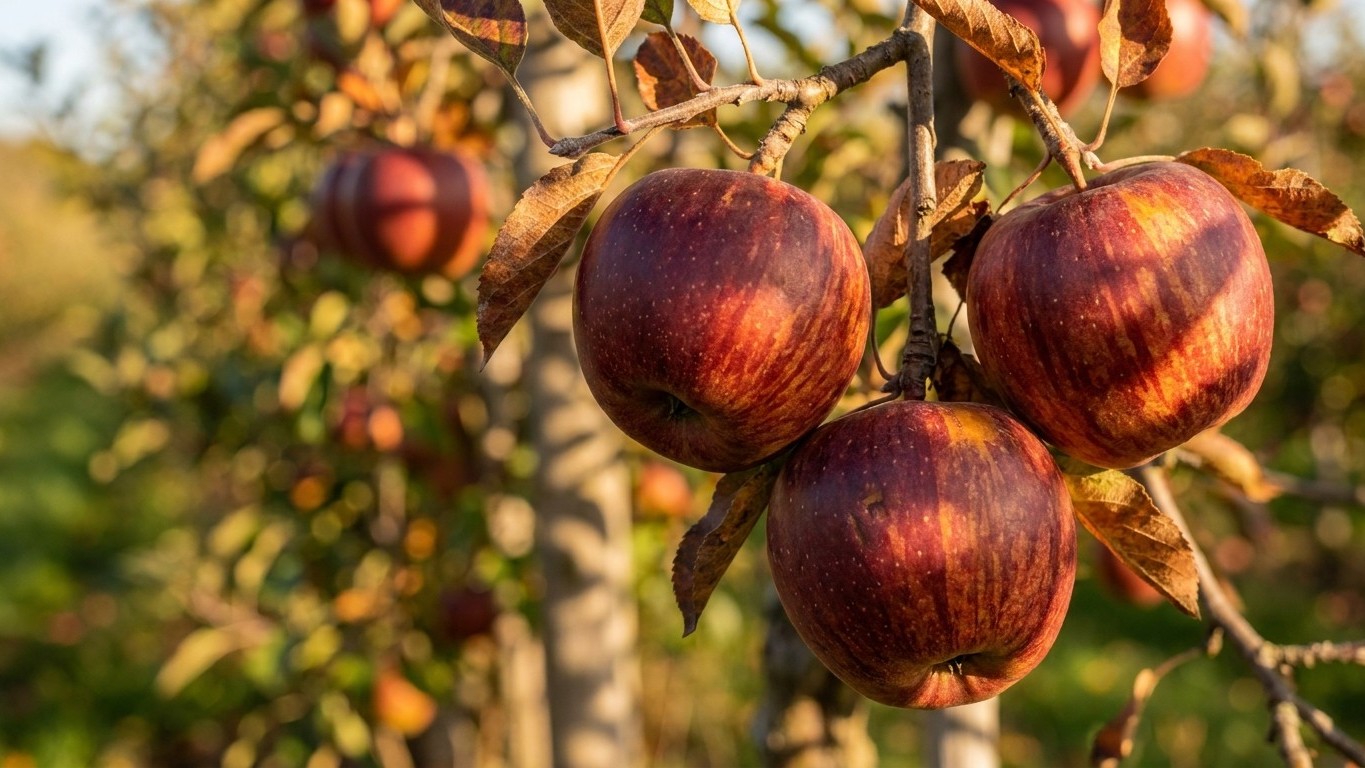

Braeburn is a late-season dessert apple that ripens in late October, carries an intensely sweet-tart, aromatic flavor in dense, very firm flesh, and holds up in the kitchen as well as on the counter. It grows in USDA zones 5 through 8. The harder question, and the one that decides whether the tree fruits at all, is what else needs to be in the ground beside it.
What Braeburn actually is

Before anything else, here’s what a grower actually gets with this variety:
- Ripens: Late October
- Taste: Intensely sweet-tart and aromatic, with dense, very firm flesh
- Best use: Fresh eating and baking, since the flesh holds its shape and the acidity survives heat
- Keeping ability: A genuinely long-season apple thanks to that firm, dense flesh
The flavor is the first thing most people notice: a sharp tartness balanced against real sweetness, wrapped in an aroma that comes through even after cooking. That density in the flesh isn’t just a texture note, it’s the reason this apple crosses over between the fruit bowl and the baking dish. A soft, juicy apple collapses into mush in a hot oven; Braeburn’s firm cell structure resists that breakdown, so slices in a tart or a pan keep their shape instead of turning to sauce. And because its acidity doesn’t cook out the way it does in blander varieties, a Braeburn pie or galette still tastes like something, rather than sweet mush with cinnamon.
The harvest date matters for planning, too. Late October puts this variety among the last apples off the tree in most of its growing range, well behind early- and mid-season varieties that come off in August and September. That late timing, according to USU Extension’s guidance on home apple production, also means the tree needs a full growing season to get the fruit to that point, so gardeners in shorter-season climates should weigh whether their fall arrives early enough to let it finish.
Will it grow where you are
Hardiness zones
USU Extension lists Braeburn as hardy across USDA zones 5 through 8, a wide band that stretches from the colder reaches of the Mountain West and the upper Midwest down through much of the mid-Atlantic and into the warmer Southeast. That range covers a lot of climate variety, and it’s worth reading as a boundary rather than a guarantee: a site at the cold edge of zone 5 and one at the warm edge of zone 8 will treat this tree very differently, even though both technically qualify.
Winter chill
Hardiness zone only answers half the question. The other half is winter chill, the accumulated hours of cold temperatures a fruit tree needs over winter before it will break dormancy and bloom normally in spring. A chill figure for Braeburn is not available, so no number should be assumed here. That said, a late-October harvest and an early bloom season, both confirmed in that same source, point toward a variety built for regions with a real, if not extreme, winter: cold enough to satisfy dormancy requirements, but with a growing season long enough to carry fruit all the way to late fall. Gardeners in the mildest parts of zone 8, where winters barely dip into true chill territory, should treat this as an open question and check with a local extension office before committing a planting spot to it.
What to plant beside it
A named list of pollination partners for Braeburn is not documented, and that is the honest answer here. That’s not the same as saying it doesn’t need one.
Nearly all apple varieties crop better with a compatible partner nearby. A handful are partly self-fertile and will set some fruit alone, but yields improve, sometimes dramatically, once bees have a second variety’s pollen to carry over. Braeburn’s own bloom season is listed as early, which is the useful clue here: whatever partner goes in the ground beside it should bloom at roughly the same time, since pollination only works when both trees are flowering together. A partner that blooms three weeks later is no partner at all, no matter how compatible the varieties are on paper.
Two more things matter beyond bloom timing, and both are easy to miss:
- A tree with sterile pollen can be pollinated by others but can’t return the favor, so it always needs at least two other compatible varieties nearby, not just one
- A parent variety generally cannot pollinate its own seedling, so knowing the parentage of nearby trees matters, not just their bloom dates
Braeburn’s pollen fertility and parentage aren’t detailed in the source used here, so neither point can be confirmed one way or the other for this specific variety. The practical move is to plant at least one other early-blooming apple variety, or a flowering crabapple known for early bloom, within a reasonable distance, and to confirm the pairing against a dedicated pollination guide before finalizing an order.
Growing it well
Fire blight
USU Extension rates Braeburn as moderately susceptible to fire blight, a bacterial disease that shows up as blackened, wilted shoot tips that curl into a shape often described as a shepherd’s crook, sometimes with a sticky bacterial ooze on cankers in humid weather. Moderate susceptibility means this variety won’t collapse at the first warm, wet spring the way a highly susceptible one might, but it also isn’t a tree a grower can ignore. In practice that means pruning out infected wood promptly, cutting well below any visible symptom, sanitizing tools between cuts, and avoiding heavy nitrogen fertilization, since lush new growth is exactly what the bacteria infects most easily.
Habit and mature size
Mature size and growth habit are determined by rootstock, not by the Braeburn variety itself, so any height quoted without naming the rootstock underneath it isn’t telling the full story. A grower choosing a dwarfing rootstock will end up with a compact tree suited to a small yard and easier hand-harvesting; a standard or semi-standard rootstock produces a much larger, longer-lived tree. That choice, made at purchase, matters more to eventual size than the variety grafted onto it.
Biennial bearing
Like many apple varieties, Braeburn can fall into a heavy-year, light-year pattern if a large crop is left unthinned. Thinning fruit clusters down to one or two apples each, done a few weeks after bloom, spreads the tree’s energy more evenly across seasons and helps guard against that boom-and-bust cycle, along with producing larger individual fruit in the current year.
Picking it and keeping it
USU Extension places Braeburn’s harvest in late October, but a date on a calendar is only a starting point. The tree itself gives better signals, checked in order:
- Lift and twist a fruit gently upward; if it separates from the spur with little resistance, it’s close to ready
- Cut one open and check the seeds; dark brown seeds signal maturity, while pale or greenish seeds mean more time is needed
- Look at the ground color, the base color beneath any red blush; a shift from green toward yellow-green usually confirms the fruit has matured
Storage
The same dense, firm flesh that lets this apple hold its shape in a tart also makes it a strong keeper. Firm, low-moisture apples like this one generally outlast softer, juicier varieties in storage, particularly when kept cold and humid, close to refrigerator temperature with some humidity to prevent the skin from shriveling. A perforated plastic bag in the crisper drawer, or a root cellar for anyone with one, extends that window considerably compared with leaving fruit out on a counter.
Common questions
Is Braeburn the same apple as any other variety sold under a different name?
No alternate name is documented for Braeburn in the source used for this page, unlike some varieties that are sold under two labels depending on the market.
Can one Braeburn tree produce apples on its own?
It may set a light crop alone, but nearly all apple varieties, Braeburn included, produce more reliably with a compatible pollination partner blooming at the same time nearby.
What zone is too cold or too warm for Braeburn?
USDA zones 5 through 8 cover its documented hardiness range; outside that band, either winter cold or lack of sufficient chill becomes a real risk, though exact chill hour needs aren’t published.
Does Braeburn need spraying for fire blight every year?
Its moderately susceptible rating means it’s at real but not extreme risk; pruning practices and nitrogen management matter more day to day than routine spraying in most home gardens.
How long will a Braeburn apple keep after picking?
Its dense, firm flesh gives it strong keeping qualities when stored cold and humid, well beyond what softer, juicier varieties typically manage on a counter or in a basic fridge drawer.
Related guides
- Cameo Apple: Ripening Late October, and What to Plant Beside It
- Candy Crisp Apple: Ripening Late October, and What to Plant Beside It
- Cortland Apple: Ripening September, and What to Plant Beside It
- Apple Diseases
- Seedling Rootstock
- G.11 Rootstock
- Northern Spy Apple: Ripening October, and What to Plant Beside It