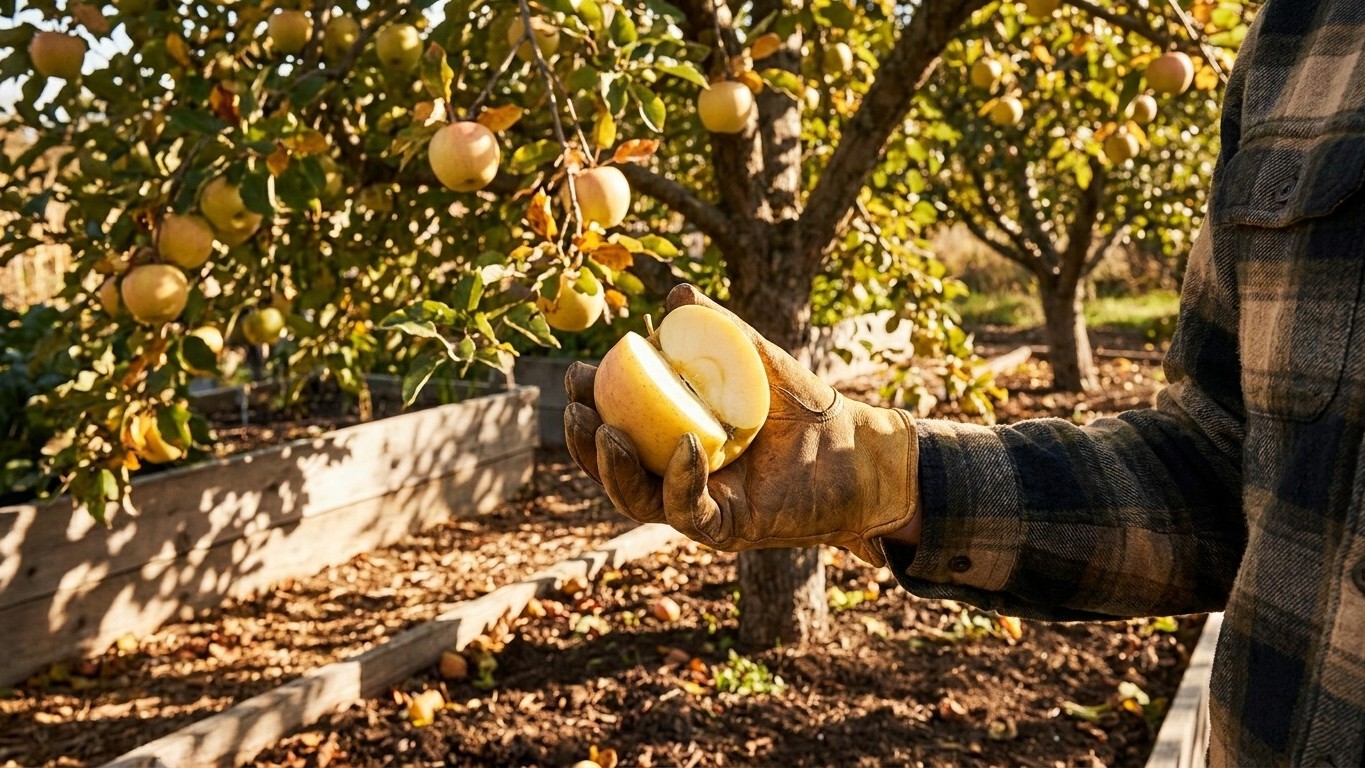

Candy Crisp is a late-October dessert apple: sweet, low-acid, pale-fleshed, and hardy in USDA zones 5 through 8. It needs a pollinator partner nearby, though which varieties do the job isn’t documented in the source behind this page. Here’s what a grower actually needs to know before planting one.
What Candy Crisp actually is

Candy Crisp is a dessert apple, meaning it was bred to be eaten out of hand rather than cooked down. According to Utah State University Extension’s guide to apple production for the home garden, four facts define what a grower gets from this tree:
- Ripens: late October
- Tastes like: very sweet and low in acid, with crisp, pale flesh
- Best for: eating fresh, not baking or saucing
- Keeps: storage life isn’t published in the source used for this page
The late harvest date puts Candy Crisp toward the back end of the apple season, well after early varieties have come and gone and after most of the classic pie apples have already been picked. That timing matters for garden planning: a late bloomer needs a partner that flowers at roughly the same time, a point covered below.
The flavor profile is the other defining trait. Very sweet with low acid isn’t just a taste note, it’s a physical fact about the fruit’s chemistry, and it explains why this variety belongs in the fresh-eating category rather than the cooking one. Low-acid apples read as mild and candy-like when raw, which is presumably where the name comes from, but that same low acidity works against the fruit once heat is involved. Cooking drives off some of what little acid is there and concentrates sugar, and the result is a dish that tastes flat rather than bright. A pie apple needs acid that survives baking and flesh dense enough to hold its shape in the oven. Candy Crisp wasn’t bred for that job, and pushing it into one usually disappoints.
Storage specifics for this variety aren’t published in the source referenced here, so it’s worth treating that as an open question rather than assuming a shelf life. What is documented is the flesh texture, crisp and pale, which at least suggests fruit that isn’t prone to rapid mealiness right off the tree.
Will it grow where you are
Hardiness zones
Candy Crisp is rated for USDA hardiness zones 5 through 8, according to USU Extension. That’s a wide band, stretching from parts of the upper Midwest and interior Northeast down through much of the mid-South and into milder coastal regions. It rules out the coldest pockets of zone 3 and 4, where winter lows can kill wood outright, and it also rules out the hottest stretches of zone 9 and above, where the tree may struggle for a different reason entirely: not enough cold.
Winter chill
Hardiness zone tells you whether the tree survives winter. Chill hours tell you whether it actually fruits well afterward. Apples need a minimum number of hours below roughly 45°F each winter to break dormancy properly and flower on schedule the following spring; skip that requirement and a tree can leaf out unevenly, bloom late or thin, and set a disappointing crop even in a technically survivable zone. That’s the filter most first-time growers never hear about until it’s already cost them a season.
A published chill-hour figure for Candy Crisp isn’t available in the source used for this page, so it would be a guess to state one. What can be said with confidence is that a variety rated for zones as far south as 8 is not a high-chill specialist bred exclusively for the coldest apple country; it’s built to tolerate a fairly broad range of winters, which is useful information even without an exact number attached. Gardeners in the warmer end of that zone range, coastal California, the Gulf South edges, the warmer parts of the Southeast, should check local chill accumulation against whatever regional extension data is available before planting, since a hardiness zone rating alone won’t catch a chill shortfall.
What to plant beside it
Nearly all apple varieties crop better with a compatible partner nearby, and Candy Crisp is no exception. Apples are largely self-unfruitful, meaning a lone tree may bloom reliably and still set little or no fruit because its own pollen can’t finish the job. A second variety, flowering at the same time and genetically compatible, is what turns blossoms into apples.
For Candy Crisp specifically, the source behind this page doesn’t publish a list of confirmed pollination partners. That’s worth stating plainly rather than guessing, because naming the wrong partner sends a reader home from the nursery with two trees that bloom weeks apart and never actually pollinate each other.
What can be said generally, based on Candy Crisp’s documented bloom season, is that any partner needs to flower in the mid-season window along with it. Bloom timing is the first filter; a partner that flowers two or three weeks early or late simply won’t be shedding pollen when Candy Crisp’s flowers are receptive, no matter how compatible the two varieties are genetically. The second filter, genetic compatibility, matters just as much: two apples can bloom together and still fail to pollinate each other if one happens to be a seedling or sport of the other, since a parent variety generally cannot pollinate its own offspring.
Given the lack of a published partner list for Candy Crisp, the practical path is to work from local nursery recommendations or a regional extension pollination chart, matching for mid-season bloom and confirming there’s no parent-offspring relationship between the two trees. A dedicated apple pollination guide covers how to read bloom charts and cross-reference compatible pairs in more detail. In the absence of a documented list here, that cross-check is the safer route than picking a second variety at random.
Growing it well
Fire blight
USU Extension rates Candy Crisp as moderately resistant to fire blight, a bacterial disease that can kill blossoms, shoots, and entire limbs in warm, wet spring weather. Moderately resistant doesn’t mean immune. In practice, it means the tree is less likely to suffer a catastrophic strike than a highly susceptible variety, but a grower should still watch for the telltale signs each spring: blackened, wilted shoot tips that curl into a shepherd’s-crook shape, and blossoms that brown and die rather than setting fruit. Pruning out infected wood well below the visible damage, and disinfecting tools between cuts, keeps a moderate infection from spreading further into the tree.
Habit and biennial bearing
Growth habit and any tendency toward biennial bearing, where a tree alternates a heavy crop one year with a light one the next, aren’t detailed in the source used for this page, so nothing specific can be said about Candy Crisp on either point without guessing. What applies broadly across apple varieties, and is worth watching for regardless of the specific tree, is that a very heavy fruit set in one season often does set up a lighter crop the next unless the grower intervenes.
Thinning
That intervention is thinning: removing some of the small developing fruit in late spring so the tree isn’t carrying more apples than it can properly size and support. A general rule used across many apple varieties is to leave one fruit every 6 to 8 inches along a branch, removing the smaller or damaged fruit from each cluster first. Thinning reduces limb stress, improves the size of the apples that remain, and helps guard against the following year’s crop coming in light.
Picking it and keeping it
Candy Crisp’s harvest window falls in late October, per USU Extension, but a calendar date is only a starting point. Weather, crop load, and microclimate can shift the actual ripe moment earlier or later, so the more reliable approach is to check the fruit itself using a sequence of physical cues:
- Lift and twist a fruit gently upward; a ripe apple separates from the spur with little resistance, while one that clings tightly usually isn’t ready yet.
- Cut one open and check the seeds; pale or greenish seeds mean more time is needed, while seeds that have turned brown signal the fruit is mature.
- Look at the ground color, the background shade beneath any red blush; a shift from green toward yellow generally tracks with ripening in most apple varieties.
Storage
Exact storage life for Candy Crisp isn’t published in the source referenced for this page, so no specific number of weeks or months can be stated with confidence. What’s generally true across late-season apples is that cold, humid conditions, close to freezing and high humidity, slow the ripening process far more than a countertop or even a regular refrigerator crisper drawer, and extend how long the fruit stays crisp and eating-quality. Anyone relying on this variety for extended storage should check in with local extension resources for expected keeping time before planning on it lasting through winter.
Common questions
Is Candy Crisp the same apple as any other named variety?
Nothing in the source used for this page indicates Candy Crisp is marketed under a different name, unlike varieties such as Mutsu (sold as Crispin) or Pink Lady (sold as Cripps Pink). Treat it as its own distinct variety unless a specific nursery or catalog states otherwise.
Can I use Candy Crisp for pie?
It isn’t the best choice. Its low acidity, an asset when eaten fresh, tends to leave cooked dishes tasting flat because there’s little tartness left to survive baking. A dedicated pie variety with firmer, more acidic flesh will hold shape and flavor better in the oven.
Do I need two trees to get fruit?
Almost certainly yes. Nearly all apple varieties, Candy Crisp included, crop far better with a compatible pollinator nearby than on their own. Since a specific partner list for Candy Crisp isn’t published in this page’s source, matching bloom timing with a mid-season variety and confirming there’s no parent-offspring relationship is the safer approach.
What zone cutoff should I worry about most?
The published range is USDA zones 5 through 8. Gardeners at the warm edge of that range should also check local winter chill accumulation, since a mild-winter area can technically fall inside the hardiness range and still deliver too few chill hours for reliable bloom and fruit set.
How do I know it’s actually ripe if I don’t have a calendar handy?
Run through the three physical checks in order: lift and twist the fruit to see if it separates easily, cut one open to check whether the seeds have turned brown, and look at the ground color beneath any blush for a shift from green toward yellow. Those three signs are more reliable than any fixed date, including the general late-October window reported for this variety.