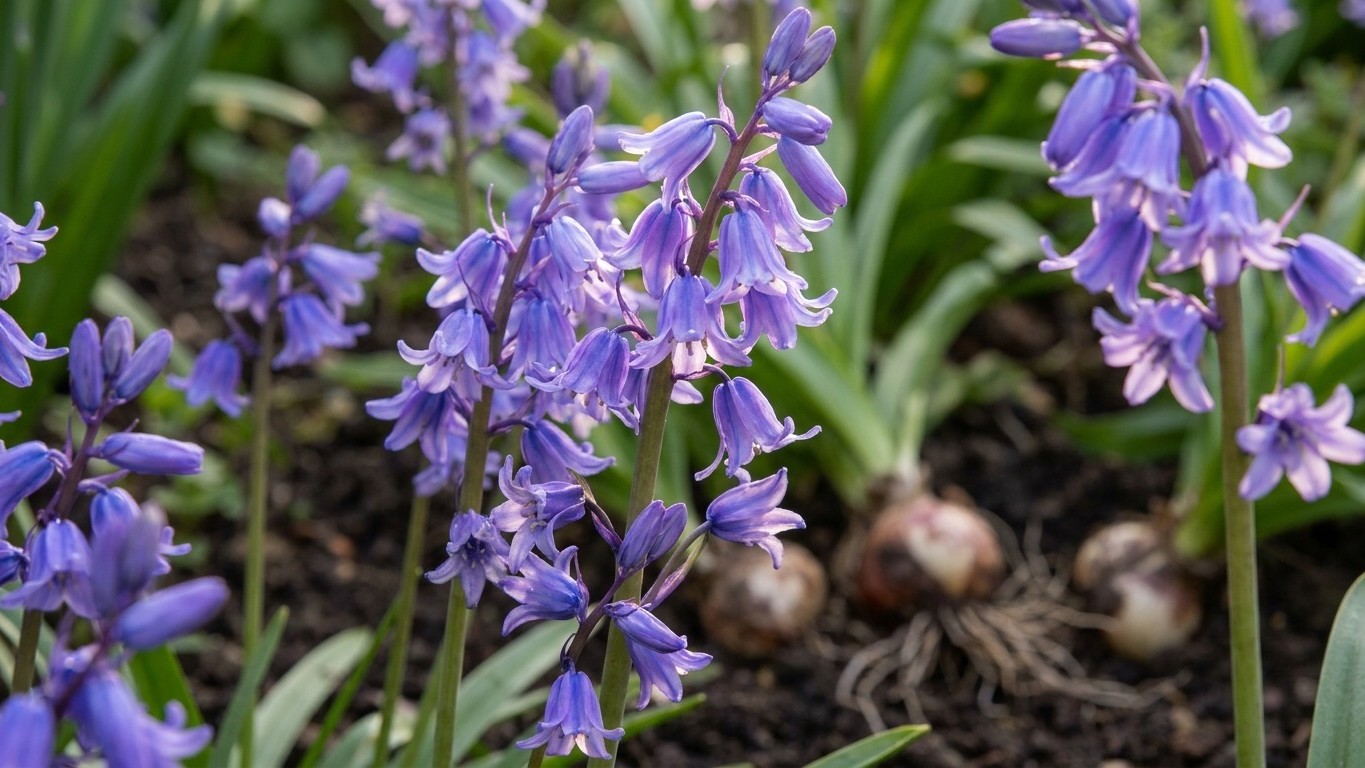

Spanish bluebell needs 12-14 weeks below 45F to flower properly, grows in USDA zones 3-8, and blooms in late spring. Plant the bulbs 4 inches deep and 6 inches apart, and expect them to come back and spread on their own for years, provided the foliage is left alone after flowering. That’s the short version. Here’s what actually matters once the bulbs are in your hand.
What Spanish Bluebell actually is

Spanish bluebell belongs to the hyacinthoides group, the same family that includes the native English bluebell it’s often confused with (and sometimes crossed with, which is a separate issue covered later). It’s hardy across USDA zones 3-8, a wide enough range that most of the country can grow it without special treatment, though gardeners in the warmer end of that range need to pay close attention to the cold requirement.
That requirement is 12-14 weeks below 45F. According to Cornell University, Department of Horticulture : Flower Bulb Research Program, this window is what triggers proper flower formation inside the bulb. Skip it, or fall short of it, and the plant doesn’t necessarily die. It just produces leaves with no flower, or a flower stalk so stunted you’d miss it walking past. A bulb that gets close to 12 weeks but not quite there often blooms weakly rather than failing outright, so gardeners near the edge of their zone’s winter chill should treat the flower show as a maybe, not a guarantee.
Bloom time is late spring, which puts it after the earliest crocuses and daffodils but often overlapping with tulips, depending on your region. Flowers come in blue, white, or pink, with blue being the color most people picture when they hear the name.
One habit worth flagging before you plant: the leaves emerge in autumn and stay green through winter, which surprises gardeners expecting bare ground until spring. Then, as the flower opens in late spring, the foliage often starts yellowing and flopping while the bloom is still fresh on the stem. That’s normal. It looks like the plant is dying right as it’s putting on its best show, and it isn’t.
How deep and how far apart
Depth and spacing aren’t cosmetic choices here. Planting at 4 inches keeps the bulb below the freeze-thaw layer of soil, the band that expands and contracts through winter and can physically push shallow bulbs up out of the ground over a few seasons. Go shallower and you’ll spend years replanting bulbs that worked their way to the surface. Spacing at 6 inches decides what the bed looks like once everything’s up: tighter than that and you get a dense mat that reads as one solid patch of color; wider and you get scattered points that look more like a row than a drift.
- Planting depth: 4 inches
- Spacing between bulbs: 6 inches
Orientation matters, and most Spanish bluebell bulbs make it obvious: the pointed end goes up, the flatter, root-scarred end goes down. When a bulb has been knocked around in shipping and the shape gives no clear signal, plant it on its side rather than guessing. The shoot will find its way up regardless, and planting sideways avoids the common mistake of burying it upside down, which can delay or weaken the bloom.
Spanish bluebell is one of the few spring bulbs that actually tolerates dry shade under mature trees, a spot where hostas sulk and most bulbs rot or simply refuse to bloom. That makes it a practical choice for the shady side of a house or the ring of bare soil under an oak, areas most catalogs steer buyers away from. It still needs decent drainage, though. Standing water in a low spot will rot the bulb regardless of how deep it’s planted.
Will it come back next year
Spanish bluebell is a genuine perennial, not a one-season bulb dressed up as one. Left undisturbed, it doesn’t just survive year to year, it spreads, both by seed and by offsets forming at the base of the parent bulb. A single patch planted one autumn can double or triple in coverage within a few years without any intervention. That’s a different category from bulbs like some tulip hybrids, which put on a strong show the first spring and taper off after two or three years because they’re bred for flower size rather than longevity.
The tradeoff is patience with the foliage. Once flowering ends, the leaves need to be left standing until they yellow and collapse on their own, which can take several weeks and looks messy in a tidy border. That yellowing period is when the bulb is photosynthesizing and storing the energy that becomes next year’s flower. Cut the leaves back green because they look untidy, and you’ve cut off the bulb’s food supply before it finished the job. This is the single most common reason a planting that bloomed well the first year produces nothing but leaves the next.
Because it spreads by seed as well as offsets, Spanish bluebell can move beyond where it was planted over time, and it’s known to cross with native bluebell populations where the two grow near each other. If there’s a native bluebell planting anywhere nearby, whether it’s yours or a neighboring wild area, keep Spanish bluebell separated from it rather than letting the two mix.
What eats it, and what leaves it alone
Rodents and deer largely pass Spanish bluebell by. Like other bulbs in the hyacinthoides group, it contains compounds that make it bitter and mildly irritating to eat, a trait it shares with daffodils and a handful of other spring bulbs that squirrels and voles learn to avoid after one bad experience. That’s part of why it works well in yards where tulips get dug up every autumn: the animals doing the digging simply aren’t interested in what’s underneath.
That doesn’t mean the bulbs are never disturbed. Squirrels dig for the sake of digging, especially in freshly turned soil, and they’ll sometimes displace a bulb even if they have no intention of eating it. If that’s a known problem in your yard, the practical fix is a layer of wire mesh laid directly over the planting bed, pinned down at the edges, left in place until the ground freezes hard enough that digging isn’t worth the effort. Once the bulbs have rooted and the soil has settled, the mesh can come off. It’s a low-cost step that solves the actual problem, rather than relying on scent repellents that wash out with the first hard rain.