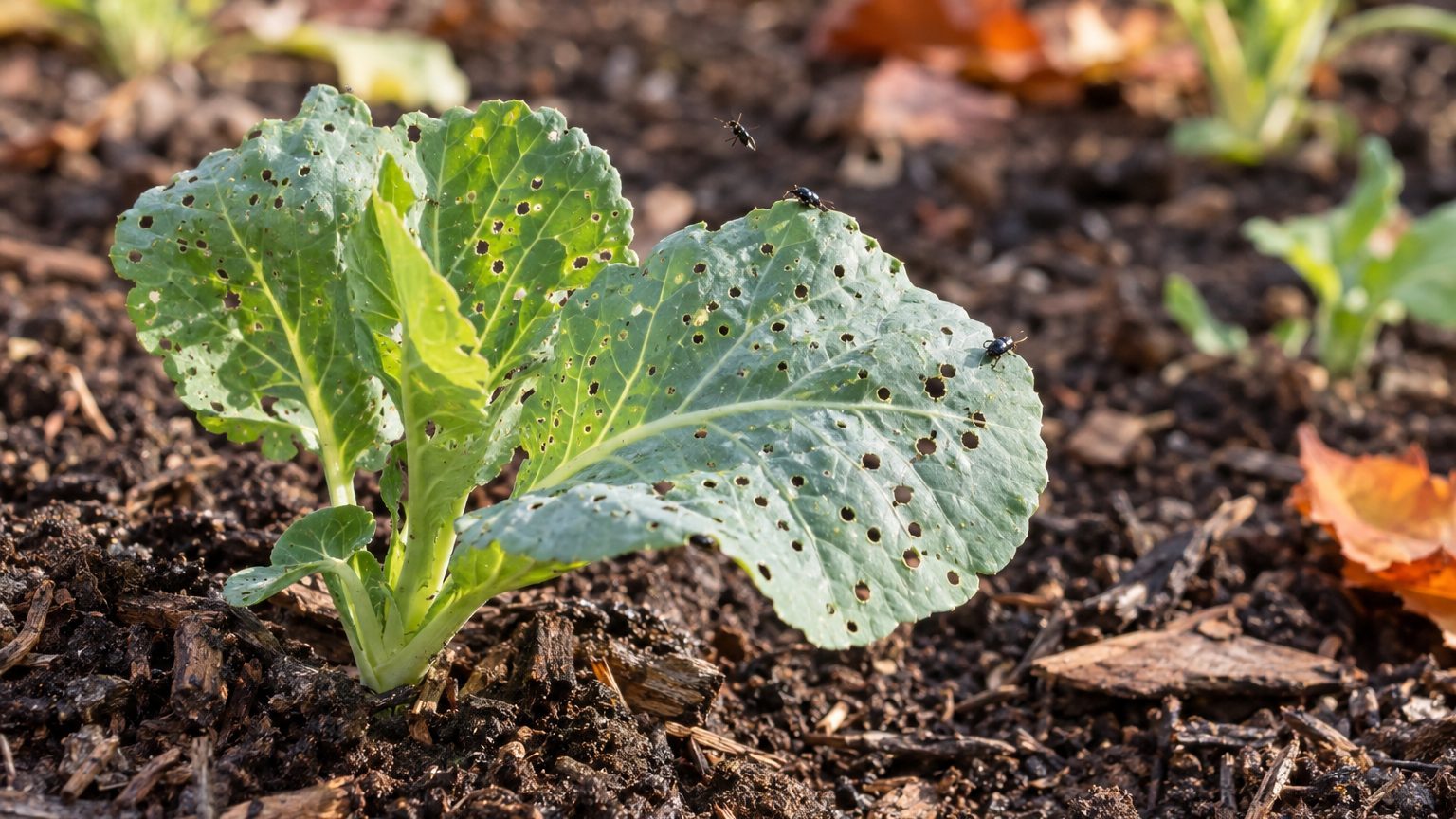

Dozens of tiny round holes, each about the size of a pinhead to a BB, scattered across a collard leaf like birdshot on a barn door. If the plant is young and the holes are fresh, flea beetles are the most likely culprits. These are black, bronze, or striped insects roughly 1/16 to 1/8 inch long that spring into the air when you brush a leaf. A healthy collard past the seedling stage usually shrugs the damage off. A seedling or fresh transplant, on the other hand, can be stunted or killed in a few days. So the job is to protect plants early and relax later.
This page covers how to confirm the diagnosis, why the damage clusters on young plants, and what works in a Southern garden where collards are often planted in two windows, early spring and late summer into fall. For the full crop picture, start with Growing Collards: One Planting, Months of Harvest.
Confirming flea beetles before you treat anything
Shot holes have several possible authors, and each calls for a different response. Flea beetles leave a distinctive signature: many small, roughly circular holes, often 1/16 to 1/8 inch across, concentrated on the youngest or newest leaves. Early feeding often looks more like pitting, where the beetle chews the upper surface and leaves the thin lower layer intact. Those pits turn into true holes as the tissue dries and drops out.
The quickest test takes ten seconds. Walk up to a damaged plant on a warm, sunny morning and tap or flick a leaf. Tiny beetles will pop off like popcorn, using their enlarged hind legs, and many will land on nearby soil or leaves. A yellow sticky card placed near seedlings will catch them too, which helps if you want to know when they show up. Species that commonly feed on brassicas include the crucifer flea beetle, the striped flea beetle, and the western black flea beetle, and the potato flea beetle (an Epitrix species) turns up on many leafy crops. Home gardeners rarely need the exact species. The management is the same.
Look-alikes are worth ruling out:
- Cabbage loopers, imported cabbageworms, and diamondback moth larvae chew larger, ragged holes and leave green frass (droppings). You will usually find the caterpillar itself on the underside of the leaf.
- Slugs and snails also make ragged holes, but they leave silvery slime trails and feed mostly at night or after rain.
- Fungal and bacterial leaf spots, such as Alternaria, can leave spots with tan centers that eventually fall out and mimic holes. Look for concentric rings or a yellow halo around the spot. Real flea beetle holes have clean edges and no ring.
- Harlequin bugs, which are red-and-black shield-shaped insects, suck sap and leave blotchy white or yellow patches rather than holes.
If you see the tiny holes and the beetles jump, you have your answer. If you see the holes, but nothing jumps, check at dawn or dusk, since beetles can be less active when it is cool and cloudy.
Why young collards take the beating
Adult flea beetles overwinter in leaf litter, plant debris, and the edges of fields and woodlots, then become active as spring warms. Extension entomologists across the country describe the same pattern. Adults feed on emerging seedlings first, then lay eggs in the soil near the plants. Larvae are thin, whitish, and small, and they feed on fine roots. On brassicas, that root feeding is generally minor compared with what the adults do above ground.
Timing is the whole story. A collard seedling has a few small leaves and no reserves, so removing a large share of its leaf area can stall it for weeks or finish it. A transplant with a half-dozen leaves has a buffer. A plant that has been growing for two months produces new leaves faster than beetles can ruin them, and the holes on older leaves become cosmetic. Collards are a long-season, heat-tolerant crop, which gives them an edge over arugula or radishes, both of which are heavily favored by flea beetles and can look like lace within days.
Flea beetles also like it dry and warm. Their feeding tends to pick up on hot, sunny days and drop off in cool or rainy stretches. In much of the South, that means two pressure points. One comes in March and April, when beetles emerge as early plantings go in. The other comes in August and September, when a new generation is active just as gardeners start fall collards in warm soil. Fall seedlings often take a worse beating than spring ones for exactly this reason, and gardeners in Georgia, Alabama, and the Carolinas commonly report that late summer is when seedlings vanish overnight.
If you are still choosing what to plant and when, Which Collards to Grow, and How They Differ covers maturity and heat tolerance, which also affect how quickly a plant outgrows the vulnerable stage.
Protecting seedlings: barriers first, sprays last
A physical barrier beats almost anything else for young brassicas. Lightweight floating row cover (the thin spun fabric sold for frost and insect protection) laid over the bed immediately after seeding or transplanting keeps adult beetles from reaching the leaves. The edges need to be sealed with soil, boards, or landscape staples, because beetles will find a gap the width of a pencil. Leave enough slack for the plants to grow, since the fabric will lift as they do.
Two cautions apply. First, row cover only works if the bed is free of beetles to begin with. If you plant into a spot where brassicas grew last season, adults overwintering in the soil may already be under the fabric when you close it up. Rotating the bed away from collards, kale, mustard, turnips, and the rest of the cabbage family for a year or more helps with that, and it also helps with soilborne trouble such as clubroot in a collard bed. Second, in the heat of a Southern August, fabric can trap warmth. Choose the lightest weight available and check for scorching or wilting on afternoons in the 90s. Because collards are grown for leaves, not fruit, there is no pollination concern, and you can leave the cover on until plants are well established, then remove it.
Other practices stack on top of the barrier:
- Set out transplants rather than direct-seeding when beetle pressure is high. A plant with several true leaves tolerates feeding far better than a cotyledon-stage seedling.
- Keep seedlings evenly moist. Dry, stressed plants suffer more, and some gardeners find that regular overhead watering seems to discourage beetles from settling. It will not stop them, but it does not hurt.
- Clean up crop debris and weeds in the cabbage family (wild mustard, shepherd’s purse) at the end of each season to remove winter shelter and alternate food.
- Time fall plantings to avoid the worst of the late-summer flush where you can, and be ready to cover seedlings when you do plant.
Trap crops are another option, though results vary. Beetles prefer certain plants over others, so a small planting of radish or a mustard green set a few feet from the collards can pull some of the pressure away. The idea is to let the decoy take the hits while the collards get established. Gardeners generally treat this as a partial help and not a fix, and the decoy has to be sacrificed or cleared out later so it does not become a beetle nursery.
When a spray makes sense
Reserve sprays for cases where seedlings are being visibly shredded and covers are not an option. Kaolin clay, sold as a particle film, coats leaves with a white powder that beetles dislike landing on, and it needs to be reapplied after rain and as new growth appears. Spinosad, a biological insecticide approved for organic production, is labeled for flea beetles on leafy brassicas, and pyrethrin products have some knockdown effect. All of these can harm bees and other beneficial insects if misused, so spray in the evening and keep drift off flowering weeds. Follow the label for crop, rate, and the interval before harvest. Insecticidal soap and neem generally give weaker, short-lived control against jumpy adult beetles, and a quick spray at midday while beetles are hopping tends to disappoint.
After the holes: how much damage is too much
An established collard can lose a surprising amount of leaf area without affecting harvest. Entomologists who work with leafy greens consistently note that plants past the seedling stage tolerate moderate flea beetle feeding, and the economic damage in field crops comes mainly from marketability, not yield. If you are not selling the leaves, the hole count matters very little. Keep an eye on the growing point at the center of the plant. If new leaves are emerging with only a few pits, the plant is winning.
Pull a seedling or replant if the growing tip is destroyed, if most of the leaf area on a young plant is gone, or if the stem has been girdled. For anything else, the right move is usually to cover the bed, keep the soil moist, and wait. New growth after covering will come in clean, and a plant that stays protected for its first few weeks will usually be fine for the rest of the season.
Edibility is not affected. Holes are cosmetic, and the leaves are safe to eat after a normal wash. And since holes expand as a leaf grows, a leaf that was pricked when it was the size of a quarter will show noticeably larger gaps by the time it reaches dinner-plate size. That is worth knowing before you panic over old leaves while the center of the plant looks perfect.