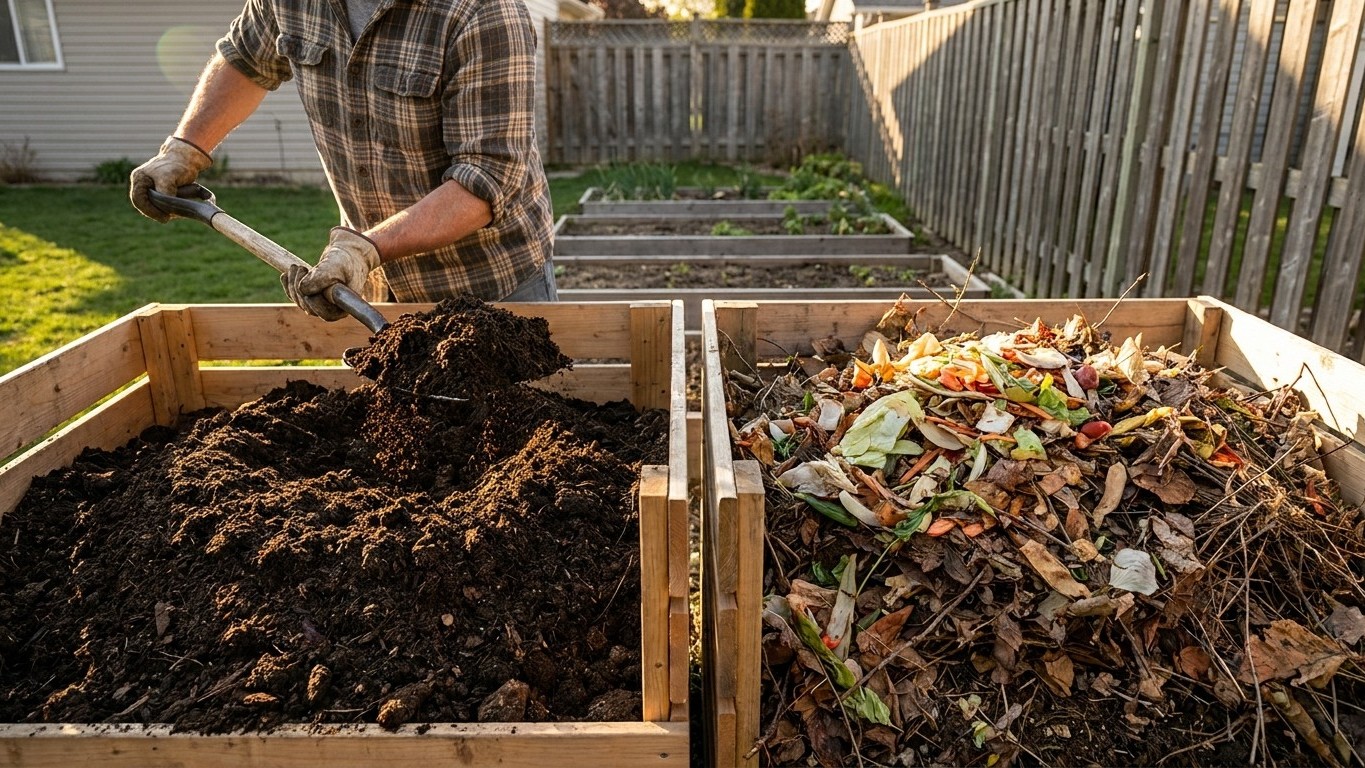

Two identical piles, same kitchen scraps and yard trimmings, can finish weeks apart or years apart. The difference isn’t the recipe. It’s one habit: how often someone picks up a pitchfork and turns the pile. Skip that step, and the exact same materials that could have been usable compost in eight weeks might still be raw scraps two years later.
The short answer
Utah State University Extension, in its Backyard Composting in Utah guide, puts numbers on that gap. Turning a pile weekly can produce finished compost in one to two months, provided the mix of materials and moisture is right. Drop to monthly turning, and the same pile takes four to six months. Leave it alone entirely, with no turning at all, and composting stretches to six months to two years. The extension’s own conclusion is blunt: aeration is generally the main factor affecting the time necessary to produce finished compost.
The reason comes down to biology, not convenience. Composting is aerobic decomposition, meaning the bacteria doing the work need oxygen to function. Their metabolism is what generates the heat inside a working pile. Aerobic composting consumes large amounts of oxygen, especially in the early stages, and if that oxygen supply runs short, the process can flip to anaerobic. That’s a slower, smellier version of the same job, run by a different set of microorganisms that don’t need air but also don’t work nearly as fast.
This matters at a scale beyond any single backyard bin. During the growing season, 30% or more of landfill waste is organic yard refuse, material that could have gone into a pile instead of a truck. Finished compost, once it’s ready, does real work in soil: it increases tilth, fertility, water holding capacity, aeration, and drainage. None of that happens on a useful timeline if the pile is starved of oxygen for months at a stretch. So while ingredients, moisture, and particle size all play a role, turning frequency is the variable that decides whether a given batch of compost is ready in two months or still sitting there in year two.
What actually decides it
Aeration runs the whole show
Oxygen levels inside a pile get replenished by lifting and turning the materials, whether with a pitchfork or a mechanical turner. There’s a technique to it beyond just flipping the pile: try to put the outside, drier materials into the center of a newly turned pile. That drier outer layer tends to be under-decomposed compared to the hot, active core, so moving it inward gives it a turn at the best conditions. Every other factor below matters, but none of them compensates for a pile that never gets air.
The carbon-to-nitrogen mix
The proper compost mixture contains approximately 2 parts carbon-rich materials to 1 part nitrogen-rich material, measured by volume, not by any chemical ratio. Carbon shows up in dry, brown materials such as leaves, chipped woody brush, sawdust, and straw. Nitrogen is most abundant in fresh, green yard and garden trimmings, vegetable scraps, and livestock manures. Microorganisms use carbon for both energy and growth, while nitrogen is essential for growth and reproduction, so an imbalance in either direction throws off the whole operation. Too little carbon and the available carbon gets used up before all the nitrogen is stabilized, producing excess ammonia and unpleasant odors. Too little nitrogen and the process slows dramatically because microorganisms don’t have enough of what they need to multiply.
Particle size
Size decides how long woody material sits around looking untouched. Chips, branches, twigs, and paper can take up to two years to decompose unless they’re finely chipped or shredded first. Running trimmings through a chipper, lawnmower, or just chopping them with a shovel or machete speeds that up considerably. Optimum composting conditions come from particle sizes ranging from 1/8 to 2 inches in average diameter, a detail that’s easy to skip and expensive in time when it’s skipped.
Moisture and heat
Moisture should stay within a 40% to 65% range, and it generally decreases as composting proceeds. Temperature follows its own pattern: a working pile climbs rapidly to 120-140°F and holds there for several weeks depending on conditions, before gradually dropping to ambient air temperature as activity slows. Two broader ranges get named separately, mesophilic (50-105°F) and thermophilic (over 105°F), and keeping Temperatures between 110 and 150°F destroys more pathogens, weed seeds, and fly larvae than a cooler pile ever will.
How to do it
- Pick the site. Choose a spot exposed to at least six hours of sunlight a day, with water readily available and good drainage, since standing water can impede decomposition.
- Choose a container. Heaps cost nothing and suit no-turn composting if built at least one cubic yard in volume. Hoops made of woven wire mesh can be unhooked, moved next to the pile, and refilled, turning the pile in the process. Boxes look tidier and should have gaps in the sides for airflow, with a removable front; building several side-by-side makes turning easier. Barrels, often a modified 55-gallon drum with air holes and an access hatch, suit small volumes and frequent turning in tight spaces.
- Size the materials. Chop or shred woody trimmings so pieces fall between 1/8 and 2 inches in diameter, rather than leaving whole branches to sit for up to two years.
- Layer the mix. Combine roughly 2 parts brown, carbon-rich material to 1 part green, nitrogen-rich material as the pile is built.
- Add nitrogen if needed. If the mix runs short on greens, mix in about 1 pound of actual nitrogen per cubic yard of material as the pile is constructed.
- Check moisture by hand. Squeeze a handful: if water squeezes out, it’s too wet; if the handful doesn’t feel moist at all, it’s too dry. Aim for the 40% to 65% range in between.
- Turn on a schedule. Weekly turning targets one to two months to finished compost; monthly turning stretches that to four to six months; no turning at all can run six months to two years.
- Watch the temperature. Expect a rise to 120-140°F. If the pile sits in the mesophilic range, mix it; if it still won’t reach thermophilic after reviewing the steps above, the active stage is complete.
- Cure before use. Once compost turns dark, crumbly, and earthy-smelling with no offensive odor, let it sit undisturbed for up to one month as extra insurance against incomplete decomposition.
What goes wrong
Two opposite faults announce themselves with two very different signals. An ammonia smell points to too much nitrogen. A pile that just sits there, cold and inactive, points to too much carbon. Beyond that split, most other failures trace back to the same fix.
- Malodorous pile: caused by compaction and insufficient oxygen, or by excess moisture. Turn the pile; if moisture is the culprit, add dry porous material like sawdust while turning.
- Ammonia odor: too much nitrogen relative to carbon. Add carbon-rich material and turn it in.
- Damp but won’t heat: insufficient nitrogen, remedied by adding fresh grass clippings or fertilizer; or the pile is too wet, in which case let it dry out and turn to dry the center.
- Dry and not composting: insufficient water. Form the pile so the center is the lowest point to prevent runoff, then apply water to moisten it.
- Pile too hot: usually because it’s too large, so reduce its size; or because ventilation is poor, in which case turn it.
- Pile too cold: can come from several directions at once, too small (enlarge or insulate the sides), too dry (water while turning), poorly aerated (turn), short on nitrogen (add greens), or simply cold weather (increase pile size or insulate with an extra layer such as straw).
- Pests like rats, raccoons, or insects: almost always traced to meat scraps or fatty food waste. Remove them, cover the pile with soil or sawdust, build an animal-proof bin, and turn the pile to raise its temperature.
- Woody chunks that never break down: particle size too large. Chip or shred material down to the 1/8 to 2 inch range before adding it.
Notice how often the remedy is the same word: turn it. Five of the eight failures above are solved, at least in part, by turning the pile, which circles back to the one habit that decides the whole timeline.
Common questions
Do I need a tumbler or special bin to compost fast?
No specific brand or design is required. Any container that’s accessible, resists decay, and allows air flow works, according to the extension guide. Barrels and tumblers simply make turning physically easier, which is why they suit tight spaces, but a well-built hoop or box turned on the same schedule gets the same result.
Can I put pet waste in my compost pile?
No. The guide is explicit on this point, stated twice: do not put pet wastes in a compost pile. Some wastes attract pests, and others carry pathogens that can survive the composting process entirely.
How do I know when compost is actually finished, not just done heating?
Finished compost is dark, crumbly, and has an earthy, non-offensive odor. Most batches still benefit from an additional curing phase, left undisturbed for up to one month, since improperly or incompletely composted material can release ammonia or continue heating once applied to soil, damaging plants.
Does a compost pile really need six hours of direct sun?
That’s the guideline in the source: at least six hours of sunlight daily, water readily available, and good drainage so standing water doesn’t impede decomposition. A shaded, waterlogged corner of the yard works against the pile before turning frequency even enters the picture.