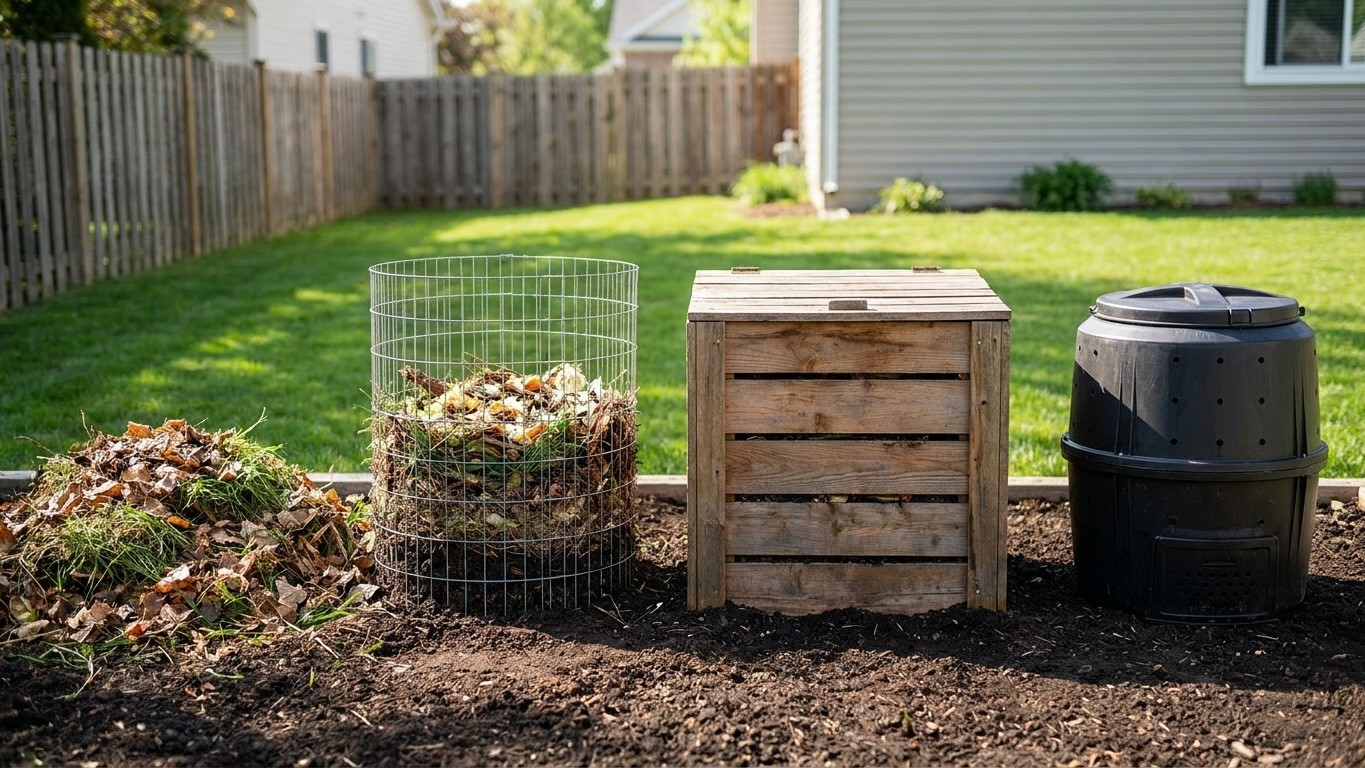

Four container types, one deciding question: how much room do you have, and how often are you willing to turn the pile? Utah State University Extension lays out heaps, hoops, boxes and barrels side by side, and the difference between them has nothing to do with sticker price. It comes down to space, turning effort, and how fast you want finished compost.
The short answer
Utah State University Extension’s guide, Backyard Composting in Utah, names four workable containers and says the choice depends on the amount of time and space you have, and the quantity of materials you’re composting. Not on cost. The only universal requirements, according to the extension, are that a container be accessible, resist decay, and allow air flow. Everything past that is a tradeoff.
A heap costs nothing. You simply pile materials in a heap, ideally at least one cubic yard in volume, and if it’s well built you can leave it alone for several months or more with no turning at all. That’s the tradeoff: no labor, no equipment, but you need the open ground to spread it out.
A hoop, made from woven wire mesh or fencing, is low cost and tidier than a bare heap. If you fasten it with hooks or twists of wire instead of a permanent seam, you can undo the hoop, set it up next to the old pile, and turn the whole batch back into the hoop in its new spot. The container itself becomes the turning tool.
A box looks better in a visible yard, is easy to cover, and runs low to moderate cost. The extension’s design detail matters here: leave spaces in the sides for air, and make the front removable so you can dig in and turn. Building several bins side by side is the recommended way to make turning practical, since you’re forking material from one bin into the next.
A barrel, typically a modified 55-gallon drum, is the pick for limited space. It costs moderate to high, but turning is easy, and by perforating the drum with air holes and cutting an access hatch in the side, you get a system that composts small amounts of material quickly. Small yard, small volume, faster result. That’s the barrel’s whole case.
What actually decides it
One variable outranks everything else in this decision: how often you’re actually going to turn the pile. Turning drives oxygen into the material, which is what keeps decomposition active instead of stalled. Every container on this list is really a different answer to the same question, how do I make turning possible given my space and my patience.
Turning frequency
A heap that’s never turned still composts, but it takes several months or because no one is reintroducing air. A hoop is built around the opposite bet: unfasten it, relocate it, and the pile turns itself as it’s shoveled back in. A barrel makes turning nearly effortless, sometimes by rolling the whole drum, which is exactly why it can process small batches quickly. Rank every other factor beneath this one. If you’re not going to turn, buy yourself space instead.
Space available
Space is the second-ranked factor, and it’s the flip side of turning. Heaps need the most ground because they need volume, at least a cubic yard, sitting undisturbed. Barrels need the least ground because they’re vertical and self-contained. If your yard can’t spare a cubic yard of open space, a barrel or a compact box narrows your options fast, regardless of what you’d prefer to build.
Quantity of material
How much yard waste and kitchen scraps you actually generate matters more than most people assume before they build anything. A household with a big lawn and a garden producing steady debris fills a heap or a multi-bin box system efficiently. A household with modest scraps and no yard waste will never generate enough material to justify a cubic-yard heap, and a barrel’s smaller capacity fits the actual volume being produced.
Time you’re willing to invest
Site placement also plays a role, though a smaller one. The extension recommends a spot exposed to at least six hours of sunlight each day, with water readily available and good drainage, since standing water can impede decomposition regardless of which container sits on top of it. But site is a constant across all four options. Turning frequency is the variable that actually splits them apart.
How to do it
- Pick the site first. Choose a spot with at least six hours of daily sunlight, easy access to water, and drainage good enough that water doesn’t pool. This applies before you decide which container to build.
- Match the container to your turning plan. If you won’t turn, build a heap at least one cubic yard in size. If you want the container to do the turning for you, build a hoop you can unfasten and relocate. If you want a visible, coverable structure, build a box with air gaps in the sides and a removable front, and add a second bin alongside it if you want to shift material between them. If space is tight, set up a perforated barrel with a side access hatch.
- Layer by volume, not weight. Build the pile using approximately two parts carbon-rich material, dried leaves, straw, shredded paper, to one part nitrogen-rich material, grass clippings, kitchen scraps, garden trimmings. Two buckets of brown material to one bucket of green is the practical measure.
- Check pile size against the cubic-yard benchmark. A heap under roughly a cubic yard won’t hold heat well; build up to that volume before expecting the pile to work without turning.
- Turn according to your container’s design. Fork a box’s contents into the neighboring bin, undo and relocate a hoop, roll or open the hatch on a barrel. A no-turn heap skips this step entirely and simply waits.
- Watch the Temperature as a working signal. An actively working pile typically runs in the 120 to 140 F range. Material in the 50 to 105 F band is in the mesophilic stage; above 105 F it has moved into the thermophilic stage. A pile that holds in the 110 to 150 F range for a stretch destroys more pathogens, weed seeds, and fly larvae than a cooler pile does.
- Give it time. A well-built, unturned heap needs several months or more. Barrels and regularly turned bins move faster because turning keeps oxygen and heat active throughout the material.
What Goes Wrong
- The pile smells like ammonia. That sharp odor signals too much nitrogen-rich material relative to carbon. Fork in more dried leaves, straw, or shredded paper to bring the mix back toward the roughly two-to-one, brown-to-green, volume ratio.
- The pile just sits there, cool and inactive. That’s the opposite signal from ammonia, it usually means not enough nitrogen-rich material, insufficient volume, or no turning to reintroduce air. Add fresh green material, build the pile up toward a full cubic yard, and turn it.
- The pile stays soggy after rain. Standing water in or around the container points to poor drainage at the site, exactly the condition the extension warns can impede decomposition. Relocate to better-draining ground or raise the container off standing water.
- A box grows moldy patches or stays wet inside. This usually traces back to sides built without enough air gaps. Add spacing to the sides, or open the removable front more often to let air move through.
- A barrel never seems to break anything down. Check that the perforations for air holes weren’t skipped or blocked, and confirm the access hatch is actually being opened and turned regularly, since a sealed drum defeats the design’s purpose.
Common questions
Do I need to turn a heap at all?
No. Utah State University Extension notes that a well-constructed heap is suited to no-turn composting, you simply leave it for several months or more. Turning speeds things up but isn’t required if the heap is sized and built correctly.
Which container works best in a small yard?
A barrel, according to the extension, is specifically suited to limited space and offers easy turning, composting small amounts of material quickly once perforated with air holes and fitted with a side access hatch.
What temperature means the compost is actually working?
A working pile typically runs 120 to 140 F. More broadly, temperatures above 105 F indicate the thermophilic stage, while 50 to 105 F is mesophilic. A pile sustained in the 110 to 150 F range destroys more pathogens, weed seeds, and fly larvae than a cooler one.
Can I rely on autumn leaves as my main carbon source?
Leaves are a common seasonal supply of carbon-rich material. The extension’s guidance is to combine roughly two parts carbon-rich material, which leaves qualify as, to one part nitrogen-rich material by volume, rather than relying on leaves as the sole ingredient.