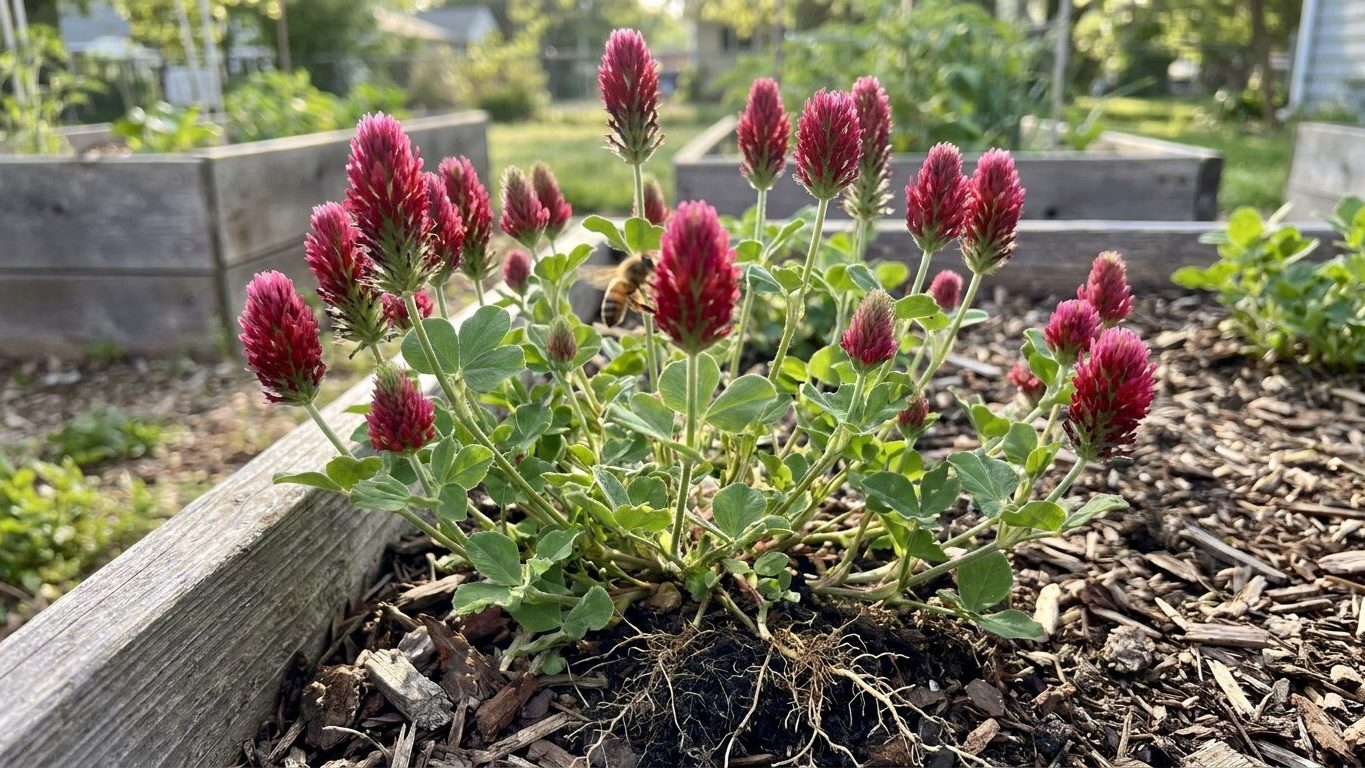

Crimson clover earns its reputation as the beginner’s legume because it forgives mistakes that would sink other cover crops. It germinates fast, grows through a single cool season, and dies back or gets terminated without a fight. That combination, easy on, easy off, is why so many home gardens start their cover-cropping habit here instead of with vetch or rye.
What is actually going on
The thing that separates crimson clover from most of the legume family is manageability, not nitrogen. Every legume partners with soil bacteria to pull nitrogen from the air and store it in root nodules, but that trait alone doesn’t make a plant garden-friendly. What makes crimson clover different is what happens on the other end, at termination, and how little drama is involved in getting there.
Crimson clover germinates within days under decent moisture and moderate soil temperature, then spends the cool season building a fibrous taproot system and a low rosette of leaves before bolting upward and producing its signature deep red flower spikes. That growth pattern matters because it means the plant commits early to root development rather than throwing all its energy into top growth, which is part of why it tolerates a hard mowing or a frost snap without collapsing the whole stand into a mess of vegetative debris.
Compare that to hairy vetch, the other legume gardeners hear about constantly. Vetch sprawls, twines around anything vertical, and if it sets seed before termination, volunteers show up in beds for two or three seasons afterward. Crimson clover sets seed too, but its seed doesn’t carry the same aggressive dormancy and spread pattern. Terminate it at the right window and you are done. That single difference, seed behavior after termination, explains most of why one legume gets recommended to first-timers and the other gets a caution label.
The nitrogen contribution itself works through decomposition, not through some fixed number you can bank on. When the plant is cut, crimped, or killed by frost, the nodules and root tissue break down and release nitrogen into the soil in a form the next crop can use, but how much and how fast depends on how much biomass the plant built before termination and how it was terminated. A stand cut at early bloom, still succulent and full of nitrogen-rich tissue, decomposes differently than one left to go woody and set seed. That is a mechanism worth understanding on its own terms, not a number worth memorizing, because the actual figure shifts with soil temperature, moisture, and how the residue is managed afterward.
This site terminates cover crops the same way it explains them: mechanically. Mowing, crimping, cutting, or letting a hard frost do the work. No spray step, no product to time around. Crimson clover’s growth habit is part of why that mechanical approach works so cleanly here, when other species resist a mower blade or regrow from a crown that survived the cut.
In the garden
Where crimson clover fits in a home rotation comes down to three decisions: when it goes in, how cold it can take, and whether you let it flower. Get any one of these wrong and the crop either underperforms or turns into extra work instead of less.
| Decision point | What to do | What happens if you get it wrong |
|---|---|---|
| Planting window | Seed it after the main harvest, while there’s still enough warm-to-cool transition time for roots to establish before growth slows for winter | Seeded too late, the stand enters winter thin and shallow-rooted, then struggles to bounce back and never builds enough biomass to matter |
| Cold tolerance | Know your own winter severity before counting on the plant to overwinter; in many regions it survives fine, in others it winterkills and that’s actually useful | Assuming it behaves the same everywhere leads to either a surprise die-off with no cover left mid-winter, or an unexpected survivor that needs spring termination you didn’t plan for |
| Letting it flower | Allow it to reach early-to-mid bloom before terminating if your schedule allows; the flowers pull in pollinators and beneficial insects and the plant has built most of its usable biomass by then | Terminate too early and you lose most of the nitrogen benefit and the biomass; wait too long, past bloom into seed set, and you’re managing volunteer clover in beds for the next year or two |
| Termination timing | Mow, crimp, or cut once flowering is underway, or rely on a hard frost where winterkill is reliable | Termination that’s rushed before bloom wastes the crop’s potential; termination skipped entirely leaves you fighting mature stalks that resist a mower |
The flowering decision is the one gardeners second-guess most, and it’s worth defending on its own. A crimson clover stand in bloom is genuinely valuable to pollinators at a time of year when not much else is flowering in a vegetable garden, and the plant doesn’t lose its structural integrity the way an over-mature grass cover crop would. The tradeoff is timing your cash crop planting around that bloom window instead of rushing to clear the bed the moment weather allows. For most home gardeners, a week or two of extra bloom time is a fair trade for the pollinator visits and the added root mass, as long as termination happens before seed heads fully form.
One practical note on establishment: crimson clover does better with decent seed-to-soil contact than a broadcast-and-walk-away approach. Light raking or a pass with a hand seeder that actually presses seed into loosened soil beats scattering it over undisturbed ground. Exact seeding rates vary by whether you’re broadcasting or drilling, by the seed source’s germination rate, and by regional recommendations, so that number is one to get from your local Cooperative Extension office rather than a general rule of thumb here.
What it depends on where you are
Everything above about growth habit, root development, and termination mechanics holds true no matter where you garden. What doesn’t hold true everywhere is timing, and that’s the part this page genuinely can’t answer for you.
Season length is the biggest variable. In regions with a long, mild fall and winter, crimson clover may keep growing slowly through the cold months and need active termination in spring. In regions with hard, early winters, frost does that job automatically, and the plant is finished before you’d have to touch it. Neither outcome is better or worse, but they call for different planning, and confusing one for the other is how a gardener ends up either terminating too early or discovering live clover still growing when the spring garden needs the bed back.
Summer heat matters less directly for a cool-season legume like this one, since it’s not actively growing during the hottest months in most climates, but it shapes the windows on either side. A region with a short, intense summer squeezed between long shoulder seasons gives you more flexibility on both the fall planting date and the spring termination date than a region where summer heat arrives fast and stays late, compressing the whole window into a few workable weeks.
Rainfall patterns during establishment change the equation too. A dry fall means germination stalls until moisture arrives, no matter what the calendar says, while a wet fall can push planting earlier than usual because soil conditions allow it. None of these variables are things a national page can responsibly assign a date or a zone to, because they shift block by block in some regions and state by state in others.
This is exactly why the state-level guides on this site exist separately from this one. They translate the mechanism explained here into the specific windows that apply to a given region’s frost dates and rainfall pattern. Beyond that, your local Cooperative Extension office has decades of trial data specific to your county, and for a crop as regionally sensitive as timing a cool-season legume, that local data will always beat a general guideline.
The mistake that costs the most
The single error that costs gardeners the most with crimson clover isn’t planting it too late or picking the wrong spot. It’s letting it go past bloom into full seed set before terminating.
Once the flower heads dry down and seed forms, crimson clover stops being a manageable, self-limiting cover crop and starts behaving like the plant it gets confused with, hairy vetch: something that comes back on its own terms the following season. A few volunteer clover plants scattered through next year’s vegetable bed sound harmless, and in small numbers they mostly are, but a full stand that went to seed can produce enough volunteers to compete seriously with transplants and direct-seeded crops, forcing hand-pulling or repeated cultivation right when a gardener least wants extra work.
The fix is straightforward and it comes down to watching the plant instead of the calendar. Crimson clover’s flower spikes go from vivid crimson to a duller, straw-colored brown as seed matures, and that color shift is the signal to terminate now rather than next week. Mowing, crimping, or cutting at that point still delivers most of the biomass and nitrogen benefit the plant can offer, while cutting even a week or two later, once seed has set and started to shatter, means some of that seed is already on the ground regardless of how the residue is handled afterward.
What to do instead is simple: check the stand weekly once flowering starts, and terminate at the color change rather than waiting for a more convenient day. If a hard frost is expected to do the job for you in your region, that’s fine too, but don’t count on it arriving before seed matures without checking your own local frost timing first. A little attentiveness at the right week beats a season of pulling volunteers out of next year’s garden.