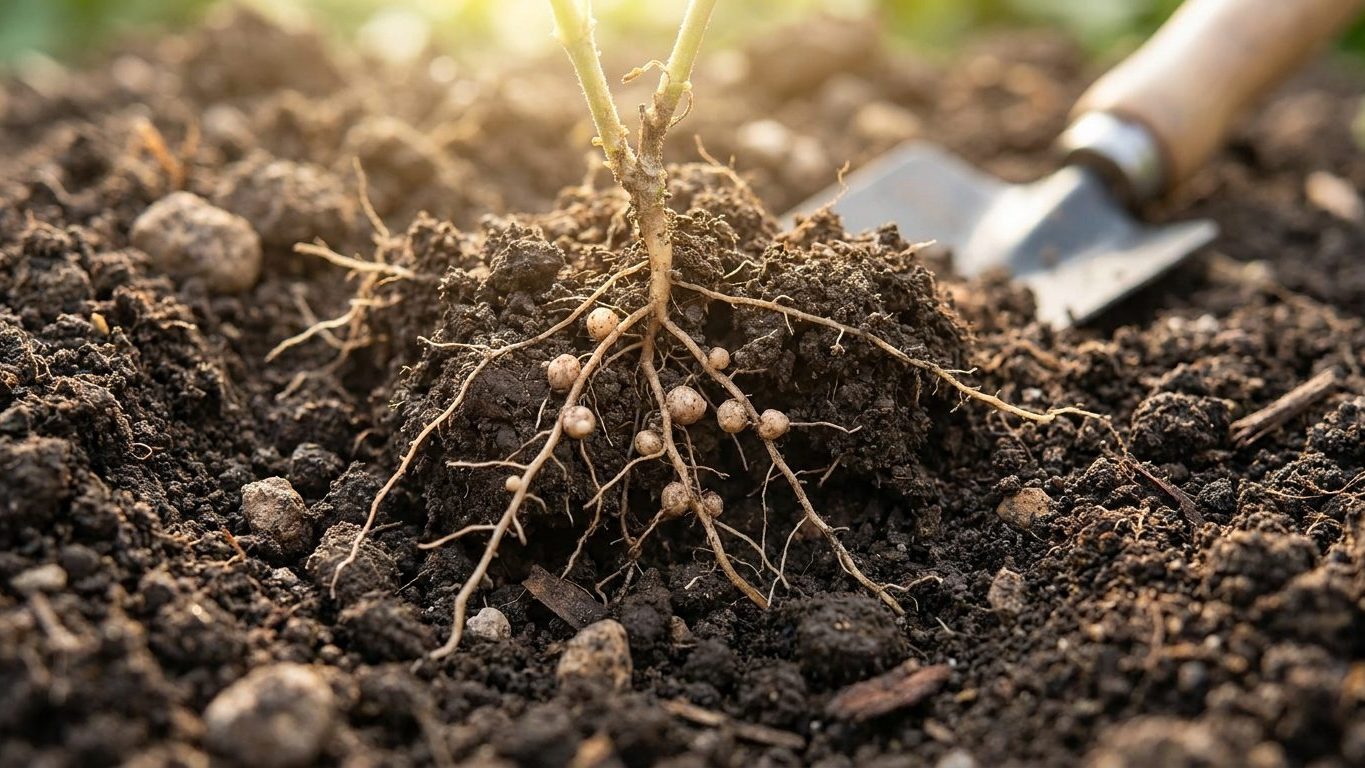

A legume doesn’t feed your soil nitrogen while it’s standing in the field, green and healthy. The nitrogen stays locked inside bacteria and root tissue until the plant dies and breaks down. That single fact explains most of the confusion around cover crops: legumes pull nitrogen from the air, but they don’t hand it to your soil until termination and decomposition do the work.
What is actually going on
The process starts underground, and it starts with a partnership, not a plant trick. Soil bacteria called Rhizobium colonize the root hairs of legumes like clover, peas, vetch and beans, then trigger the plant to grow small nodules along its roots. Inside those nodules, the bacteria use an enzyme called nitrogenase to convert atmospheric nitrogen gas, the stuff that makes up nearly 80 percent of the air around you, into ammonia the plant can actually use. In exchange, the plant feeds the bacteria sugars from photosynthesis. Neither side does this alone. A legume grown in sterile soil, with no Rhizobium present, fixes almost no nitrogen at all.
Here’s the part that trips people up: that fixed nitrogen mostly stays inside the plant. It builds leaves, stems, roots and the nodules themselves. Only a small fraction leaks into the surrounding soil while the plant is alive. The bulk of it becomes available to a future crop only after the legume dies and soil microbes decompose its tissue, a process called mineralization. Kill the plant, and you start the clock on release. Leave it standing, and the nitrogen stays tied up in living tissue.
Why the timing of death changes the math
Two things decide how much nitrogen a decomposing legume actually delivers: how much tissue it produced, and the carbon-to-nitrogen ratio of that tissue at the moment it dies. Young, succulent growth has a narrow carbon-to-nitrogen ratio, and soil microbes break it down fast, releasing nitrogen within weeks. Let the same plant flower and start setting seed, and its stems turn fibrous and woody. The carbon-to-nitrogen ratio widens, decomposition slows, and the nitrogen gets temporarily locked up in microbial bodies instead of being available to roots. Harvest the pods or seed for your own use, and you’ve exported a chunk of that fixed nitrogen off the plot entirely, since seeds are nitrogen-dense tissue too.
None of this means legumes are unreliable. It means the benefit is a function of biomass and decomposition timing, not a fixed amount you can bank on regardless of how the crop is managed.
In the garden
Termination timing is where most of the value gets won or lost, and it’s also where gardeners most often undo their own work without realizing it. The table below walks through what happens at different termination points, using mechanical methods only: mowing, crimping, cutting, or letting frost finish the job.
| Termination point | What happens | Why it goes wrong or right |
|---|---|---|
| Cut early, before flowering | Total biomass is low; nitrogen fixed so far is modest, though it breaks down fast once cut | You get quick release but from a smaller pool. Nodule activity is still ramping up at this stage, so you’re cutting the plant off before it’s done its best work. |
| Cut at flowering | Biomass and nodule activity are both near their peak, and tissue carbon-to-nitrogen ratio is still narrow enough to decompose quickly | This is usually the sweet spot: maximum nitrogen fixed for the least delay in release. |
| Cut after flowering, into seed set | Biomass is higher, but stems have gone fibrous and some nitrogen has shifted into developing seed | Decomposition slows because of the wider carbon-to-nitrogen ratio. A crop planted right behind it can actually show a temporary nitrogen dip while soil microbes work through the tougher residue first. |
| Killed late by hard frost | Similar effect to seed-set termination: tissue is mature and slow to break down | Useful for winter soil cover, but plan on a longer wait before the released nitrogen is available to a spring crop. |
| Pulled and hauled away | Most of the fixed nitrogen leaves with the plant | This is the one that erases the benefit almost entirely. The nitrogen is in the tissue, and if the tissue leaves the plot, so does the payoff. |
Mechanical method matters too, separate from timing. Crimping lays stems flat and intact, which slows airflow to the residue and can stretch out decomposition compared with mowing, which chops tissue into smaller pieces that microbes reach faster. Neither is wrong, but they’re not interchangeable if your next planting date is close behind.
One more practical point: don’t expect to terminate a legume and plant into the same bed the next morning. Roots and stems need time in contact with soil moisture and microbial activity before mineralization delivers usable nitrogen. Finely chopped residue speeds that window; thick, intact stems stretch it out. Exact windows depend on species, biomass and your local soil temperature, which is exactly the kind of detail your county extension office can calibrate for your conditions and your seeding method.
What it depends on where you are
Some of this page is universal biology. Rhizobium bacteria, nodule formation, the shift from fixation to mineralization at termination, that mechanism doesn’t change whether you garden in a river valley or a high desert. What changes by location is how much time the plant gets to build biomass before it has to come out, and how efficiently the bacteria work while it’s growing.
Season length sets the ceiling on total growth. A legume with a short window between planting and the next crop’s start date simply won’t build the biomass that the same species would in a longer growing window, and less biomass means less total nitrogen fixed, regardless of how well the bacteria performed. Summer heat and rainfall patterns affect the bacteria directly: Rhizobium activity slows under drought stress and under waterlogged, oxygen-poor soil, and soil pH outside the near-neutral range can reduce nodulation before fixation even starts. None of that is something a national page can tell you with any precision, because it varies by region, by soil type, and by year.
This is also where local knowledge outperforms generic advice. Your county extension office tracks regional frost dates, typical soil temperatures, and which legume species nodulate reliably in local soils, and they can tell you the realistic biomass window for your area in a way no general guide can. The state-level guides elsewhere on this site walk through species selection and rough timing by region; treat this page as the mechanism, and treat those as the local calibration.
The mistake that costs the most
The single costliest error isn’t picking the wrong species or cutting a week too early or too late. It’s terminating the legume and then removing the top growth from the plot, whether that’s mowing and raking off the clippings, cutting it for the compost bin across the yard, or hauling it to the curb with yard waste. The nitrogen a legume fixes lives in its tissue. Take the tissue away, and you take the nitrogen with it, no matter how well the plant grew or how perfectly you timed the cut.
This mistake is easy to make because it feels tidy. A mowed, raked bed looks more finished than one covered in cut stems and wilting leaves. But that residue lying on the surface, or lightly worked into the top few inches of soil, is the entire point of growing the legume in the first place. Mechanical termination, mowing, crimping, or a simple hand cut, is meant to kill the plant in place, not clear the bed.
The fix is straightforward once the mechanism is clear: terminate where the plant stands, and leave the residue on the surface or work it shallowly into the soil rather than bagging it or moving it elsewhere. If a tidy look matters to you, chop the residue finer with a mower pass, which speeds decomposition and makes the bed look less like a green tangle within a couple of weeks. Compost the plant somewhere else and you’ve grown a legume for nothing more than the exercise. Leave it where it fell, and the same plant becomes next season’s nitrogen.