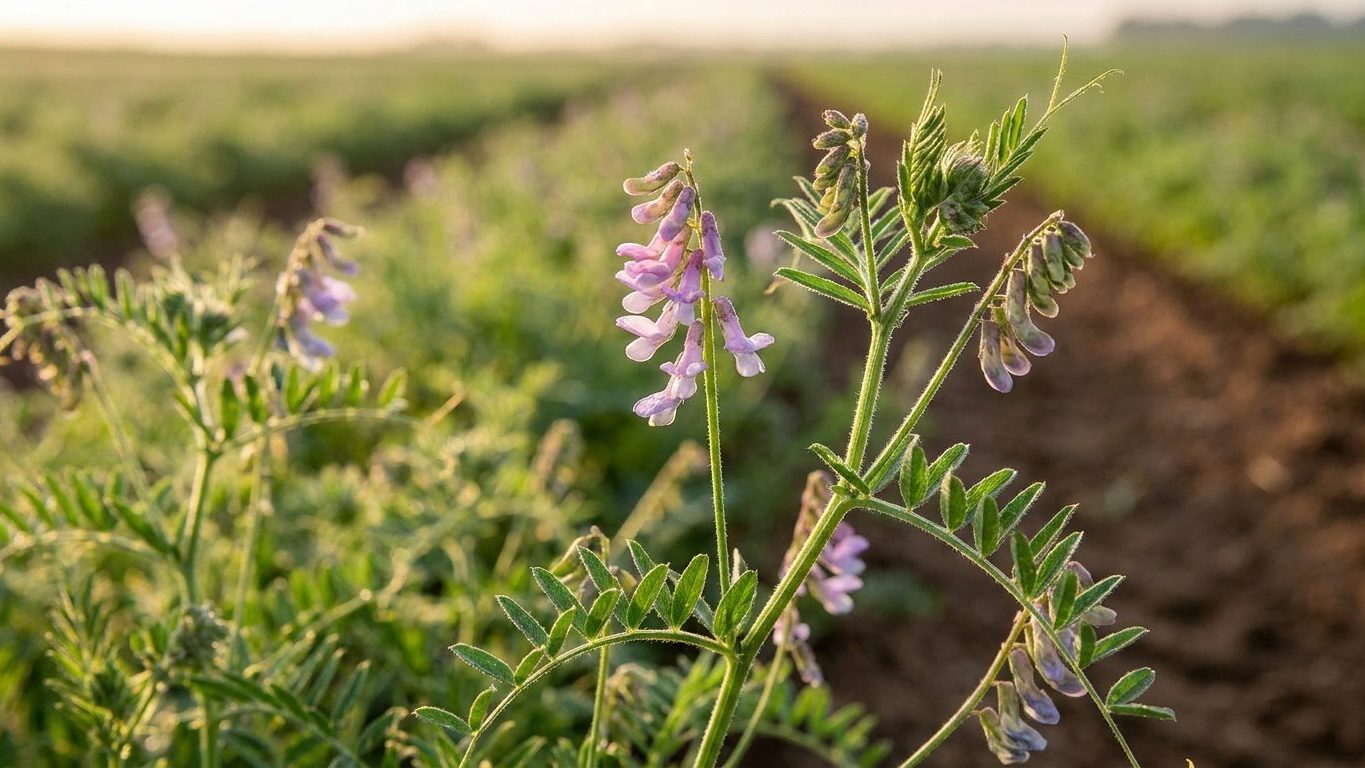

The right moment to kill a cover crop is when it flowers, not before, not long after. For a legume that means first bloom, when nitrogen is already banked in the shoots but seed hasn’t formed. For a grass like cereal rye it means the boot stage to early head, before the stem lignifies into something a mower just bends instead of cutting. Miss that window either direction and the crop stops working for you.
What is actually going on
Flowering is the hinge point in a cover crop’s life, and almost everything about termination timing hangs on it. Before flowering, a plant is still investing energy into leaves, stems, and roots. Biomass climbs, and so does the nitrogen a legume is pulling out of the air and storing in its tissue. That’s the growth you want to capture before you cut it down.
After flowering, the plant’s priorities shift. A grass like rye or oats starts pushing lignin into its stems to hold up a seed head, and that lignin is exactly what makes old cover crop residue tough to mow, tough to crimp, and slow to break down once it’s on the soil. A legume, meanwhile, redirects its energy from leaves toward pods. Once seed starts to fill, the nitrogen that was tied up in leafy growth gets partly reallocated to the seed itself, and some of what you were counting on for the next crop walks off with a harvest you didn’t want.
Wait too long on either type and you run into the second problem: viable seed. A grass that’s headed out and a legume that’s podded can both drop seed onto the bed before you ever get the mower over it. Now you’re not terminating a cover crop, you’re planting one, whether you meant to or not. That volunteer growth competes with whatever you intended to grow next, and pulling it out by hand later costs more time than getting the timing right the first time would have.
Cut too early and the opposite failure shows up. A young cover crop hasn’t built much biomass yet, so there’s little organic matter to protect the soil surface or feed the microbes that turn residue into humus. A legume terminated well before flowering has barely started fixing nitrogen at scale, so the fertility benefit you were hoping to bank for the next planting is thin. You’ve done the work of growing and killing a crop without collecting much of the payoff.
This site terminates cover crops mechanically: mowing, crimping, cutting, or letting a hard frost do the job. Each method has its own relationship to timing. A crimper, which lays the stalk down and crushes the stem without severing it, only works reliably on a plant that’s already flowering or just past it, because that’s when the stem is rigid enough to crease and die rather than bounce back. Mowing is more forgiving on timing but less forgiving on regrowth if you cut a legume before it flowers, since many legumes will simply resprout from the crown after a scalping.
In the garden
For a home gardener, the goal is the same as it is on a farm field: catch the plant at or just past flowering, before seed set, and get it down before it turns fibrous. But garden beds add a wrinkle a large field doesn’t have as sharply: you usually need that bed back for a specific planting date, and the cover crop’s ideal termination stage doesn’t always line up with your calendar.
Here’s how the common species behave at each end of the timing window, and what actually happens if you miss it.
| Species | Target termination stage | If terminated too early | If terminated too late |
|---|---|---|---|
| Cereal rye | Boot stage to early head emergence | Thin residue, little weed suppression next season | Stem is woody, hard to cut, slow to break down, may drop viable seed |
| Crimson clover | First bloom, roughly 10 to 30 percent of flowers open | Little nitrogen contribution banked yet | Seed pods form and shatter, creating volunteer clover for years |
| Hairy vetch | Early to mid bloom | Weak biomass, resprouts easily after cutting | Twines into a mat that’s hard to turn under, sets hard seed |
| Oats (winter-killed regions) | Let frost terminate naturally | Not applicable; frost sets the schedule | Not applicable; frost sets the schedule |
| Field peas | Early flowering | Minimal nitrogen benefit realized | Pods dry and split, seed scatters into the bed |
| Buckwheat | First flowers, before seed browns | Rarely an issue, buckwheat flowers fast | Seed matures within days of flowering and drops immediately |
Buckwheat is worth calling out on its own, because the window between flowering and seed drop is short, sometimes just a few days. If you’ve grown it as a quick summer cover between plantings, check it every few days once you see the first white flowers rather than waiting for a convenient weekend.
When the calendar forces your hand, the honest compromise is to terminate a little early rather than a little late. Losing some biomass and some of a legume’s nitrogen contribution is a manageable setback. Dealing with volunteer rye or self-seeded vetch in a vegetable bed for the next two seasons is not. If you’re up against a planting deadline and the crop isn’t flowering yet, mow it anyway and accept the smaller benefit. Don’t let it run past flowering just because you’re not ready for it either.
Sizing the planting itself, meaning how much seed goes into a given bed, depends on the species, the method you’ll use to terminate it, and how thick a stand you’re after, and that’s a question best answered by your local Cooperative Extension office rather than a general rule here.
What it depends on where you are
Everything above about flowering and stem toughness is biology, and it holds everywhere. What changes by region is the calendar those stages fall on, and that part of the answer, this page genuinely can’t give you.
Season length is the first variable. A grower with a short frost-free season is often relying on winter-kill to terminate a cover crop for them, choosing species that die on their own once temperatures drop far enough, and never touching a mower at all. A grower in a long, mild season is more likely to actively terminate a crop that would otherwise keep growing through winter, and may get two windows of growth and termination in a single year where a colder region gets one.
Summer heat changes which species even reach flowering reliably. A legume that blooms readily in a cool, humid spring can bolt through flowering and into seed almost overnight once temperatures spike, shrinking the window between “not ready” and “already dropped seed” from a couple of weeks to a couple of days. That’s part of why buckwheat behaves differently in a hot southern summer than it does in a cooler northern one.
Summer rainfall, or the lack of it, affects how much biomass a crop builds before it flowers at all. A cover crop under drought stress can flower early and small, cutting short the growth phase where it’s building the biomass and, for legumes, the nitrogen you’re trying to capture. In wetter regions the same species might grow taller and flower later, giving a wider window to catch it at the right stage.
Because of all that, the closest thing to a specific calendar for termination timing lives at two places: the state-level guides on this site, where regional planting and termination windows are laid out by climate zone, and your local Cooperative Extension office, which tracks the actual weather patterns and flowering dates for your county rather than a national average. The USDA’s extension office locator is the fastest way to find the contact for your area if you don’t already have one.
The mistake that costs the most
The single costliest error isn’t cutting a cover crop too early. It’s letting it go past flowering because the gardener is waiting for a bigger stand, more biomass, more of a good thing. That instinct is understandable and it’s backwards. Once a grass heads out or a legume starts podding, the clock is no longer working in your favor.
The cost shows up in two ways, and both are worse than the modest loss from terminating a bit early. First, the residue itself changes. A rye stem that’s gone past boot stage has already started laying down lignin, the structural compound that makes plant tissue rigid and slow to decompose. Cut it now and you’re left with tough, wiry stalks that resist breakdown, tie up soil nitrogen as microbes work to decompose that carbon-heavy material, and can actually make less nitrogen available to your next planting for weeks, not more.
Second, and more lasting, is seed. A legume or grass that reaches maturity before you terminate it will drop viable seed into the bed, and that seed doesn’t disappear when you turn the bed under. It sits there and germinates the next time conditions are right, showing up as a volunteer crop tangled through whatever you actually meant to grow. Hairy vetch in particular is notorious for this; its seed can stay dormant in soil for years, resurfacing as a weed problem long after the gardener who planted it has forgotten they ever did.
The fix costs nothing extra: check the bed for flowering rather than watching the calendar or eyeballing how tall the crop looks. A cover crop that looks thin and short but has started to flower is ready. One that looks lush and full but hasn’t flowered yet isn’t done building biomass, and one that’s already gone to seed is past the point where mowing alone solves the problem. Walk the bed, look for the first open flowers, and terminate within that window rather than waiting for the stand to look more impressive than it needs to.