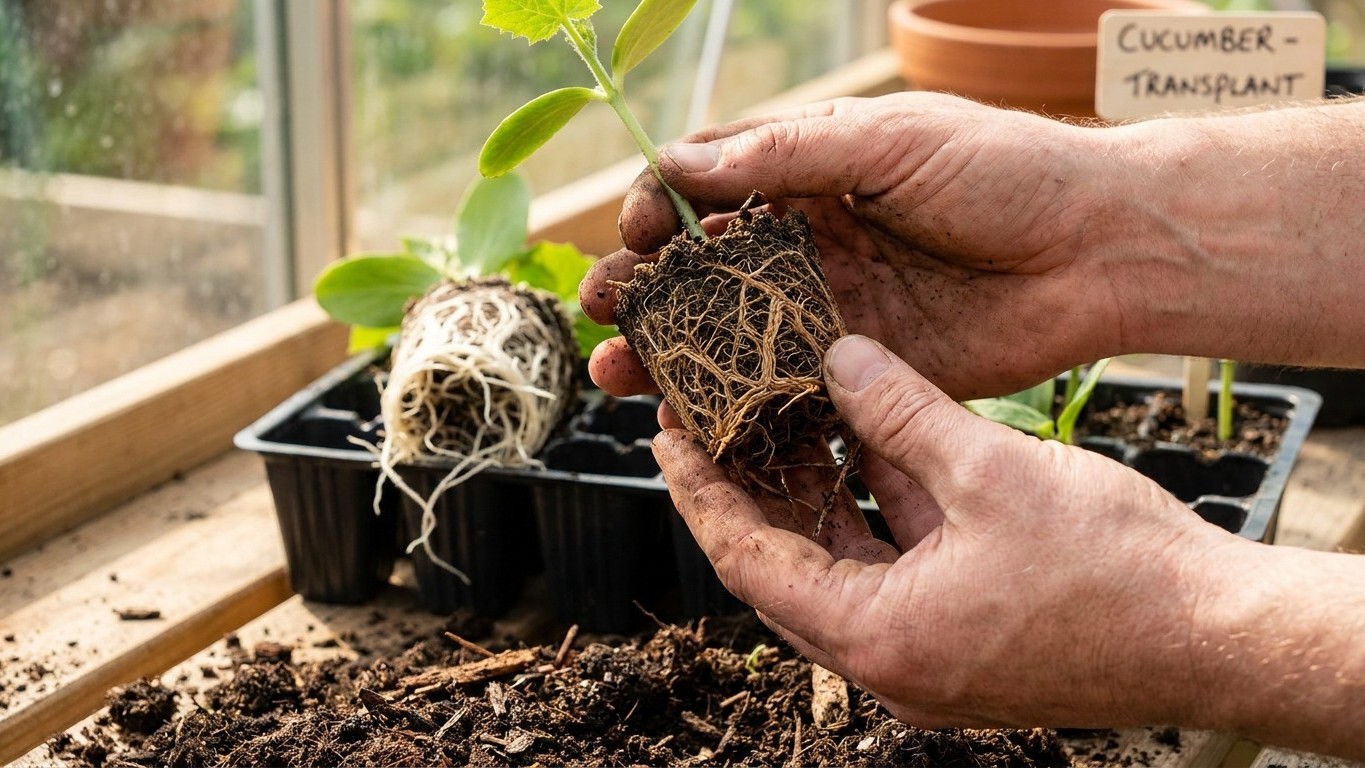

Cucumbers can go either way, but most gardeners get better results direct sowing. The seeds germinate fast in warm soil, and the plants skip the root disturbance that transplanting causes. Transplants earn their keep only in short-season climates where a few extra weeks matter more than the setback risk. The right call depends on your season length, not on habit.
What is actually going on

The thing to understand here is root disturbance. Cucumbers belong to the cucurbit family, along with squash and melons, and cucurbits share a trait that makes nursery workers wince: brittle taproots that do not regenerate readily once broken. Pull a cucumber seedling from a cell tray and you’ll often see a root system that looks tangled and cramped rather than the loose, spreading web you’d find on a tomato or a pepper at the same stage. That difference is not cosmetic. It’s the whole story.
When a root tip snaps or gets twisted against the wall of a container, the plant doesn’t just pause. It redirects energy into repairing or regrowing that root before it resumes putting out leaves. Gardeners call this transplant shock, and with cucumbers it shows up as a stall that can run a week or more, sometimes longer if the weather turns cold or dry right after planting. A tomato shrugs this off in a few days. A cucumber sulks.
Seed sown directly in the garden never faces that setback. The root grows outward from the seed in place, undisturbed, extending as far and as fast as soil conditions allow. That’s part of why direct-sown cucumbers frequently catch up to and pass transplanted ones that had a two- or three-week head start in a tray. The transplant’s early lead gets eaten up by the time it spends recovering.
Vining habit versus bush habit
The type of cucumber you’re growing changes how much this matters. Vining types, the long-running plants meant for trellises, tend to put on an aggressive root system early because they need to support a sprawling top. Bush types, bred for containers and small beds, are naturally more compact both above and below ground, which can make them slightly more forgiving of a transplant check, though not immune to it. Pickling types and slicing types don’t differ much on this point. What matters is vining versus bush, and whether the variety is parthenocarpic (setting Fruit Without Pollination, common in some burpless and greenhouse-style types) or standard. None of that changes the root biology. It just changes how visible the setback is.
None of this means transplanting is wrong. It means it’s a trade: a head start against a season-length problem, paid for with a recovery period that direct-sown plants never have to go through. The next section is about when that trade is worth making.
In the garden
Transplanting cucumbers makes sense in one specific situation: a short growing season where the plant needs every extra week of warmth it can get before frost cuts things off. Everywhere else, direct seeding is simpler, cheaper, and generally produces a sturdier plant by midsummer. Here’s how the decision plays out, and what happens when each approach goes wrong.
| Situation | Better choice | What goes wrong if you pick the other option |
|---|---|---|
| Long, warm growing season | Direct sow | Transplanting adds cost and labor for no real gain, and the plant stalls for a week it didn’t need to lose. |
| Short season, late soil warm-up | Transplant, started indoors 2-3 weeks before the safe outdoor date | Direct sowing too late means the plant runs out of season before it fruits well. |
| Sandy or fast-draining soil | Direct sow | Transplant roots in sandy soil dry out faster during establishment, worsening shock. |
| Heavy clay soil that’s slow to warm | Transplant, timed to skip the coldest wet weeks | Direct-sown seed can rot in cold, waterlogged clay before it ever germinates. |
| Gardener starting seed indoors anyway for other crops | Transplant, using biodegradable pots | Transplanting from a hard plastic cell tray increases root damage versus a pot that goes into the ground intact. |
If you do transplant, the goal is to make the move as close to invisible as possible for the roots. A few practices reduce the check consistently:
- Start seed in biodegradable pots (peat, coir, or paper) so the entire root ball goes into the ground without handling, rather than being pulled or shaken from a plastic tray.
- Move seedlings out at three to four true leaves, not later. Older seedlings have more root mass to disturb and recover slower.
- Harden plants off over several days, gradually increasing outdoor exposure, so the shock of wind, sun, and temperature swing isn’t stacked on top of the root disturbance.
- Water thoroughly right before and right after the move, since a well-hydrated root system tolerates handling better than a stressed one.
- Transplant on a calm, overcast day or in the evening, when the plant isn’t losing water through its leaves as fast as it would in full midday sun.
Skip any one of these steps and the setback described in the first section gets worse, not better. A gardener who transplants from a hard tray at six true leaves on a hot, windy afternoon is stacking every risk factor at once, and the stall that follows will look a lot like a plant that’s failing, even though it usually recovers eventually.
What it depends on where you are
Everything above is biology, and biology doesn’t change by zip code. What does change is how much runway you have to work with, and that’s entirely local. Season length is the big variable: a longer, warmer season gives direct-sown seed enough time to catch up to and pass a transplant, while a compressed one can make the head start from transplanting the difference between a harvest and none at all.
Summer heat matters too, in a way that cuts against the instinct to just “get ahead” by transplanting. In regions where midsummer heat is intense enough to stress or stop fruit set, an early transplanted crop that matures right as that heat wave hits can actually underperform a slightly later direct-sown crop that matures once temperatures ease. Timing the harvest window around your region’s heat pattern sometimes matters more than starting early.
Rainfall and humidity patterns shift things on the disease side. Regions with humid, rainy summers tend to see more foliar disease pressure on cucumbers regardless of how they were started, and a plant that’s already stressed from transplant shock has less reserve to fend that off. In drier climates, the bigger local concern is usually keeping newly disturbed transplant roots from drying out during establishment, since sandy or fast-draining soils common in some regions compound that risk.
This page can tell you the mechanism and the trade-off. It can’t tell you your last frost date, your typical July soil temperature, or which cucumber types have performed well in trials near you. That’s local information, and it’s exactly what your state’s cooperative extension service tracks year over year. If this site has a guide for your state, that’s the next place to check for planting windows and variety performance specific to your region. Where it doesn’t, your extension office is the most reliable source, and it’s free.
The mistake that costs the most
The single costliest mistake isn’t choosing to transplant. It’s transplanting cucumbers the same way you’d transplant tomatoes or peppers, treating the move as routine when it isn’t. Gardeners who’ve had good luck moving other vegetable transplants often assume cucumbers will tolerate the same handling, the same tray, the same timing. They won’t, and the plant tells you so with a stall that can look, to an inexperienced eye, like the crop is simply failing.
What happens next makes it worse. A gardener who sees a stalled, yellowing transplant often assumes it needs more water, more fertilizer, or protection from disease, and starts treating symptoms that are really just root recovery in progress. Extra fertilizer on a plant with a damaged root system can do more harm than good, since the roots aren’t in a position to take it up efficiently yet. The right response is patience and consistent, moderate moisture, not intervention.
The fix is to stop treating the transplant step as neutral. If your season allows it, direct sow and remove the risk entirely. If it doesn’t, respect the biology: start in a container the roots never have to leave, move the plant at a smaller size than feels intuitive, and accept that even a well-handled cucumber transplant will pause for a few days before it takes off. That pause is normal. Panicking over it, and reaching for fertilizer or a fungicide to fix a problem that’s really just a root system catching its breath, is the mistake that turns a minor, expected setback into a genuinely lost plant.