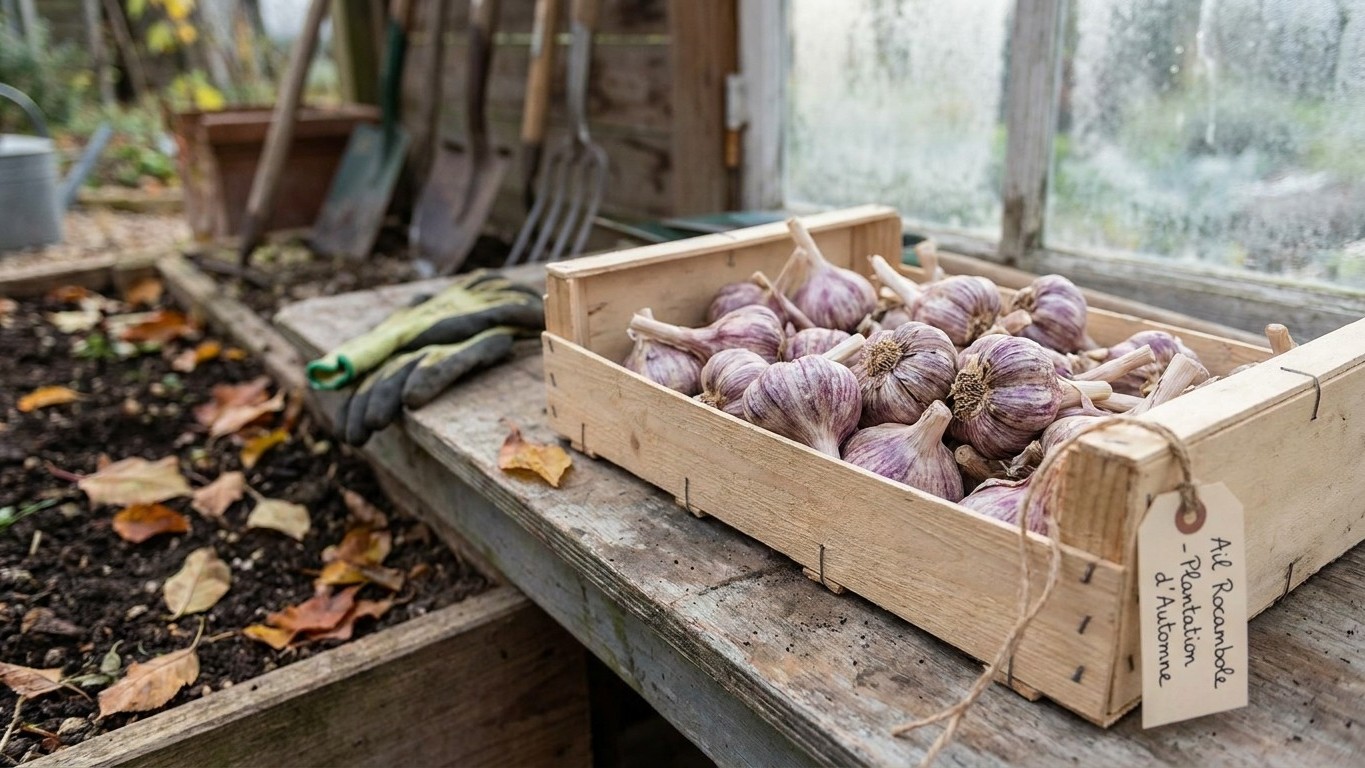

German Red heads, split into cloves for planting, look almost too handsome to bury: satiny white skin streaked purple, wrapped around fat, easy-peeling cloves that already hint at the heat waiting inside. This is a rocambole through and through, full-bodied and spicy rather than mild, and it only gets there by going through a real winter first. Get the timing wrong and the bulbs stay small and loosely clustered instead of forming that single, generous ring of cloves the variety is known for.
What German Red actually is

German Red is a rocambole, and it tastes like one at full strength: full-bodied, strong and spicy, with none of the softness people sometimes expect from garlic in general. This is not a variety to use sparingly out of caution — it holds its own in cooking and makes itself known raw. The heat and depth are the point, and they line up with what rocamboles are prized for in the first place: this is a case of the variety living up to its type rather than working against it.
As a rocambole, German Red is a hardneck. It sends up a tall, coiling flower stalk (the scape) before harvest, and that stalk is worth cutting and using — rocambole scapes are tender and flavorful in their own right. Below ground, the bulb typically forms a single ring of large, easy-to-peel cloves, usually four to eight per head, wrapped in satiny white skin streaked and blushed with purple. Heads grown well are notably large and handsome, which is part of why the variety is popular with growers who sell at markets as much as with cooks.
The trade-off comes at storage. Rocamboles as a group are not long keepers, and German Red follows that pattern: expect a useful storage life of roughly four to six months under good conditions — cool, dry, and dark — rather than the eight-months-plus some softneck varieties manage. Buy or grow German Red for the eating quality and the fat, striking heads, but plan to use it up over autumn and winter rather than counting on it to last until the following summer’s harvest.
What German Red tastes like, and what to do with it
The strength described for German Red is real in the way that matters for cooking, not just as a note on a page. Raw garlic hits hardest, and cooking softens that hit progressively — a light sauté takes the edge off while keeping the character intact, and a long roast will sweeten almost any garlic into something mellow and spreadable, German Red included. So the “strong and spicy” reputation is most obvious raw or lightly cooked: crushed into a dressing, worked into a raw salsa, or added near the end of cooking rather than the start. Roast a head of it whole and you’ll get a sweet, mild paste like any other garlic would give you — pleasant, but not what makes this variety worth seeking out.
Where it earns its keep is in dishes built to showcase garlic rather than dissolve it: a garlic-heavy aioli, a pungent vinaigrette, or a simple pasta aglio e olio where the clove is barely cooked and its spice is the whole point. Used that way, German Red doesn’t need much help or much quantity — a little goes further than it would with a milder garlic.
This is worth stressing because rocamboles as a type are already the strongest-flavored of the hardnecks, and German Red doesn’t soften that reputation the way some varieties within a type break from the average. It sits at full strength for its category, so treat the “strong and spicy” description as literal rather than a starting point to season around.
Beyond flavor and use, nothing further about aroma, aftertaste, or specific pairing notes is documented for this variety — what’s known is the category’s general profile and the two facts already established: full-bodied heat and a white, purple-streaked skin.
Will it get the cold it needs where you are
Garlic clove division is not automatic. The clove needs a sustained cold period after it goes in the ground, and without it the plant grows on as a single round bulb instead of splitting into the ring of cloves you expect at harvest. Hardneck garlic, and German Red is a hardneck, is the type that demands the most cold of any garlic. That single fact decides whether this variety belongs in your garden at all.
Where the cold falls short
In Los Angeles, the reference station for California, winters log zero weeks with temperatures below 40°F against the roughly six weeks German Red needs, which is why the verdict there is flatly risky. The same shortfall shows up at the stations behind Louisiana (New Orleans), Texas (Houston), Florida (Jacksonville), Hawaii (Honolulu) and Arizona (Phoenix): all six report zero qualifying weeks under 40°F. Plant German Red untreated in any of these and you’re likely to lift a crop of round, undivided bulbs, not heads of cloves.
Growers in those regions have two workable paths. The first is to refrigerate seed cloves for roughly the same six weeks the variety would otherwise spend in cold ground, faking the chill before planting. The second, and the one most growers in warm-winter climates actually take, is to plant a softneck strain instead, such as an Artichoke type or a Silverskin, since those ask for far less cold to divide properly. A Lorz Italian, one of the milder Artichoke strains, is built for exactly this kind of winter, and Lorz Italian Garlic: When to Plant the Artichoke Heads That Suit a Mild Winter covers its planting window in the same warm-climate stations named above.
Where it’s no problem at all
Move to the opposite end of the map and the concern disappears entirely, sometimes replaced by a different one. Charlottetown, the station behind Prince Edward Island, still counts as comfortable for chilling but its growing-degree-day total of 1,569 over the year runs tight enough that growers there lean on an early cultivar and plastic mulch to close the gap and finish the bulb in time. Farther north, Whitehorse in Yukon accumulates only about 600 growing degree-days across the year, and Rankin Inlet behind Nunavut logs just 159. In those territories the cold requirement is met many times over. The limiting factor becomes overall season heat, not chilling, and a hoop house or greenhouse is what actually gets a bulb to size before the ground freezes again.
When to put the cloves in
Garlic goes in the ground in fall, not spring, and the date that matters is the first fall frost at your location, not a fixed calendar day. The clove needs enough time to grow roots before the soil locks up cold, but not so much time that it pushes green leaves above ground before winter arrives, since exposed top growth is far more vulnerable to a hard freeze than a dormant, rooted clove sitting under mulch.
How that shifts by region
The gap between regions is wide enough that a single national planting date is useless. In Houston, behind the Texas data, growers set cloves out from early to late November and pull the first ripe bulbs in early August the following summer. New Orleans, the station for Louisiana, runs later still, with planting from late November into mid December and first bulbs also ready by late August. Move to the far side of the continent and the calendar flips entirely: Calgary, behind Alberta, sets out in late August for a harvest starting in early May, and Whitehorse in Yukon plants even earlier, in early August, with bulbs ready by mid April. Charlottetown growers in Prince Edward Island split the difference, planting in late September for a first harvest in early June.
That spread is the reason regional extension offices rarely agree on a single planting month for garlic, and it is worth taking that disagreement seriously rather than smoothing it into one generic recommendation. Check your own state or provincial extension service for its published planting window, since it will be built around your local frost data rather than a station three states away.
Hardneck or softneck: what this one asks of you
German Red is a hardneck, and that habit sets three obligations a softneck grower never deals with. First, the plant sends up a curling flower stalk called a scape in early summer, and that scape has to be cut off while it is still tightly coiled or the bulb below it stays small, diverting energy into the stalk instead of the cloves. Second, a hardneck head carries fewer cloves than a softneck, usually a single ring of large, uniform ones arranged around a woody core, which peel easily but leave you with less to plant back next season from the same harvest. Third, as covered above, that stored bulb keeps for a matter of months, not most of a year.
| Trait | Hardneck (German Red) | Softneck |
|---|---|---|
| Scape | Sends one up, must be cut | None |
| Clove count | Fewer, larger | More, smaller |
| Peeling | Easy | Fiddlier |
| Storage | A few months | Several months to nearly a year |
| Cold needed to divide | High | Low to moderate |
This habit is exactly why the cold requirement covered earlier matters so much for this particular variety. A long, genuinely cold winter is what a hardneck like German Red is built for, and a short, mild one is what pushes a grower toward a softneck strain such as those grown in place of it in warmer stations. If you’re weighing another hardneck against it, the Porcelain type covered in German White Garlic: When to Plant the Porcelain Heads That Need a Real Winter carries a similarly demanding chill requirement but a noticeably different clove structure and flavor.
Growing and curing it without losing the crop
Set cloves pointed end up, a couple of inches deep, with several inches between them in the row. Cover the bed with a loose mulch of straw once the ground begins to cool. That mulch does more work on an overwintered crop than it would on anything planted in spring: it buffers the freeze-thaw cycles that heave a rooted clove partway out of the soil, and it holds moisture through a dry fall.
Reading the harvest signal
Stop watering roughly two to three weeks before you expect to lift the crop, since wet soil at harvest invites staining and rot in storage. The signal to dig is in the leaves, not the calendar: watch for the lower leaves to brown while three or four leaves up top stay green. Pull a test bulb and check the wrapper. If it’s still tight and the cloves are well formed, the rest of the bed is ready.
- Lower leaves browned, upper three or four still green: ready to lift
- Wrapper loose and papery, cloves separating on their own: overdue, lift now
- All leaves still green: too early, cloves likely underformed
Cure the pulled bulbs whole, with tops and roots still attached, in a shaded, well-ventilated spot out of direct sun for a couple of weeks before trimming. Curing badly, in the sun or in a sealed space with no airflow, is the classic way to lose an entire season’s harvest to soft rot after all the work of getting the timing right in the ground.
Common questions
Can I plant German Red in spring instead of fall?
You can push a clove into the ground in spring, but it won’t have gone through the cold period it needs to divide, so you’ll most likely get a small, undivided round bulb instead of a head of cloves. Fall planting followed by a real winter is what this variety is built around.
How many cloves do I need to plant per pound of seed garlic?
That depends on clove size, which varies by grower and by season, so weigh out a sample handful of cloves from your own seed stock and count them rather than relying on a fixed ratio from a catalog grown somewhere else.
My bulbs came up round with no separate cloves. What happened?
That’s the classic sign of insufficient winter chilling, the exact issue covered above for warm-winter stations like Houston or Phoenix. Refrigerate next year’s seed cloves before planting, or switch to a softneck variety suited to a mild winter.
Do I need to cut the scape on German Red?
Yes, cut it while it’s still curled and before it straightens out, since leaving it on diverts the plant’s energy away from bulb formation. Many growers cook the cut scapes rather than discard them.