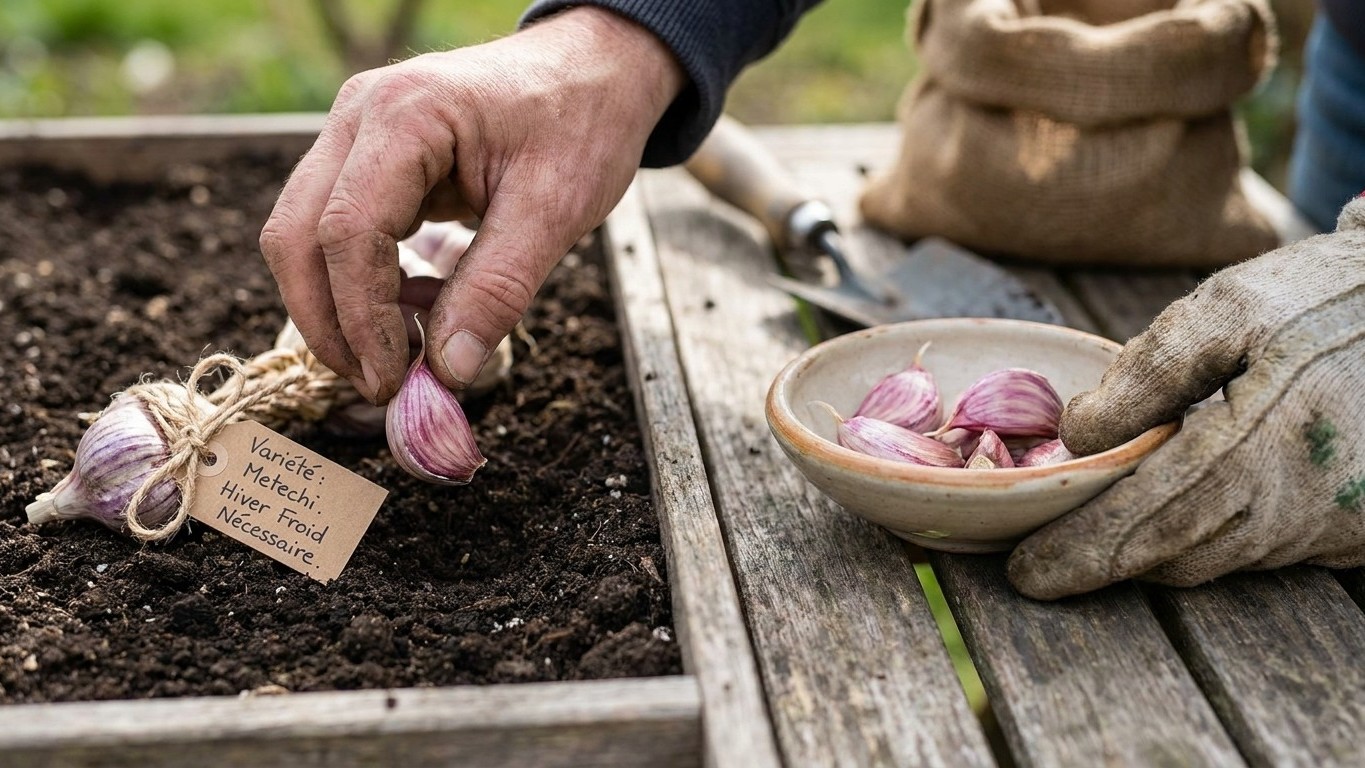

Metechi is a hardneck Purple Stripe garlic, delivering robust garlic flavor with a sharp bite raw, turning rich and almost caramelized once roasted, with cloves that store roughly four to six months after curing. It only earns that flavor if it gets a real winter first: without enough sustained cold after planting, the clove never divides into a head at all. NOAA’s climate data for Los Angeles puts the city at zero weeks below 40°F in a typical winter, against the six weeks Metechi needs to split. Before you order seed stock, check your own region’s average weeks below 40°F through your state climate office or land-grant extension service.
What Metechi actually is

Metechi belongs to the Purple Stripe family, one of the smaller hardneck groups and the one most gardeners meet through Chesnok Red or Persian Star before they find Metechi itself. It sends up a firm central stalk, called a scape, that has to be cut off in early summer so the plant’s energy goes into the bulb instead of the stalk. That single fact, hardneck versus softneck, decides almost everything else about how the crop behaves in your garden.
The wrappers on a cured Metechi bulb run purple-streaked over a buff or tan skin, and the cloves underneath are fewer and larger than a softneck’s, usually six to ten per bulb, and easy to peel by hand. Seed garlic catalogs that carry Metechi describe its raw flavor as hot and sharp, mellowing to a deep, almost smoky sweetness when roasted whole. Purple Stripe types are not the longest keepers: expect four to six months of storage in a cool, dry space before the cloves start to soften or sprout, shorter than a Porcelain type like Music and well short of a Silverskin softneck. If you are still deciding between garlic families for your climate, the broader rundown at Garlic Varieties is worth reading before you commit a bed to any one of them.
What Metechi tastes like, and what to do with it
Metechi’s reputation rests on that combination the article already named: hot and sharp raw, deep and smoky once roasted. This is the ordinary arc of hardneck garlic, and Metechi sits at the intense end of it rather than the mild end. Where a Purple Stripe like Chesnok Red is often singled out as the gentle, almost mild-mannered member of the family, Metechi is not that variety — it keeps the family’s fire and adds a heavier, more assertive garlic flavor on top of it. If you have grown a softneck like an Artichoke type and found it forgettable raw, Metechi is the corrective: it is built for people who want to actually taste the garlic.
That heat means the raw clove is not the place to judge it. Grated or crushed into a dressing, salsa verde, or the last minute of a sauce, Metechi’s bite will dominate more delicately flavored ingredients around it, so use it with a light hand until you know its strength in your own kitchen. Cooked into a sauté or braise, the sharpness folds into a rounder, more savory garlic taste rather than disappearing. Whole and roasted, the cloves lose the bite entirely and turn soft and sweet, and this is where the smokiness attributed to Metechi comes through most clearly — spread on bread, stirred into mashed potatoes, or blended into a soup base.
Beyond raw, cooked, and roasted behavior, there is not much else documented about Metechi specifically: no published notes on drying it for powder, fermenting it into black garlic, or pairing it with particular cuisines. Given its intensity, it is a reasonable guess that it would hold up well in dishes built around raw garlic punch, but that is inference from its category and flavor description, not a documented fact about the variety itself.
Will it get the cold it needs where you are
Garlic clove division is a cold response, not a calendar event. Plant a hardneck clove and leave it without a real stretch of near-freezing weather, and it will grow a plant and even bulb up, but the bulb comes up as one round, undivided clove instead of a head split into segments. Metechi, as a Purple Stripe hardneck, sits at the demanding end of the hardneck spectrum: it wants roughly six weeks of temperatures below 40°F after planting before it will split properly.
Where the winter is too short
NOAA’s climate data for a run of southern and desert cities shows the shortfall clearly. The table below uses the tightest margin in the country as its anchor and works outward.
| Territory (reference station) | Weeks below 40°F | Weeks Metechi needs | Verdict |
|---|---|---|---|
| California (Los Angeles) | 0 | 6 | Bulb will not divide |
| Louisiana (New Orleans) | 0 | 6 | Bulb will not divide |
| Texas (Houston) | 0 | 6 | Bulb will not divide |
| Florida (Jacksonville) | 0 | 6 | Bulb will not divide |
| Hawaii (Honolulu) | 0 | 6 | Bulb will not divide |
| Arizona (Phoenix) | 0 | 6 | Bulb will not divide |
In each of those six territories the arithmetic is the same: zero weeks of the cold Metechi asks for, against a six-week requirement, leaves a gap that no amount of good soil or watering closes. Louisiana, Texas and Florida growers who still want a fall-planted crop typically set cloves out from early to mid November and lift in early August, but that timing does not manufacture cold that never arrives. Two real options exist here. Refrigerate the cloves for several weeks before planting, mimicking the cold snap the ground will not provide, or grow a type that asks for less chilling in the first place. An Artichoke-type softneck such as Red Toch was bred for exactly this situation and divides reliably with far less cold than Metechi demands.
Where the cold is plentiful but the season is short on heat
The opposite problem shows up at the far northern edge of the growing map. Alaska, Yukon, Northwest Territories, Alberta and Nunavut all deliver more than enough cold for Metechi to divide, but garlic still needs a season’s worth of accumulated warmth to bulb up to size, measured in growing degree-days rather than weeks of frost. Nunavut’s Rankin Inlet station accumulates only around 159 degree-days across the year, Yukon’s Whitehorse around 600, and even Alberta’s Calgary reaches only around 1,171, all well short of what a full-size bulb needs regardless of how cold the winter runs. A high tunnel or greenhouse that extends the growing season is not optional in these territories, it is what turns a divided clove into a harvestable head. Prince Edward Island sits closer to the line: Charlottetown’s roughly 1,569 degree-days are workable but tight, and growers there lean on an early-maturing planting and a plastic mulch to bank a few extra weeks of soil warmth.
When to put the cloves in
Garlic goes in the ground in fall and comes out the following summer, and the planting window is set by the first fall frost, not by a fixed date on the calendar. The goal is a clove that has time to grow roots before the ground freezes hard, but not so much time that it pushes green top growth that gets scorched by winter cold.
Cold, mild and warm regions differ, and sources disagree
In genuinely cold territory, planting tends to happen in the weeks around the first fall frost or shortly after, once soil temperatures are dropping but before the ground locks up. Alaska growers around Anchorage typically set cloves out in early September for a mid-May first harvest the following year, and Yukon growers around Whitehorse plant even earlier, in early August, because their whole season compresses toward the short end. In much warmer territory the pattern flips entirely: Louisiana growers around New Orleans plant from late November into mid December, Texas growers around Houston from early to late November, and Florida growers around Jacksonville on a similar early-to-late November schedule, all aiming for a harvest that lands in late summer.
State extension services do not fully agree on how close to the First Frost is ideal, and that disagreement is worth taking seriously rather than smoothing over. Some recommend planting closer to the frost to limit top growth going into winter, others favor a slightly earlier window so roots are well established first. Your own state or provincial extension service, not a national blanket date, is the right place to settle that question for your specific ground and elevation.
Hardneck or softneck: what this one asks of you
Metechi is a hardneck through and through, and that carries real obligations a softneck grower never deals with. You must cut the scape, the curling flower stalk that rises in early summer, or the bulb below it stays smaller and the wrapper looser at curing time. In exchange, hardneck cloves are famously easy to peel and come fewer to the bulb, usually six to ten large cloves rather than the twelve to twenty small ones a softneck like Inchelium Red or a Silverskin type produces.
What follows from that trade
Hardneck garlic also does not braid, since there is no soft, pliable neck to weave, so storage means mesh bags or bundles rather than the classic kitchen braid a softneck allows. It keeps for a shorter window too, that four to six months mentioned earlier for Purple Stripe types, against six to nine months or more for a well-cured softneck. If your winter is long and reliably cold, that trade favors you: hardneck types like Metechi and the Porcelain Music, another variety that needs a genuinely cold winter to perform, thrive where softnecks struggle to get the chill they want. Where winters run mild, the calculation flips, and a softneck or an Artichoke type bred for shorter chilling is the more forgiving choice.
Growing and curing it without losing the crop
Plant individual cloves root-down, roughly two inches deep and six inches apart in rows spaced about a foot apart, pointed tip just under the soil surface. Mulch matters more here than on almost any other vegetable because an overwintered crop sits through months of freeze and thaw cycles that can heave a shallow-planted clove right out of the ground. A four to six inch layer of straw, applied after the ground cools but before it freezes solid, insulates the soil and keeps that heaving from happening.
Reading the plant and curing the bulb
Stop watering roughly two to three weeks before you expect to lift, since wet soil right up to harvest invites staining and rot on the wrapper and shortens storage life. The signal to lift is foliage, not a date: watch for the lower third to half of the leaves to yellow and die back while the upper leaves stay green, which is the point at which the bulb has finished sizing but the wrapper hasn’t started to split.
- Lift by loosening soil with a fork rather than pulling, to avoid tearing the wrapper
- Leave roots and tops attached and cure in a shaded, airy spot out of direct sun
- Cure for two to three weeks until the outer wrappers are papery and the neck is fully dry
- Trim roots and tops only after curing is complete, leaving an inch or so of neck
The two mistakes that cost growers their whole crop are lifting too late, after the wrapper has already split and let soil pathogens in, and curing in a damp or sun-baked spot that either rots the bulbs or cooks them before they finish drying. Neither mistake shows up until you go to store the harvest and find half of it soft by midwinter.
Common questions
Can I grow Metechi in a warm climate if I just refrigerate the cloves?
Yes, refrigerating seed cloves for several weeks before planting is the standard workaround where winters do not deliver enough natural cold, and it is the option growers in California, Texas, Louisiana and Florida generally reach for if they specifically want a Purple Stripe. It is extra handling for a crop that does better on autopilot in a colder region, so weigh whether a naturally suited variety would save you the trouble.
What happens if I don’t cut the scape?
The bulb finishes noticeably smaller and the wrapper often stays looser at curing time, since the plant is putting energy into the scape instead of the bulb below ground. The scape itself is edible and worth cutting for the kitchen regardless, it has a mild garlic flavor good in a stir-fry or pesto.
Why did my Metechi come up as one round clove instead of a head?
That is the classic sign of insufficient cold after planting, the same failure the cold-crossing section above walks through for warm-climate territories. The fix for next season is either refrigerating the seed cloves before planting or switching to a lower-chill type such as an Artichoke or Silverskin softneck.
Is Metechi the same as Persian Star or Chesnok Red?
No, all three are Purple Stripe types and share family traits like easy peeling and a spicy raw bite, but they are distinct named cultivars with their own catalog descriptions and days to maturity. Treat any specific days-to-maturity figure on a seed packet as a starting point that shifts by a week or two with the season, not a fixed date.