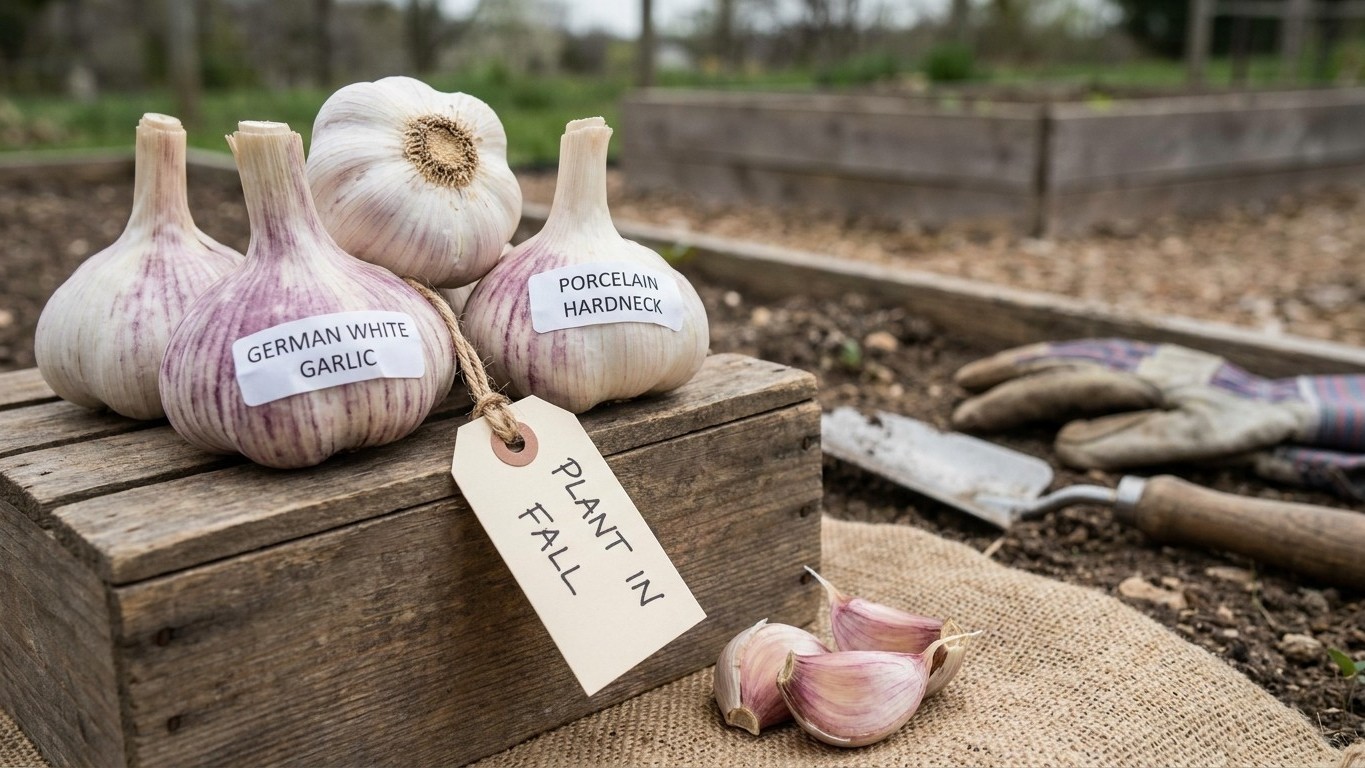

German White is a Porcelain-type hardneck garlic, grown for its plump ivory bulbs, its small number of oversized cloves, and a succulent flavor balanced with a touch of spice, mellowing to something richer and rounder once cured. It only forms that head of cloves if it spends a real stretch of winter in cold soil. Before you order cloves, check your nearest first-fall-frost date and how many weeks your winter typically holds below 40°F, because that single number decides whether you get a head of garlic or one round, undivided bulb.
What German White actually is

Porcelain garlics are hardneck types, botanically Allium sativum var. ophioscorodon, and German White is one of the most widely grown of the group. The wrapper is smooth and bright white, and inside it you find only four to six cloves, each one noticeably larger than what you get from a softneck bulb. That size is the whole appeal in the kitchen: fewer cloves to peel for the same amount of garlic, and a skin that comes off in one piece instead of shredding.
Seed catalog descriptions consistently call the raw flavor hot and assertive, settling into a fuller, more rounded taste after curing, which is typical of the Porcelain group generally. Where German White does not compete with softneck types is storage. Porcelain garlic typically holds for four to six months in a cool, dry space before the cloves start to soften or sprout, noticeably shorter than a Silverskin or Artichoke type softneck, which can carry into spring. If long storage matters more to you than clove size, that trade-off is worth weighing before you plant, and it’s the same trade-off covered on the wider Garlic Varieties page for the whole family of hardneck and softneck types.
None of that flavor or storage profile changes with climate. What changes is whether the bulb forms at all, and that’s a cold problem, not a flavor one.
What German White tastes like, and what to do with it
The reason hardneck garlics like German White carry a hotter, more layered raw flavor than softnecks is structural: they put energy into a flower stalk and fewer, larger cloves, concentrating the compounds that give garlic its bite. Softnecks spread that energy across more, smaller cloves and trade intensity for shelf life. That’s the mechanism behind everything already said about this variety curing into a fuller, rounder taste after a hot start — it’s the Porcelain pattern, not something unique to German White.
What is specific to this variety is a description of the cured flavor as succulent and balanced, with only a touch of spice rather than an aggressive burn. That’s worth taking at face value rather than rounding up to match the group’s reputation for heat: German White seems to land on the gentler end of what Porcelain garlic can do, generous in size but not punishing in the mouth once it’s cured. Where that character actually shows depends on how you cook it. Eaten raw, straight off the clove, expect the sharper edge the catalog descriptions warn about. Minced into a dressing, salsa, or compound butter, that edge softens but still comes through as real spice, not filler. Roasted whole, the heat drops out almost entirely and what’s left is sweetness and body — a bulb this size roasts well precisely because there’s more flesh per clove to caramelize.
Beyond that, there isn’t a published breakdown of how German White compares to other Porcelain varieties side by side, or how it performs specifically in something like a raw aioli versus a long-cooked braise. Treat it as a good all-purpose garlic that leans toward the mellow side of its type, and use the roasting-versus-raw split above as the practical guide until more specific information exists.
Will it get the cold it needs where you are
Hardneck garlic needs a sustained period of cold after planting to trigger the clove inside the seed piece to divide into a full head. Skip that cold and you don’t get a smaller harvest, you get a different result entirely: one round, undivided bulb, because the vernalization signal never arrived. Porcelain types like German White sit at the demanding end of that requirement. Of all the garlic groups, hardneck asks for the longest and coldest chill, more than any Purple Stripe, Rocambole, Artichoke, or Silverskin.
Where the winter is too short
A run of roughly six weeks with soil temperatures under 40°F is the rough benchmark hardneck garlic needs to divide reliably. Several states never get close to it.
| Territory | Reference station | Verdict | What limits it |
|---|---|---|---|
| California | Los Angeles | Too warm | 0 weeks under 40°F, against roughly 6 needed |
| Texas | Houston | Too warm | 0 weeks under 40°F, against roughly 6 needed |
| Florida | Jacksonville | Too warm | 0 weeks under 40°F, against roughly 6 needed |
| Prince Edward Island | Charlottetown | Marginal | 1,569 growing degree-days, just enough |
| Alaska | Anchorage | Cold enough, heat short | 917 growing degree-days for the year |
| Nunavut | Rankin Inlet | Cold enough, heat short | 159 growing degree-days for the year |
Louisiana, Hawaii, and Arizona sit in the same too-warm bracket as California, Texas, and Florida: none of them log the six weeks of sub-40°F soil that a Porcelain garlic wants. If you garden in one of these states, you have two honest options. Refrigerate your cloves for several weeks before planting to simulate the missing winter, or switch to a softneck type that asks for less cold in the first place, such as the Silverskin-type Nootka Rose Garlic, bred for exactly this kind of mild winter.
Where the cold is real but the growing season isn’t
At the other end, places like Alaska, Yukon, and Nunavut have more cold than German White will ever need, but that’s not the whole story for a hardneck bulb. Once the clove divides, it still needs enough cumulative warmth over the growing season to size up into a full bulb, measured in growing degree-days rather than weeks of chill. Alaska’s Anchorage station logs 917 growing degree-days across the year, and Nunavut’s Rankin Inlet logs just 159. In both cases, a greenhouse or a low tunnel that extends the warm months is what closes the gap, not a change of variety. Prince Edward Island’s Charlottetown station is closer to workable at 1,569 growing degree-days, but growers there still lean on an early-maturing variety and plastic mulch to get a full harvest in a short season.
German White is not the only Porcelain or Purple Stripe hardneck asking this same question of your winter. Metechi Garlic, a Purple Stripe type, has a nearly identical cold requirement and the same too-warm, too-cold-but-heat-short pattern across these territories.
When to put the cloves in
Garlic is a fall-planted, summer-lifted crop everywhere it’s grown, but the actual planting window swings by months depending on how early your ground freezes. The rule that holds across all of them is the same: plant late enough that the sprout doesn’t push much top growth before winter, but early enough for the roots to get established while the soil is still workable. A calendar date is useless here because the same date means something different in Louisiana and in the Yukon.
How the window actually shifts
In the warm Gulf states, that window sits deep in the fall. Louisiana growers near the New Orleans station typically get cloves in from late November into mid December, with a first-ripe harvest arriving in late August the following year. Texas growers near Houston plant slightly earlier, from early to late November, with bulbs ready around early August. Florida’s Jacksonville-area growers plant on almost the same schedule as Houston, early to late November, lifting in early August.
At the far cold end, the whole calendar moves back by months. Yukon growers near Whitehorse plant in early August, months before a Gulf Coast grower even orders cloves, because the ground there is already closing in by fall. Alaska’s Anchorage-area growers plant in early September and lift as early as mid May the following spring. Alberta and the Northwest Territories both plant in late August, with Nunavut on the same late-August schedule near Rankin Inlet.
Notice what all of these have in common: none of them are calendar dates chosen in isolation. Each one is set by Counting Back From the First fall freeze in that specific location, which is exactly why a state extension service’s local planting guide will always beat a generic “plant in October” instruction. Check your own extension office for the recommended count-back in your county, since it can differ by several weeks even within one state.
Hardneck or softneck: what this one asks of you
German White is a hardneck through and through, and that habit shapes almost every decision you make with it after planting. In early summer, it sends up a curling flower stalk called a scape, and that scape has to be cut off while it’s still tender, both to keep the plant’s energy going into the bulb and because a mature scape turns woody and inedible fast. Leave it on and you’ll still get a bulb, just a smaller one.
Hardneck bulbs also give you fewer, larger cloves arranged in a single ring around the central stalk, and those cloves peel far more easily than the tightly packed, irregular cloves of a softneck. What you lose is storage life and the ability to braid: hardneck garlic cannot be braided the way softneck can, since the hard central stalk stays stiff even after curing.
This is why hardneck varieties in general, and Porcelain types like German White specifically, are the traditional choice for gardeners with a genuinely cold winter, and why softneck types dominate in the mild-winter South and West. If your climate falls on the wrong side of that line, a softneck like Nootka Rose Garlic gives you the braid-and-store convenience that German White simply isn’t built for.
Growing and curing it without losing the crop
Plant individual cloves pointed end up, roughly two inches deep, spaced about six inches apart in rows a foot or so apart, in soil that drains well since standing winter water rots cloves before they ever root. Mulch matters more here than on almost any other vegetable, because an overwintered crop sits in the ground through freeze-thaw cycles that can heave a shallow-rooted clove right out of the soil. A layer of straw a few inches deep insulates against that heaving and suppresses the weeds that would otherwise compete with garlic’s shallow root system come spring.
Reading the harvest signal
Stop watering roughly two to three weeks before you expect to lift, since wet soil at harvest stains the wrappers and invites rot in storage. The signal to watch is the foliage: lift when the bottom three to four leaves have browned and died back but the top few are still green. Pull too early and the cloves haven’t finished sizing up. Wait until all the leaves are brown and the bulb has likely already split open in the ground, letting soil organisms and moisture in.
- Loosen the soil with a fork before pulling; never yank a bulb by the stalk.
- Brush off loose soil but don’t wash the bulbs before curing.
- Cure in a shaded, well-ventilated spot for three to four weeks, stalks still attached.
- Trim stalks and roots only once the outer wrappers are fully dry and papery.
A crop cured too fast, in direct sun or with poor airflow, softens in storage within weeks no matter how well it grew. That’s the failure that catches new garlic growers most often, not the planting or the harvest itself.
Common questions
Can I plant German White in a mild-winter state if I don’t want to refrigerate cloves?
You can try, but expect a round, undivided bulb rather than a head of cloves, since the vernalization step is what triggers division. Refrigerating cloves for several weeks before planting is the simpler fix if you want to keep growing this specific variety.
Is German White the same as regular grocery store garlic?
No. Most grocery store garlic is a softneck type, often California-grown, bred for mild winters and long shelf life rather than the large cloves and stronger flavor of a Porcelain hardneck like German White.
Do I need to cut the scape or can I leave it for the flavor?
Cut it. Garlic is grown for the bulb, and an uncut scape pulls energy away from bulb development without adding anything to the flavor of the clove itself. Scapes are edible and worth cooking with, so cutting them isn’t wasted effort.
How do I know if my winter is cold enough without checking the tables above?
Ask your state’s extension service whether your county typically holds several consecutive weeks below 40°F in winter, since that’s the rough threshold Porcelain hardnecks like German White need to divide. If your extension office doesn’t track that figure directly, your average January low temperature is a reasonable proxy to ask about instead.