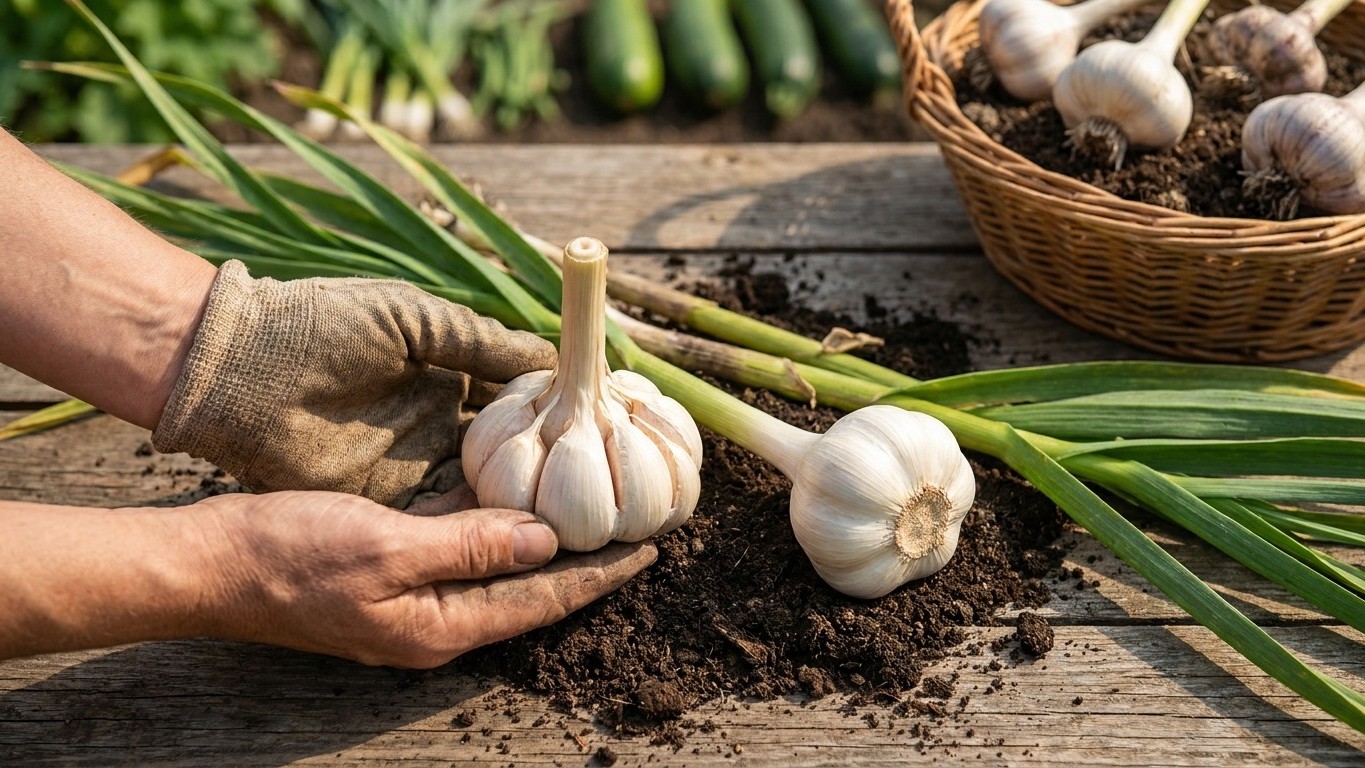

Great Combo Garlic isn’t one plant, it’s two: a hardneck and a softneck bulb sold together, both white-skinned, bred for what the catalog calls “mouthwatering, scrumptious fresh-from-the-garden flavor and long-lasting storability.” No published disease resistances come with either half. What that combination actually buys you is flexibility, and that’s the part worth unpacking.
What Music actually is

Great Combo Garlic ships as a pairing rather than a single strain: one hardneck bulb and one softneck bulb in the same order, both finishing white-skinned at harvest. The catalog listing doesn’t break the pair down into the usual botanical families you’ll see on other variety pages (Porcelain, Rocambole, Purple Stripe, Artichoke, Silverskin), it simply promises “mouthwatering, scrumptious fresh-from-the-garden flavor” from each half and “long-lasting storability” once cured. Take that flavor claim as the seller’s description, not an independent taste test, because no third-party tasting notes are attached to it here.
That’s worth sitting with for a second. A hardneck garlic and a softneck garlic don’t behave the same way in the ground, they don’t cure the same way, and they don’t store for the same number of months. Buying them as a pair means you’re really buying two separate growing plans under one order number, not one plant with two names. The white skin color is the one trait both halves share on paper. Everything else, from how much cold each one wants to how long each one sits in your pantry, splits down the middle.
No published resistances means exactly that: the listing makes no claim about rot, rust, or nematode tolerance for either bulb. That’s not unusual for garlic sold this way, but it does mean you’re managing disease risk with good rotation and drainage rather than leaning on a bred-in trait.
Will it get the cold it needs where you are
Garlic doesn’t just tolerate cold, it requires it. A clove planted in fall needs a stretch of genuinely cold weather over winter to trigger division, the process that turns one round clove into a full head of cloves by the following summer. Skip that cold exposure and the plant lifts as a single round bulb, undivided, because the signal that tells it to split never arrived. This is the single most common reason a garlic crop disappoints, and it has nothing to do with soil quality or watering.
Because Great Combo Garlic is a pair, this question actually has two answers instead of one. The hardneck half is the type that wants the longer, colder stretch, the kind of winter you get across the Upper Midwest, New England, and the Mountain West, where the ground stays cold for months at a stretch. That’s where the hardneck bulb in this pairing is going to divide reliably and reward you with the classic hardneck cloves, few per head but large.
The softneck half asks for less. Softneck types have always been the ones grown in places like the Gulf Coast, coastal California, and other regions where hard freezes are brief or rare, because they don’t need as deep or as long a chill to divide properly. That’s exactly where the softneck bulb in a Great Combo order is doing the real work, while the hardneck bulb in the same order is the one at risk of running marginal.
No specific frost-date or degree-day figures are published on this page for either half, so treat the region names above as general guidance, not a guarantee tied to your exact address. If you garden somewhere the winters run mild, you have two real options rather than one. First, you can refrigerate the hardneck cloves for several weeks before planting, mimicking the cold they’d otherwise miss, a common workaround gardeners in warm climates use for hardneck garlic generally. Second, and simpler, you can lean on the softneck half of the pair and treat it as your main crop, since it’s the one built for a shorter chill to begin with. Nobody should be told to skip garlic entirely because of a mild winter. The combo format, as it happens, already hedges that bet for you.
When to put the cloves in
Garlic goes in the ground in fall and comes out the following summer, and the timing is set by the first fall frost in your area rather than by a fixed date on the calendar. The general rule gardeners across regions rely on is to plant roughly four to six weeks before the ground is expected to freeze solid, giving the cloves enough time to root before winter locks up but not so much time that they push a lot of leaf growth above ground first.
In colder parts of the country, that window tends to fall in September through October, sometimes into early November depending on how early frost typically arrives locally. In milder regions, gardeners often wait until October or November, since the ground stays workable and warm longer into fall. In the warmest parts of the country, where a hard freeze may never really show up, planting often slides into November or even December, timed instead to cooler, wetter weather rather than frost at all.
Sources genuinely disagree on the exact number of weeks before frost, and that’s worth saying plainly instead of papering over it. Some extension guides lean toward the shorter end of that four-to-six-week window, others push closer to two months. The safest read for a two-variety order like this one is to prioritize rooting time over top growth: cloves that have established roots but haven’t sent up much leaf are the ones that overwinter best, no matter which half of the pair you’re planting.
Because the hardneck and softneck halves want different amounts of cold to divide, some gardeners choose to plant them a week or two apart, with the softneck going in slightly later since it needs less lead time before the ground cools. That’s a reasonable adjustment, not a strict rule.
Hardneck or softneck: what this one asks of you
This is where the “combo” in the name actually changes your to-do list, because you’re managing two different habits at once rather than one.
The hardneck half sends up a rigid central stalk, called a scape, partway through the growing season. That scape needs to be cut off before it fully curls, which redirects the plant’s energy back into the bulb instead of into the scape itself. Cut scapes are edible, by the way, and often get used in cooking rather than tossed. Hardneck bulbs typically yield fewer cloves per head, but each clove tends to be noticeably larger, and the papery skin peels off easily when you’re prepping it. The tradeoff is storage life: hardneck garlic generally keeps for a shorter stretch than softneck, often a few months rather than most of a year.
The softneck half skips the scape entirely, the stalk stays soft and pliable, which is exactly what lets softneck garlic be braided for storage. It produces more cloves per head, smaller and sometimes fussier to peel, but it keeps considerably longer in a cool, dry spot. That longer shelf life is a big part of why softneck varieties dominate mild-winter regions, where growers plant them precisely because they store well through a long off-season.
Put together, the pattern holds: hardneck suits long, cold winters and rewards you with big cloves you’ll use up faster, softneck suits milder winters and rewards you with a braid that lasts on the pantry wall for months. Great Combo Garlic hands you one of each so you’re not forced to pick a single strategy.
Growing and curing it without losing the crop
In the ground
Plant individual cloves pointed end up, about 2 inches deep, spaced 4 to 6 inches apart in rows a foot or more apart, giving each bulb room to bulk up without crowding its neighbors. A layer of mulch, straw or shredded leaves work well, matters more here than on a spring-planted crop, because it’s insulating cloves through an entire winter aboveground before they’ve even sprouted, not just protecting a few weeks of cold snap. Pull the mulch back partway once spring growth starts so shoots aren’t smothered.
Keep the soil consistently moist through spring while the bulbs are actively sizing up, then cut watering back a few weeks before harvest. Garlic that’s kept wet right up to lifting is far more prone to staining, mold, and poor storage, which defeats the whole point of growing a variety marketed on its keeping ability.
Knowing when to lift, and how to cure
The classic signal that garlic is ready is the lower leaves browning and dying back while the upper leaves stay green, generally somewhere around five to six green leaves remaining. Pulling too early means underdeveloped cloves; waiting too long risks the bulb splitting open in the ground or the wrapper skins deteriorating, both of which shorten storage life dramatically.
Once lifted, cure the bulbs whole, roots and tops still attached, in a shaded, dry, well-ventilated spot for two to four weeks before trimming and storing. Skipping or rushing this step is the single most common way a promising harvest turns into a moldy disappointment a month later. Cured properly, the softneck half of this combo is the one built to reward that patience the longest.
Common questions
Is Great Combo Garlic one variety or two?
It’s two separate bulbs sold as a pair, one hardneck and one softneck, both white-skinned. They aren’t a single crossbred plant.
Which half should I plant if my winters are mild?
Lean on the softneck bulb, since softneck garlic generally needs less sustained cold to divide properly than hardneck does. The hardneck half can still work with a pre-plant refrigeration period for the cloves.
Do I need to cut the scape on both halves?
No. Only the hardneck bulb sends up a scape that needs cutting. The softneck half doesn’t produce one, which is also why softneck garlic can be braided and hardneck can’t.
Which half stores longer once it’s cured?
The softneck bulb. Softneck garlic typically keeps for months in a cool, dry spot, while the hardneck half generally stores for a shorter window before quality drops.