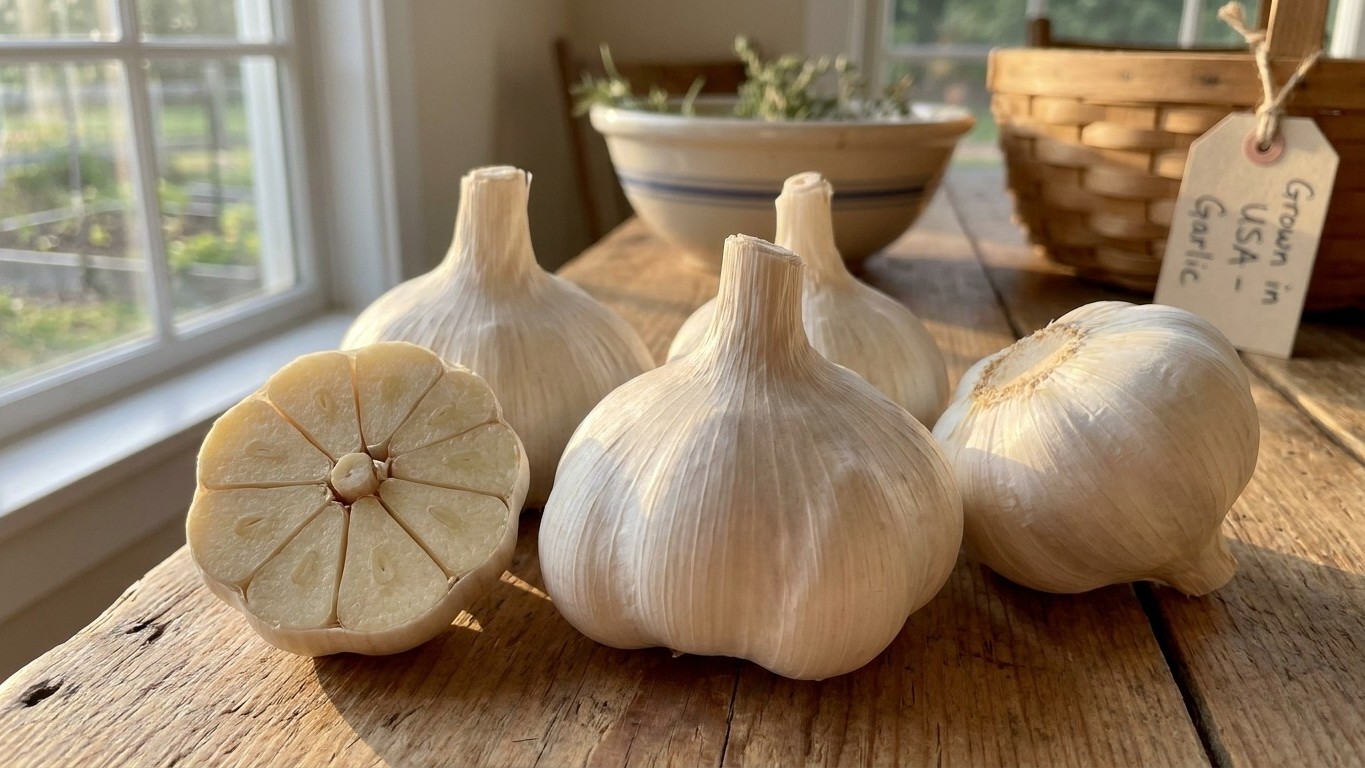

Messidor is a softneck Artichoke type garlic with white skin and a smooth, mellow flavor that turns gently sweet when roasted. That combination, softneck habit plus a lighter cold requirement than hardneck types carry, makes it a practical pick in regions where winters don’t get brutally cold, and a poor match for the coldest ones.
What Music actually is

Messidor is an Artichoke type garlic, the softneck line that produces layered heads of many cloves rather than a single ring around a stiff stem. It carries white skin, and the cloves run smooth and mellow, turning gently sweet when roasted, as its variety description puts it. Being softneck, it never sends up the tall flowering stalk that hardneck types do, so there’s no scape to cut and no bonus crop of scapes for the kitchen.
In the kitchen it counts among the winter keepers. Catalog listings for softneck Artichoke garlic like this one put its clove count anywhere from 10 to 40 per head, small toward the center, larger toward the outside, and describe a storage life of 6 to 9 months at room temperature, longer than most hardneck varieties can manage. No disease or pest resistance is published for Messidor, which isn’t unusual in garlic generally; formal resistance ratings are rare across the crop, and the absence should read as untested rather than as a weakness.
What sets Messidor apart isn’t any single trait but the combination: an artichoke habit built for long storage, white skin, a flavor that sweetens with roasting, and a cold requirement lighter than most hardneck varieties need. That last point is the one that decides whether it belongs in your garden at all.
Will it get the cold it needs where you are
Garlic doesn’t turn one clove into a full head automatically. It needs to feel a real stretch of cold first, cool enough for long enough that each clove inside the bulb is triggered to divide again. Skip that cold, and a grower lifts one plump, undivided round in early summer instead of a head of cloves, a common disappointment for gardeners in warm climates who plant the wrong type expecting a normal harvest.
Messidor’s advantage is that, as a softneck Artichoke type, it asks for less of that chill than hardneck varieties do. Rocambole and Porcelain types often struggle where winters stay consistently mild; softneck Artichoke garlic, coming from milder growing traditions, tends to divide reliably with a shorter, gentler cold spell. That’s why softneck is the standard steer for gardeners across the Gulf Coast states, much of California’s Central Valley, and the warmer parts of the Southeast, while hardneck varieties get pushed toward the northern tier and mountain states with long, hard winters.
Where it gets marginal, and the two real fixes
Even so, needing less cold isn’t the same as needing none. In the mildest pockets of the country, coastal South Florida, the low desert Southwest, and similarly frost-rare micro-climates, winter temperatures may never fall low enough, or stay low long enough, for reliable clove division even in a softneck type. Gardeners in those areas have two real options instead of skipping garlic altogether.
- Refrigerate the cloves for several weeks before planting, which mimics the chill the ground itself won’t provide.
- Lean on a type built for even less cold than an Artichoke softneck, if a location is truly frost-free most winters.
Where winters are simply mild rather than frost-free, most of the Southeast, the southern Plains, and inland California, Messidor fits comfortably without extra steps: ordinary fall planting, a typical winter, no special handling needed. It’s the varieties bred for harsh Rocambole or Porcelain-style cold that struggle there, not this one.
When to put the cloves in
Garlic goes into the ground in fall and comes out the following summer, but the exact date shifts with the region because it hinges on one thing: the first fall frost, not a fixed spot on the calendar. The goal is rooting cloves in well before the soil freezes solid, without pushing so much top growth that a hard freeze later on damages exposed leaves.
In cold-winter regions, the northern Midwest, New England, the mountain West, guidance generally points toward planting a few weeks ahead of when the ground is expected to freeze, often landing in mid-to-late fall. In milder regions, the mid-Atlantic, the Pacific Northwest, much of the transition zone, that same rooting window opens later, since the soil stays workable and frost-free longer into the year.
In the warmest parts of the country, the Gulf Coast, the Southeast’s coastal plain, inland California, growers often plant later still, sometimes into early winter, because the ground never really threatens to freeze and there’s no urgency to beat a hard freeze.
Sources don’t fully agree on exact windows, and that’s worth stating plainly rather than pretending one national planting date exists. Extension guidance varies by state, and even within a state, a raised bed against a south wall behaves differently than open ground in a low spot. For Messidor, that flexibility works in the gardener’s favor: as a softneck type with a lighter cold requirement, it tolerates a slightly later planting than a hardneck would if fall slips away from you, without paying as steep a price in yield.
Hardneck or softneck: what this one asks of you
Messidor is a softneck, and that shapes nearly everything about growing and using it. Softneck garlic never bolts a scape the way hardneck varieties do, so there’s no cutting step in early summer and no separate crop of scapes for the kitchen. What you get instead is more cloves per head, arranged in overlapping layers rather than a single ring, and Messidor’s own count runs 10 to 40 cloves per bulb, small ones tucked inside larger outer ones.
The trade-off runs the other direction too. Hardneck garlic tends to produce fewer, larger, more uniform cloves that peel easily, but it pays for that with a shorter shelf life, often just a few months in typical home storage. Softneck types like Messidor peel less easily clove by clove, since the skins are thinner and more layered, but they keep far longer: 6 to 9 months at room temperature, the kind of run that carries a household from one fall harvest almost to the next planting season. Softneck is also the type that braids, since the leaves stay pliable after curing instead of drying into a stiff, snappable stalk.
None of this is arbitrary. Hardneck varieties evolved to handle long, hard winters and don’t mind a sharper chill; softneck types, Messidor included, come from milder growing traditions, need less cold to divide, and store better once cured. Hardneck for the far North, softneck for everywhere the winter doesn’t bite too hard, and Messidor sits squarely in that second group.
Growing and curing it without losing the crop
Plant Messidor cloves about 2 inches deep and roughly 4 to 6 inches apart, pointed end up, in rows spaced enough to weed comfortably. Depth matters more for an overwintered crop than for a spring-planted vegetable, since cloves set too shallow can heave out of the ground during freeze-thaw cycles before they’ve rooted in properly.
A mulch layer, straw or shredded leaves a few inches thick, does double duty for a fall-planted crop: it insulates against the freeze-thaw swings that push cloves upward, and it suppresses the weeds that would otherwise get a head start over winter while the cloves grow slowly. Pull the mulch back partway in early spring once new growth shows, so the soil can warm.
Water regularly through spring while the bulb sizes up, then stop about two to three weeks before you expect to lift, since wet soil right up to harvest invites staining and rot instead of a clean cure. The plant signals it’s close when the lower third to half of the leaves have yellowed and started to die back; pulling early risks small, underdeveloped bulbs, and waiting too long risks the head splitting open underground, which ruins storage life even when the flavor is unaffected.
Cure whole plants, roots and all, in a shaded, dry, well-ventilated spot for several weeks, out of direct sun, which can scorch the wrappers. Only trim roots and tops once the outer skins are fully papery. Lifting too early or curing somewhere damp or sunny is the classic way to lose a garlic crop, not in the ground, but months later in storage, when soft rot shows up in a braid that looked fine going into the pantry.
Common questions
Is Messidor garlic hardneck or softneck?
Softneck. It’s an Artichoke type, which means layered cloves, no scape, and good braiding once cured.
How long does Messidor garlic keep in storage?
Around 6 to 9 months at room temperature, well cured, which is typical for a softneck Artichoke type and longer than most hardneck varieties manage.
Can I grow Messidor garlic in a mild-winter climate?
Yes, more comfortably than a hardneck variety would, since softneck Artichoke types need less sustained cold to divide properly. Only the very mildest, nearly frost-free pockets of the country push past what it can handle without help.
Does Messidor garlic need refrigeration before planting?
Only in the warmest, nearly frost-free climates. Refrigerating cloves for several weeks before planting mimics the cold division trigger that the ground itself won’t provide there; elsewhere, a normal fall planting is enough.