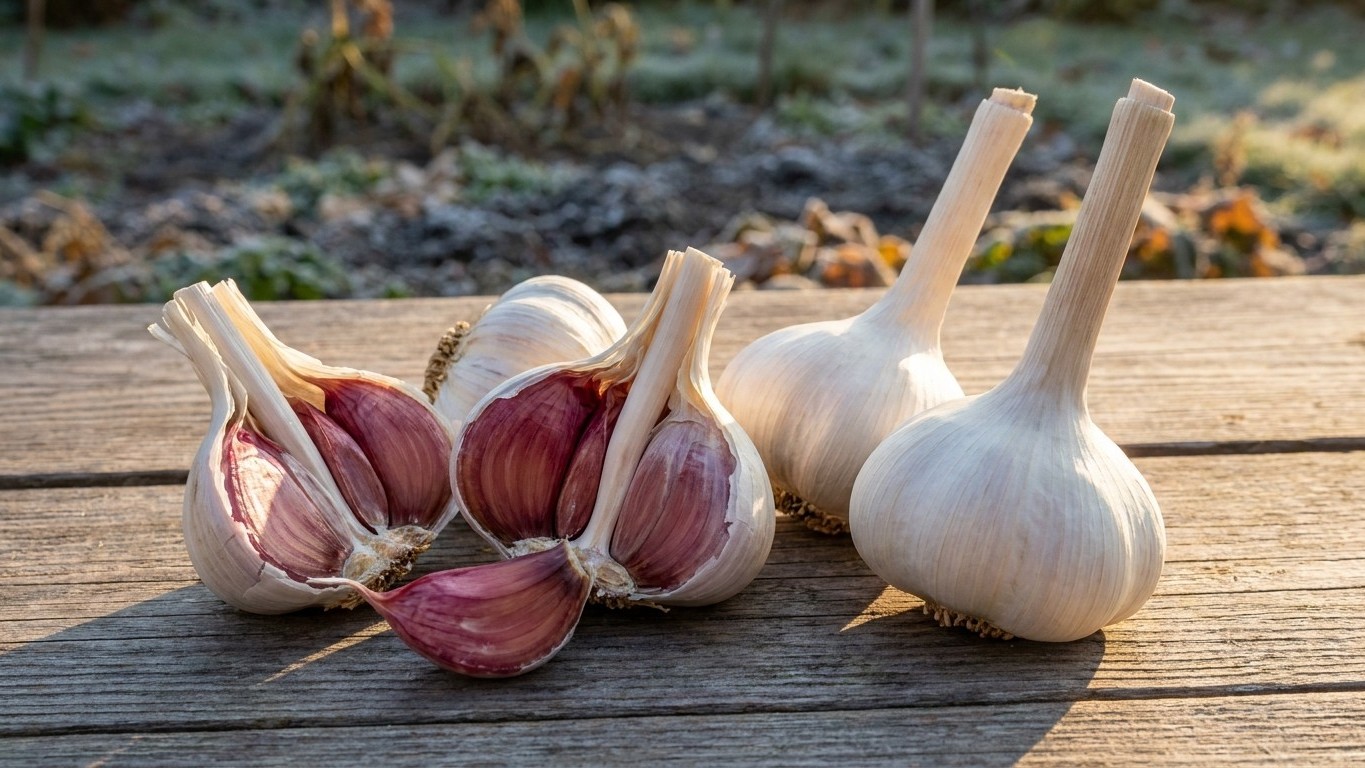

Polish Jenn is a porcelain hardneck, and porcelain garlics are the ones that punish a mild winter. Plant the cloves in fall, after the first frost has cooled the soil but before it locks up, and only where a real cold season follows. Skip that cold and you lift a single round bulb instead of a head of cloves.
What Music actually is

Polish Jenn belongs to the porcelain family, the group of garlics known for smooth, papery white wrappers and a small number of oversized cloves packed inside each head. It is a hardneck, which means it grows a stiff central stalk (the scape) and stores its energy in fewer, bigger cloves rather than the many small ones a softneck produces.
The color inside is red, and the flavor is described, in the catalog listing for this variety, as large cloves with a refined flavor and good cold hardiness. That last phrase matters more than it sounds. Porcelains as a type are bred around a genuine winter, and a catalog that leads with cold hardiness is telling you, before anything else, what climate this plant expects.
Storage is the tradeoff. This variety keeps only 3 to 4 months at room temperature, which is short next to the softnecks that can sit in a pantry through winter. The practical advice attached to it is blunt: eat this one first. If you are planning a year’s supply of garlic, Polish Jenn is the head you pull off the shelf in October and November, not the one you’re still working through in March.
No disease or pest resistances are published for this variety. That is not a gap in this article. It is the actual state of the catalog data, and it is worth knowing before you plant, rather than assuming a resistance that was never claimed.
Will it get the cold it needs where you are
Garlic divides into cloves through a process called vernalization: a sustained stretch of cold after planting signals the bulb to split. Without enough of that cold, the plant grows top leaves but the bulb underneath stays a single, undivided round, sometimes called a “round” or “rock” garlic by growers who’ve seen it happen. This is the single most common reason a home garden garlic crop disappoints, and it has nothing to do with soil, watering, or fertilizer. It’s temperature, full stop.
Porcelains, Polish Jenn included, sit at the demanding end of the cold-requirement spectrum. They’re bred for regions with a proper winter, and they perform best where the ground freezes or comes close to it for an extended stretch. The USDA Plant Hardiness Zone Map is the standard reference for checking where you fall, and it’s worth pulling up before you order cloves.
In broad terms, gardeners in the colder hardiness zones, roughly zone 6 and colder, give this variety exactly what it wants. The ground freezes deep enough and long enough for the cloves to sit through a real winter and divide properly by spring. Move into zone 7 and the picture gets marginal. Winters there flirt with cold but don’t commit to it every year, so results with a porcelain like Polish Jenn can swing from a strong harvest one season to disappointing, undersized bulbs the next.
Push further south, into zone 8 and warmer, and a porcelain hardneck is fighting its own biology. The soil simply doesn’t hold the sustained cold this type needs, and the honest answer is that Polish Jenn is not the right choice there without intervention.
That intervention exists, and it’s real. Growers in warm-winter regions who still want to grow hardneck types buy their cloves and refrigerate them, typically for several weeks before planting, mimicking the cold the ground won’t provide. It works, but it’s an extra step, not a shortcut everyone wants to manage. The other option is simpler: choose a softneck variety instead, one bred for exactly the mild-winter conditions where a porcelain struggles. Neither path means giving up on garlic. It means matching the type to the climate, or doing the climate’s job yourself with a refrigerator.
The takeaway by zone
| Winter climate | How Polish Jenn performs |
|---|---|
| Cold (roughly zone 6 and colder) | Comfortable fit; cold requirement met naturally |
| Marginal (roughly zone 7) | Inconsistent; some years divide well, others don’t |
| Warm (roughly zone 8 and warmer) | Not a natural fit; needs refrigerated cloves or a softneck instead |
When to put the cloves in
Garlic is a fall-planted, summer-harvested crop, and the timing is anchored to the first fall frost rather than a fixed date on the calendar. The general rule growers pass along is to plant roughly four to six weeks before the ground is expected to freeze hard. That window gives the clove enough time to grow roots and anchor itself without pushing much green top growth, which is exactly the balance you want heading into winter.
In cold-winter regions, that often lands in September or October, sometimes as early as late September in the coldest pockets. Gardeners in mild-winter regions plant later, often into November or even December, because their ground stays workable and frost-free much longer into the year. Warm-climate growers, if they’re using refrigerated cloves to substitute for a real winter, tend to plant on the later end of fall as well, once nighttime temperatures have dropped enough to avoid premature top growth.
It’s worth saying plainly: sources on exact planting windows disagree by region, and that’s not sloppiness on anyone’s part. A frost date in Vermont and a frost date in coastal Virginia are different problems, and no single calendar date works for both. The frost timeline for your specific area, not a generic “plant in October” rule, is the number that should drive your planting day.
Plant too early and the clove sends up leaves before winter, leaving tender growth exposed to hard freezes. Plant too late and the clove doesn’t root well before the soil locks up, weakening the plant heading into spring. Both mistakes are avoidable once you’re working from your local frost date instead of a national one-size-fits-all schedule.
Hardneck or softneck: what this one asks of you
Polish Jenn is a hardneck, and that habit shapes almost everything about growing and using it. Sometime in late spring or early summer, before the bulb finishes filling out, it sends up a curling flower stalk called a scape. That scape needs to be cut, not left to grow, because leaving it in place diverts the plant’s energy away from the bulb and into the stalk. Cutting it is a maintenance task, not an optional one.
In exchange, hardneck types like this one give you fewer cloves per head, but each one is noticeably larger than what a softneck produces, and those cloves peel far more easily. Both traits show up directly in this variety’s numbers: 4 to 12 cloves per head, easy to peel, but a storage life of only 3 to 4 months at room temperature. That’s a real tradeoff against softnecks, which typically produce more, smaller cloves and can keep for many months longer.
The hardneck habit and the cold requirement aren’t a coincidence. Hardneck garlics as a category, porcelains especially, evolved to handle long, cold winters, while softnecks were selected for milder climates where they don’t need that chill to perform. If you’re gardening through a real winter, Polish Jenn’s hardneck habit is simply part of the package that comes with the cold hardiness you’re planting it for. If you’re in a mild climate reaching for the refrigeration workaround, know you’re also signing up for scape-cutting and a shorter pantry life, not just a cold substitute.
Growing and curing it without losing the crop
Plant cloves about 2 inches deep and roughly 6 inches apart, pointed end up, in soil that drains well. A layer of mulch, straw is the common choice, matters more here than with a spring-planted crop, because it’s insulating the clove through an entire winter, not just protecting it from a late frost. Pull the mulch back a bit in early spring once new growth appears, so the shoots aren’t smothered.
Cut the scape when it curls, both to redirect energy into the bulb and because the scape itself is edible. Watering should taper off in the weeks before harvest; wet soil right up to lifting encourages rot and stains the wrappers, which hurts storage. The classic signal that a head is ready is the lower leaves turning brown and dying back while a handful of upper leaves stay green, usually in early to mid summer depending on your planting date.
Curing is where a lot of otherwise good crops go wrong. Lift the bulbs carefully rather than yanking them, then hang or lay them in a shaded, dry, well-ventilated spot for two to three weeks, roots and tops still attached. Don’t wash them and don’t rush this step. A bulb cured too fast or in humid conditions molds in storage; a bulb cured too long or in the sun scorches. Given that Polish Jenn already keeps for only 3 to 4 months at room temperature, a sloppy cure eats directly into an already short window, so this is the step worth doing patiently.
Common questions
Can I grow Polish Jenn without a cold winter?
Not comfortably outdoors in warm zones. The workaround is refrigerating the cloves for several weeks before planting to substitute for the cold the ground won’t provide, though a softneck variety suited to mild winters is usually the simpler choice.
How many cloves come from one head?
This variety produces 4 to 12 cloves per head, on the low end of typical for a porcelain hardneck, with each clove large and easy to peel.
How long does Polish Jenn keep after harvest?
Only 3 to 4 months at room temperature. That’s short for garlic, and it’s a variety meant to be used early rather than stored for a full year.
Do I have to cut the scape?
Yes, if you want a full-sized bulb. As a hardneck, Polish Jenn sends up a scape that draws energy away from the bulb if it’s left uncut, so removing it once it curls is part of growing this type well.