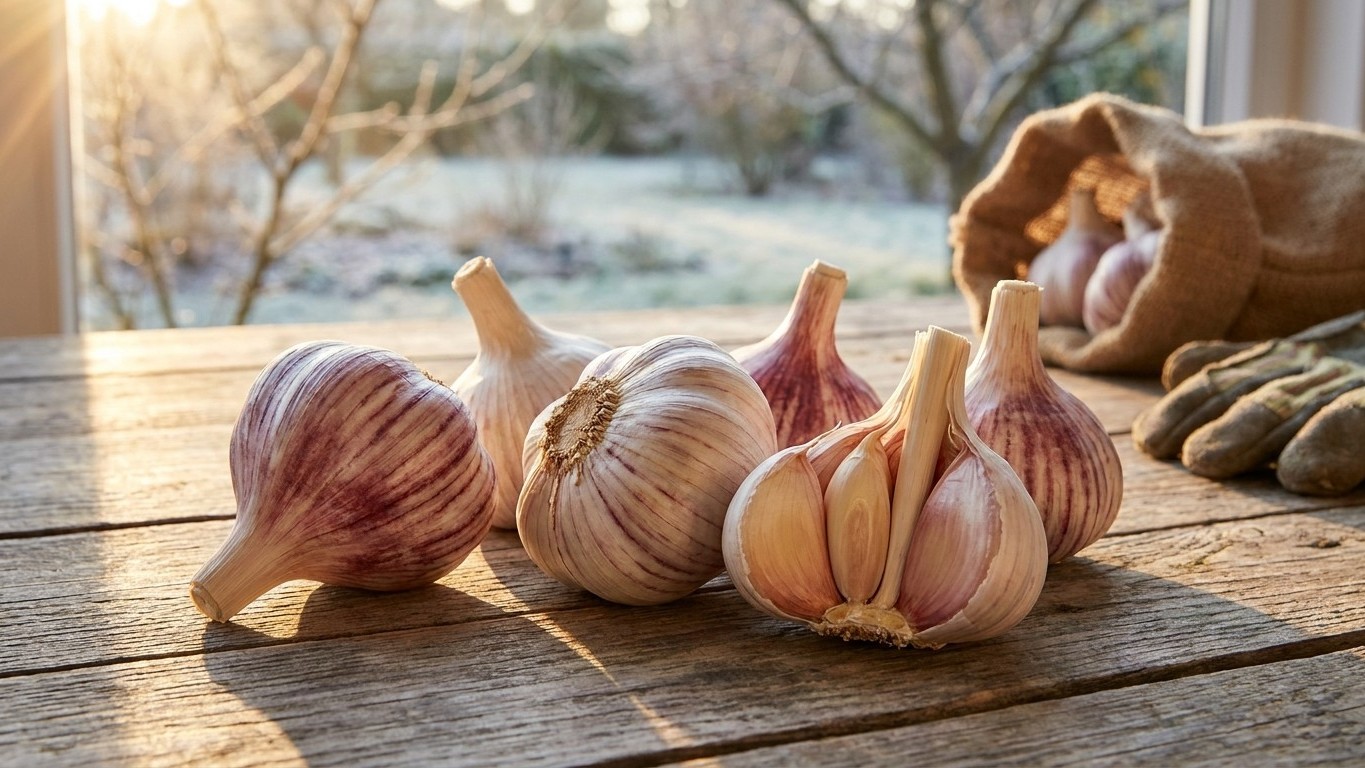

Romanian Red is a porcelain hardneck, and that single fact decides everything about when you plant it. Porcelain types need a real winter, a sustained stretch of cold, or the clove never splits into the four or five fat segments that make this garlic worth growing. Where you live, more than the calendar, sets the planting date.
What Music actually is

Romanian Red belongs to the porcelain family, the same broad group that includes some of the best-known hardneck garlics grown in the United States. Porcelain garlics are recognizable by their smooth, glossy wrappers, usually white with a faint striping, and by heads that carry fewer cloves than a softneck but each one noticeably larger. Romanian Red follows that pattern: it is a hardneck, meaning it sends up a rigid central stalk (the scape) each spring, and the heads it produces are described in catalogue material as huge, holding 4-5 fat cloves with a flavor that same source calls hot, pungent and long-lasting.
Storage is the tradeoff. Catalogue data lists 4 to 12 cloves per head that peel easily once cured, but the bulbs keep only 3 to 4 months at room temperature, short next to the six-to-nine-month shelf life some softneck varieties manage. No published disease or pest resistances are attached to this variety, so growers should treat it like any other porcelain: watch for the usual garlic problems (white rot, rust, bloat nematode) rather than expecting built-in protection.
Will it get the cold it needs where you are
Garlic doesn’t grow like a normal bulb crop. Plant a clove of any hardneck variety and it will root, but without a sustained period of cold weather it will grow into one round, undivided bulb the following summer. This process, sometimes called vernalization, is the reason garlic is planted in fall rather than spring almost everywhere in the country. Porcelain types, Romanian Red among them, are on the demanding end of this requirement. They come from cold-winter growing traditions and tend to underperform when the ground barely dips below freezing for more than a few weeks.
Regions with long, cold winters, the Upper Midwest, northern New England, the Mountain West, and most of the USDA hardiness zones numbered 3 through 6, give this variety exactly what it needs without any extra effort. The soil freezes solid, the cloves get their chill, and by early summer the grower is lifting full, well-divided heads. Gardeners in these zones can plant on the standard fall schedule and expect the variety to perform as described.
The picture gets murkier in transitional zones, the mid-Atlantic, parts of the Pacific Northwest, and the warmer edges of zone 7, where winters are cold but inconsistent. Romanian Red can still produce a divided head in these areas, but results tend to be less predictable than in a true cold-winter zone.
Further south, the Gulf Coast, peninsular Florida, and the low desert Southwest rarely deliver the sustained cold a porcelain garlic wants. There are two real paths forward. The first is pre-chilling: storing the cloves in a refrigerator, separated but not peeled, for several weeks before planting, to simulate cold the ground won’t provide. The second, often more reliable, is choosing a softneck variety bred for mild climates instead, since softnecks generally need less cold to divide properly and are the traditional choice in warm-winter regions like California’s Central Valley. Neither option is a downgrade so much as a different tool for a different climate.
When to put the cloves in
Garlic is a fall-planted, summer-harvested crop almost everywhere it’s grown in the U.S., and the planting window is set by the first fall frost in your area rather than by a fixed calendar date. Plant early enough that the clove has time to root before the ground freezes hard, but late enough that it doesn’t push much leafy top growth before winter arrives. Garlic that sprouts too much above ground before a hard freeze can suffer dieback that weakens the plant come spring.
In cold-winter regions, that usually means planting in the weeks around the first fall frost, often in October, so the clove has a few weeks of mild soil temperatures to root before the freeze sets in. In milder, transitional climates, growers often wait longer, sometimes into November. In warm-winter regions where garlic is planted at all, the window can stretch into December, since there’s no hard freeze to race against.
Sources on exact timing disagree region to region, since frost patterns, soil types and typical winter severity genuinely differ. The safest approach for a demanding porcelain type like Romanian Red is to anchor the decision to your local first frost date and count backward four to six weeks, adjusting toward the earlier end of that range in the coldest zones and the later end where winters run milder.
Hardneck or softneck: what this one asks of you
Romanian Red is a hardneck, and that habit shapes nearly every task involved in growing it. Hardneck garlics send up a rigid central stalk each spring called a scape, which curls and eventually would flower if left alone, but growers cut it off well before that happens. Removing the scape redirects the plant’s energy into the bulb rather than into that stalk, and it also happens to be a genuinely useful ingredient, chopped into a stir-fry or blended into a pesto. Skipping this step doesn’t ruin the crop, but it does mean smaller heads at harvest.
Hardnecks in general, and this porcelain type specifically, produce fewer cloves per head than a softneck, typically the 4 to 12 range noted in catalogue data, but each clove runs noticeably larger and peels away from its wrapper more easily. The tradeoff is storage life: hardnecks as a class don’t keep as long as softnecks, and Romanian Red’s 3-to-4-month window sits on the shorter side even within that category. That’s a variety to plan on eating through fall and early winter, not one to count on for a March batch of roasted garlic.
None of this is arbitrary. Hardneck garlics evolved for, and still perform best in, regions with long, cold winters, exactly the climate this variety wants for good bulb division in the first place. Softnecks, by contrast, dominate mild-winter growing regions and store for months longer, which is why they’re the type most often seen braided and hung in a kitchen. If you garden somewhere with real winters, Romanian Red’s habit lines up with your climate. If you don’t, that mismatch shows up twice, once in bulb formation and again on the shelf.
Growing and curing it without losing the crop
Plant cloves pointed end up, about 2 inches deep and 6 to 8 inches apart, in loose, well-drained soil that’s had compost worked in ahead of planting. A thick mulch layer, straw or shredded leaves, matters more for an overwintered crop like garlic than for almost anything else in the garden, since it buffers the soil against freeze-thaw cycles that can heave young roots out of the ground over winter. Pull that mulch back partially in spring once new growth appears, so the soil can warm and the shoots aren’t smothered.
Watering should continue through spring bulb development but stop entirely two to three weeks before harvest, since wet soil at that stage encourages disease and can stain the wrappers. The clearest sign the crop is ready to lift is the foliage: when the lower third to half of the leaves have browned while the upper leaves are still green, the bulbs are typically mature. Pulling too early gives you undersized cloves; waiting too long risks the wrapper splitting open in the ground, which shortens storage life immediately.
Curing is where a lot of home-grown garlic quietly fails after a good season in the ground. Freshly pulled bulbs need three to four weeks hanging or laid out in a warm, dry, well-ventilated, shaded spot, roots and tops still attached, before you trim them down for storage. Skipping or rushing this step is the classic mistake that costs growers their harvest months later in the pantry, when improperly cured heads soften, mold, or sprout early. Given Romanian Red’s already short shelf life, a full, unhurried cure is what stands between a fall harvest and a January disappointment.
Common questions
Can Romanian Red be grown in a warm climate at all? Yes, though not without help. Refrigerating the cloves for several weeks before planting can substitute for the sustained cold that mild winters don’t provide, though results in true warm-winter regions are still less reliable than in a cold-winter zone.
Why does my garlic come up as one round bulb instead of separate cloves? That’s the classic sign of insufficient cold exposure after planting. The clove rooted and grew, but without enough sustained chill it never divided, a problem that shows up most often with demanding porcelain types like this one in marginal or warm climates.
Do I have to cut the scape? Not strictly, but leaving it on redirects the plant’s energy away from the bulb, typically resulting in smaller heads at harvest. Most growers cut it as soon as it curls.
How soon after harvest should I plan to use this garlic? Given its 3-to-4-month room-temperature shelf life, Romanian Red is best treated as an early-use variety, worked through in the months right after harvest rather than saved for late winter.