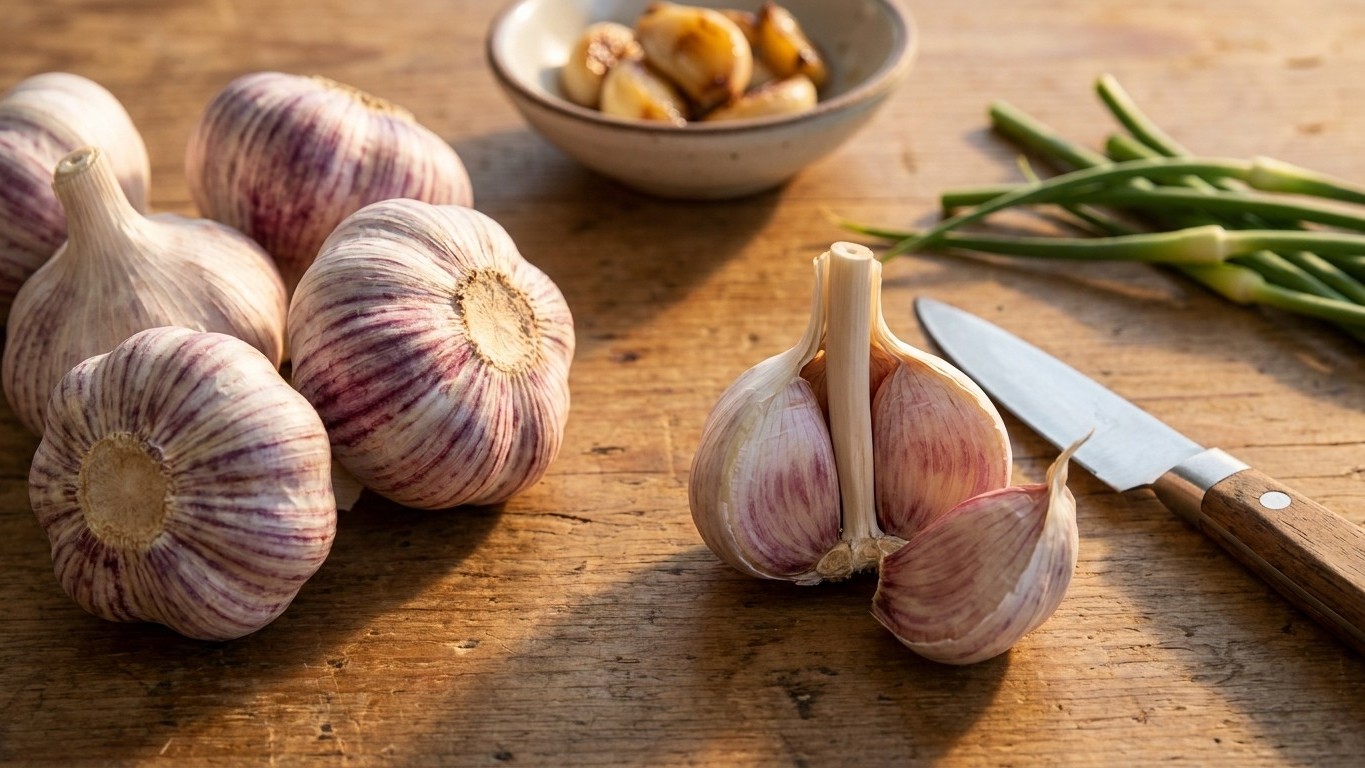

Svea garlic is a hardneck, marbled purple stripe variety with a sharp, spicy bite that mellows into a nutty sweetness once roasted, and it keeps only three to four months at room temperature, which makes it a garlic for eating early rather than storing through winter. Getting a full head of cloves out of it, though, depends less on soil or fertilizer than on whether your winter is cold enough to do its job.
What Music actually is

Svea belongs to the marbled purple stripe group, a family of hardneck garlics known for bulbs streaked with violet and burgundy under a papery white skin. Hardneck types send up a rigid central stalk, called a scape, that the grower cuts off before harvest. That stalk is also why hardneck garlics tend to produce fewer, larger cloves arranged in a single ring around the stem, instead of the tight, multi-layered cluster a softneck bulb gives.
The catalog description for Svea calls it an eye-opening garlic with a strong, spicy flavor that mellows to a tasty nuttiness when roasted or baked. Raw, it carries real heat; that heat softens into something closer to caramelized onion once the cloves hit a hot oven.
Storage is where Svea asks for a compromise. Its room-temperature shelf life is just three to four months, short by garlic standards. Compare that to a softneck like a Silverskin type, which can hold six months or more, and the takeaway is simple: plant Svea if you cook with garlic often enough to work through a harvest by late winter, not if you’re trying to stock a pantry until next summer’s planting.
No disease or pest resistances are published for this variety, at least not in any published record.
Will it get the cold it needs where you are
Garlic isn’t like a tomato seedling that just needs warmth and daylight. A hardneck clove planted in the ground has to pass through a real stretch of cold before it will divide into multiple cloves the following summer. Skip that cold exposure, or shortchange it, and the plant grows a single round, undivided bulb, essentially an overgrown clove, instead of the segmented head a cook expects to peel. Growers call this vernalization, and for hardneck types like Svea it isn’t optional. It’s the mechanism that turns one clove into eight or ten.
This is the part most general garlic guides skip past with a vague “plant in fall and mulch well.” The real question is whether your region delivers enough sustained cold after planting and before the ground freezes solid, and that answer changes dramatically by geography.
Where the cold comes easily
Across the northern tier of the country, broadly USDA zones 3 to 6, winters routinely bring weeks of freezing or near-freezing soil temperatures. That’s comfortable territory for a hardneck marbled purple stripe like Svea. States like Minnesota, Wisconsin, Maine, and most of the Mountain West and Upper Midwest hand this variety exactly what it evolved to expect. Growers in these zones can plant with confidence and skip any extra intervention.
Where it gets marginal
Move into zone 7, much of the mid-Atlantic, the Ohio Valley, and parts of the coastal Pacific Northwest, and the cold arrives but sometimes inconsistently. Some winters deliver a solid cold snap; others stay mild enough that bulb division is spotty, with a mix of well-formed heads and smaller, under-divided ones in the same row. Growers here generally still get a usable crop, but yields and cloves-per-bulb tend to run less predictable than up north.
Where it falls short
In zones 8 through 10, most of the Deep South, coastal California, and Florida, winter temperatures rarely stay cold long enough to trigger reliable division in an unmodified hardneck clove. Two real options exist for gardeners in these regions:
- Pre-chill the cloves. Store seed cloves in a refrigerator, separate from any fruit that gives off ethylene, for several weeks before planting, simulating the cold they won’t get naturally in the ground.
- Choose a variety with a lower cold requirement. Softneck garlics, as a category, need far less chilling and are the traditional choice for mild-winter regions, since they were bred and selected in warmer climates to begin with.
Neither path is a downgrade, just a matter of matching the tool to the climate. A warm-region grower who pre-chills Svea cloves and plants at the right depth can still get a respectable harvest; they’re simply doing manually what a Minnesota winter does for free.
When to put the cloves in
Garlic planting runs in the opposite direction from most vegetables: it goes into the ground in fall and comes out the following summer. The anchor point isn’t a date on a calendar but the first fall frost in your area, because what matters is giving the clove enough time to grow roots before the soil freezes hard, without giving it so much time that it pushes vulnerable green top growth above ground before winter sets in.
In cold-winter regions, that generally means planting four to six weeks ahead of the ground freezing solid, often landing somewhere in mid-September to October depending on how far north you are. The goal is root establishment, not leaf growth. A clove planted too early can send up shoots that get damaged by hard freezes later; one planted too late may not root deeply enough before the soil locks up, leaving it vulnerable to frost heave over winter.
In milder, transitional climates, roughly the zone 7 band described above, the window stretches later into fall, often October into November, since the ground stays workable and the frost risk to young roots is lower.
In warm-winter regions where pre-chilled cloves are the strategy, planting typically happens later still, sometimes not until November or December, timed so the cool season, brief as it is, lines up with the plant’s early growth.
Regional guidance genuinely disagrees on exact windows, and that’s not sloppiness on anyone’s part. Microclimates, soil drainage, and how early a given fall turns cold all shift the ideal date by a couple of weeks in either direction. Local extension offices and experienced regional growers remain the best tiebreaker when the general guidance and your particular yard don’t quite match.
Hardneck or softneck: what this one asks of you
Svea is a hardneck variety, and that classification carries real, hands-on consequences beyond the cold requirement already covered. Hardneck garlics send up a scape, a curling flower stalk, in late spring, and that scape needs to be cut off before it fully matures. Left in place, it diverts the plant’s energy into the stalk instead of bulb growth, shrinking the harvest. Cutting scapes is a small extra task softneck growers never deal with, but it comes with a bonus: scapes are edible, with a mild garlic flavor good in stir-fries or pesto.
Beyond scape management, hardneck cloves are typically easier to peel than softneck cloves, since they’re larger and fewer per bulb, generally four to twelve cloves for Svea specifically. That’s a real kitchen advantage for anyone tired of fighting with a dozen tiny softneck cloves for a single recipe.
The tradeoff, again, is storage life. Hardneck garlics as a category don’t keep as long as softnecks, and Svea’s three-to-four-month window sits on the shorter end even within that category. Softneck types, bred for milder climates and longer shelf life, can often be braided and hung for six months or more.
The practical rule holds: hardneck varieties like Svea suit long-winter climates and cooks who’ll use up the harvest within a few months of curing. Softneck varieties suit mild-winter growers and pantries meant to stretch toward the following spring.
Growing and curing it without losing the crop
Plant individual cloves pointy end up, about two inches deep and six inches apart, in rows spaced roughly twelve inches apart, in loose, well-drained soil. A layer of straw mulch, four to six inches, matters more for an overwintered crop than for almost anything else in the garden, since it buffers the soil against the freeze-thaw cycles that heave young roots out of the ground over a long winter.
Watering matters through spring as the bulb bulks up, but it should taper off and stop entirely two to three weeks before harvest. Wet soil at harvest time invites rot and stains the wrapper, both of which shorten an already short storage window for a variety like Svea.
The bulb is ready to lift when the lower third to half of the leaves have browned while the upper leaves are still green, generally in early to mid-summer depending on planting date and region. Pulling too early means underdeveloped cloves; waiting too long, until all the leaves have died back, risks the bulb wrappers splitting open in the ground, which ruins storage potential entirely.
Curing is the step growers most often shortchange, and it’s the difference between garlic that lasts the full three to four months and garlic that molds in half that time. Cure bulbs, unwashed, with tops and roots intact, in a shaded, dry, well-ventilated spot for two to three weeks until the outer wrappers are papery and the neck is fully dry. Only then trim the tops and roots and move the bulbs to storage.
Common questions
Can I plant Svea garlic in a raised bed?
Yes, and raised beds often suit garlic well because they drain faster than in-ground plots, reducing rot risk over a long winter. The same depth, spacing, and mulch guidance applies regardless of bed type.
Does Svea garlic need full sun?
Garlic generally performs best with at least six hours of direct sun daily. Partial shade slows bulb development and can result in smaller heads, a particular concern for a variety already producing a limited number of cloves per bulb.
What happens if I skip cutting the scape?
The plant will put energy into the flowering stalk instead of the bulb, typically resulting in a smaller harvest. Cutting the scape once it curls, usually a few weeks before the main harvest, redirects that energy back into the developing cloves.
Is Svea garlic a good choice for a beginner?
It’s reasonable for a beginner in a cold-winter region, since the climate does most of the work automatically. Beginners in mild-winter regions will need to manage the pre-chilling step carefully, which adds a layer of complexity worth knowing about before planting.