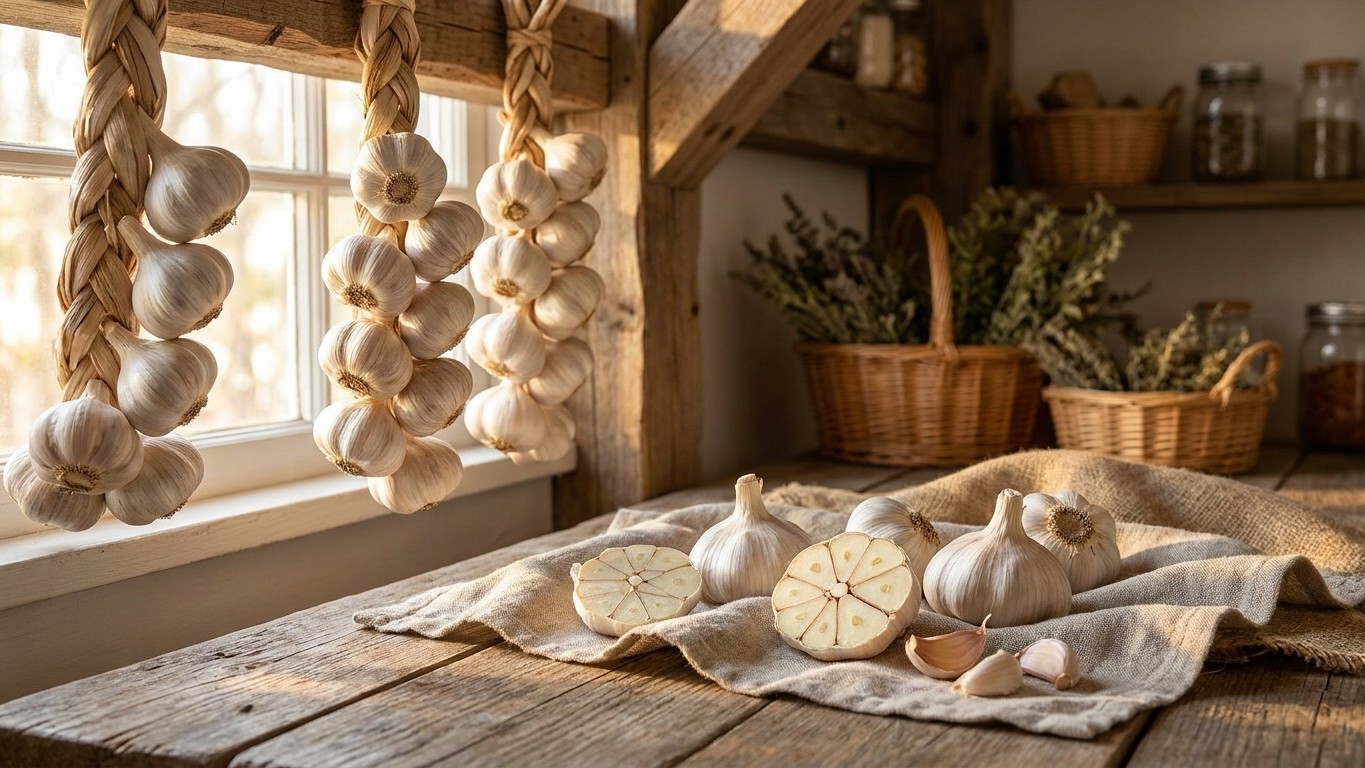

Western Rose is a softneck silverskin: the type that braids, stores the longest, and asks less of a cold winter than its hardneck cousins. Plant it in fall, six to eight weeks before the ground freezes hard, and in mild-winter regions it will outlast almost anything else in the pantry, sometimes nine months on a shelf.
What Music actually is

Western Rose belongs to the Silverskin group, the softneck branch of the garlic family that also gives you the tight, papery-white braiding bulbs you see hanging in farmhouse kitchens. Silverskins are softneck by habit, meaning the plant never sends up a rigid central stalk and never needs a scape cut in early summer. That single trait shapes almost everything else about how the bulb grows and how long it lasts.
The flavor, as catalogue descriptions put it, comes from a bulb built in two layers: smaller inner cloves surrounded by larger outer ones, and all of them carry a sharp, distinctly garlicky bite rather than the milder, sweeter notes some Artichoke types offer. That layered structure is typical of Silverskins and it means a single head can give you both a big clove for roasting and several small ones for mincing, without buying two different bulbs.
Storage is where this type earns its keep. A softneck bulb like this one typically holds 10 to 40 cloves per head and keeps 6 to 9 months at room temperature, which puts it firmly in the “winter keeper” category gardeners plant specifically to still have garlic on hand in March. There are no published disease or pest resistances tied to this variety, which is not a red flag, just a gap in the catalogue record worth knowing before you plant it expecting built-in protection it doesn’t claim to have.
Will it get the cold it needs where you are
Garlic will not divide into a head of cloves without a real stretch of cold after planting. Skip that chilling period and you lift a single round, undivided bulb the following summer, essentially a giant clove with nothing to peel apart. This is the step most general planting guides skate past, and it’s the one that actually decides whether growing this variety is worth your garden space.
Hardneck garlics are the ones that demand serious winter cold, often needing an extended run of temperatures below 40°F to trigger clove formation, which is why they dominate in the northern tier of the country. Softneck types like Western Rose ask for noticeably less. They still need some chilling, but a mild winter that would leave a hardneck bulb undivided is often enough to satisfy a Silverskin.
That makes Western Rose a realistic choice across a wide swath of the country where garlic guides written for hardneck types would otherwise tell a gardener to give up. The USDA Plant Hardiness Zone Map is the standard public reference for sorting out where winters run mild, moderate, or cold, and it’s worth checking your zone against it before ordering seed stock, since “mild winter” covers a lot of ground, from coastal California to the Gulf Coast to the lower Southeast.
Where it’s comfortable, marginal, or a stretch
In genuinely mild-winter zones, the kind found along much of the Pacific Coast and the Deep South, a softneck Silverskin like this one is the sensible pick precisely because it doesn’t need the sustained hard freeze that hardneck types rely on. Move into zones with a short, shallow cold snap rather than a long winter, and Western Rose sits in marginal territory: it may still divide, but the head can come up smaller or less uniform than in a region with a fuller cold season. In zones with essentially no real winter chill at all, or in very high-elevation, long-cold regions where hardneck varieties are the traditional crop, the calculation shifts in opposite directions.
For a gardener in a warm zone where even Western Rose’s modest chilling requirement is in doubt, there is a real fix rather than a reason to skip garlic altogether: refrigerate the cloves for several weeks before planting, mimicking the cold they’d otherwise miss in the ground. For a gardener in a zone so cold that garlic overall struggles regardless of type, the answer runs the other direction, toward a hardneck variety bred for that longer, harder winter rather than trying to push a Silverskin past its comfort zone. Neither situation is a dead end. Both just mean matching the clove to the winter you actually have instead of the one a generic guide assumed.
When to put the cloves in
Garlic is a fall-planted, summer-lifted crop almost everywhere in the country, and the timing hinges on your first fall frost date rather than a fixed date on the calendar. The general target is to get cloves in the ground roughly six to eight weeks before that first hard frost, giving them enough time to root into the soil before it freezes solid, without pushing so much green top growth that a hard freeze damages young shoots.
In cold-winter regions, that usually lands planting somewhere in September or early October, since the first frost arrives early and the soil needs to still be workable when the cloves go in. In regions with a milder, later fall, planting commonly slides into October or November. And in the mildest winter zones, the ones where Western Rose performs best, growers often wait until November or even into December, since the ground stays workable longer and there’s no rush to beat an early freeze.
It’s worth saying plainly that regional planting calendars don’t fully agree on exact windows, and that’s not sloppiness, it reflects real variation in how fast soil cools and how early frost lands from one state to the next. Rather than chase a single universal date, the more reliable approach is tracking your own area’s typical first frost and counting backward six to eight weeks from there, adjusting a little later in genuinely mild winters where the cold arrives slowly and there’s less urgency to root the cloves before a freeze.
Hardneck or softneck: what this one asks of you
Western Rose is softneck, and that single fact drives a handful of very practical differences in how it grows and how you handle the harvest. Hardneck varieties send up a rigid central stalk called a scape, which has to be cut off in early summer so the plant’s energy goes into the bulb instead of that stalk; softneck varieties skip that step entirely, since they never send one up. That’s one less task on the calendar, and one less window you can miss.
Hardneck bulbs tend to produce fewer, larger cloves that peel easily but don’t store especially long, often just a few months. Softneck types like Western Rose flip that trade-off: more cloves per head, generally smaller and a bit fussier to peel, but capable of keeping 6 to 9 months at room temperature. The pliable, papery stems are also what let softneck bulbs be braided into the ropes you see hung in kitchens, something a stiff hardneck stalk can’t do.
The pattern maps directly onto climate. Hardneck varieties are the traditional choice for long, hard winters, partly because they need that sustained cold and partly because their shorter storage life matters less when a grower is working through the harvest over a shorter, colder season. Softneck varieties like Western Rose belong to milder climates and to anyone who wants a head of garlic still good to cook with well into the following spring.
Growing and curing it without losing the crop
Plant individual cloves pointed end up, about 2 inches deep and 4 to 6 inches apart, in rows spaced roughly 12 inches apart to give bulbs room to size up. A layer of mulch, straw is the common choice, matters more for an overwintered crop like garlic than for most vegetables, since it buffers the soil against freeze-thaw cycles that can heave young roots out of the ground before they’ve had a chance to establish.
Water regularly through spring while the bulb is bulking up, then stop watering roughly two to three weeks before you plan to lift, letting the soil dry out so the outer wrapper on each bulb firms up rather than staying soft and prone to rot in storage. The classic signal that a softneck bulb is ready is the foliage: when the lower leaves have browned and died back but four or five green leaves remain up top, it’s time to lift, since each healthy leaf roughly corresponds to a papery wrapper layer protecting the bulb.
Curing is the step that decides whether that 6 to 9 month storage window is real or theoretical. Lift the bulbs carefully rather than yanking them, brush off loose soil without washing them, and hang or lay them in a shaded, dry, well-ventilated spot for two to three weeks until the necks are fully dry and papery. Skip or rush that curing period and even a well-grown Western Rose bulb can rot in storage well before it earns out its keeping reputation.
Common questions
Does Western Rose garlic need a scape cut like hardneck varieties?
No. It’s a softneck type and doesn’t send up a central flowering stalk, so there’s no scape to cut and one less step in the growing season.
Can I grow Western Rose garlic in a cold northern climate?
It can survive, but its modest chilling requirement is better matched to mild and moderate winters. In a long, hard-winter zone, a hardneck variety bred for that cold is usually the more reliable choice.
How long does Western Rose garlic actually keep after harvest?
Properly cured and stored at room temperature, it typically holds 6 to 9 months, among the longer storage windows in the softneck category.
What happens if I plant Western Rose garlic too early in fall?
Planting too far ahead of the first frost can push too much top growth before winter, leaving young shoots exposed to freeze damage. Aim for roughly six to eight weeks before your area’s typical first frost instead.