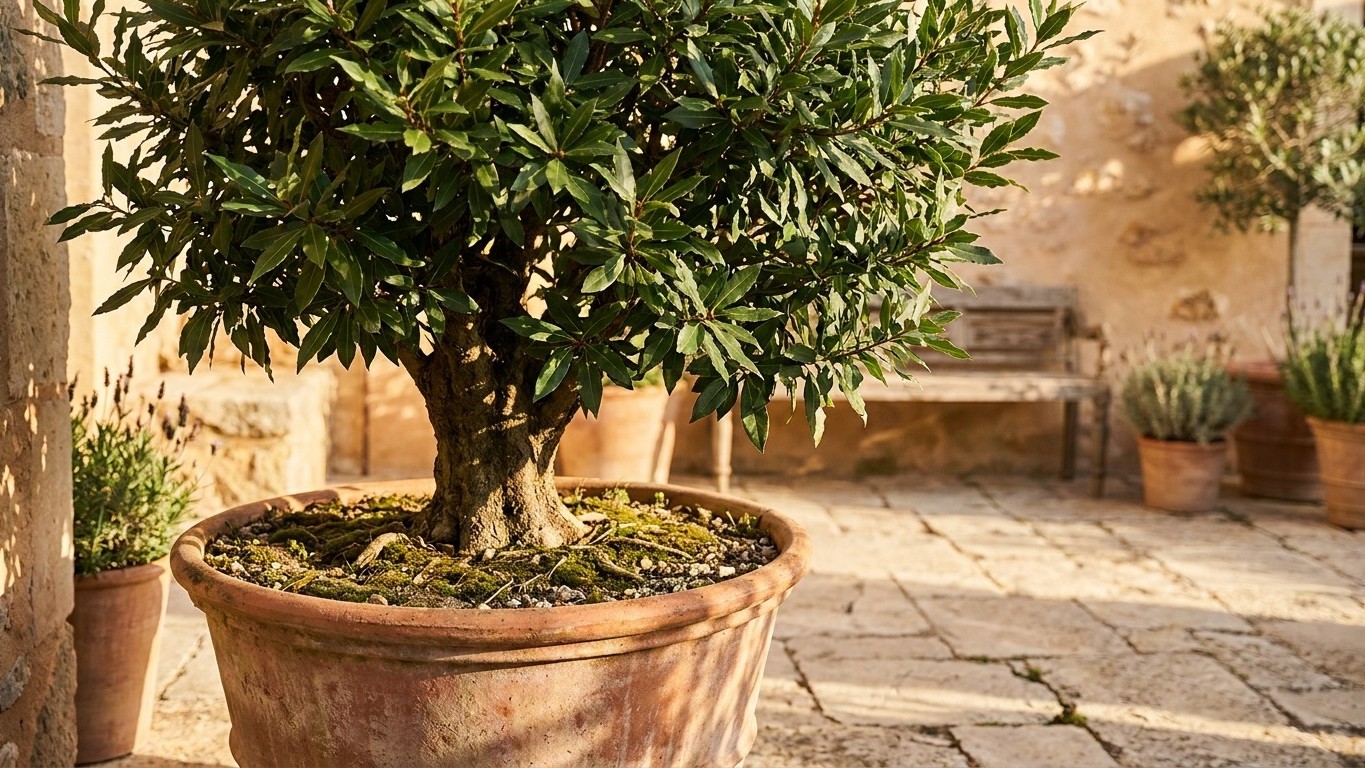

Bay is a Mediterranean tree, Laurus nobilis, that most American gardeners grow small and container-bound rather than as the 40-foot specimen it becomes in the wild. That single fact, tree kept small in a pot, decides how you water it, feed it, and bring it through winter, wherever you live.
What is actually going on

Bay isn’t a herb in the botanical sense at all. Basil, cilantro, and dill are annuals or Short-Lived perennials built to grow fast, flower, and die. Bay is a slow, long-lived tree that happens to get treated like a kitchen herb because its leaves are useful in small quantities. That mismatch, tree biology managed with herb-garden habits, is the root of most problems people run into.
The mechanism to understand is root restriction. A bay tree living in a pot for ten or twenty years is permanently root-bound by design. Its root system fills the available soil, then keeps circling and thickening because there’s nowhere else to go. This isn’t a temporary phase you fix once with a bigger pot; it’s the ongoing condition of the plant for as long as you grow it this way. Every decision about care follows from it.
Root-bound soil dries out faster than open ground because there’s more root mass and less actual soil volume holding water. That’s why a bay in a container can go from fine to wilted in the space of a hot week, even though the same tree planted in open soil in a mild climate would barely notice a dry spell. It also means the plant depends entirely on you for nutrients, since roots confined to a pot exhaust what’s available in the soil within a season or two, unlike a tree with room to forage outward.
Repotting bay isn’t about giving it more room to grow bigger, the way you’d repot a young houseplant. It’s about refreshing exhausted soil and trimming the densest root mass every few years so the tree stays healthy at roughly the same size. Growers who forget this and keep bumping bay into ever-larger containers, thinking bigger pot equals bigger happier tree, usually end up with a top-heavy plant sitting in soil that stays wet for days after watering, which the root system was never built to tolerate.
Bay has a long-standing reputation in traditional and medicinal contexts.
In the garden
Because bay behaves like a tree, its care reads more like arboriculture in miniature than like tending a bed of chives. The table below covers the points that actually matter and what tends to go wrong when a grower gets one of them backward.
| Care point | What bay needs | What goes wrong if you get it wrong |
|---|---|---|
| Watering | Water deeply when the top inch or two of soil is dry, then let it drain fully. Frequency depends on pot size, heat, and season, not a fixed schedule. | Watering on a calendar instead of checking the soil either drowns the root-bound mass in constantly wet soil, causing root rot, or lets it dry so hard the leaves scorch and drop. |
| Drainage | A pot with real drainage holes and a coarse, free-draining potting mix, not garden soil packed in a container. | Dense, moisture-holding soil in a root-bound pot stays soggy at the bottom long after the surface looks dry, which is where root rot starts and often goes unnoticed until leaves yellow. |
| Feeding | A balanced feed during the active growing season, tapered off as growth slows. | Skipping feeding starves a tree with no soil reserve to draw on, producing pale, thin leaves; over-feeding pushes soft, weak growth that’s more vulnerable to cold and pests. |
| Light | Full sun to light shade outdoors; the brightest spot available indoors when it has to come in. | Too little light indoors over winter causes leaf drop and leggy growth, which owners often mistake for a disease rather than a light problem. |
| Repotting | Every few years, into a pot only slightly larger, with root trimming to manage the root-bound mass rather than eliminate it. | Jumping to a much bigger pot leaves excess soil that stays wet around a root system too small to use it, inviting rot instead of growth. |
| Pests | Regular checks for scale and aphids, especially on new growth and leaf undersides. | Left unchecked, scale in particular can build up for months indoors over winter before it’s noticed, weakening the tree before spring. |
| Cold tolerance | Bay tolerates light frost but is damaged by hard freezes, which is why it’s grown as an outdoor plant only in the mildest winter regions and as a pot plant brought indoors Everywhere else. | Leaving it out through a hard freeze can kill it outright or defoliate it badly enough that recovery takes a full growing season. |
The cold limit is the detail that decides the whole yearly rhythm for most owners. In much of the country, bay spends summer outdoors and comes inside, often to an unheated but frost-free space like a garage or porch, once nights turn consistently cold. That transition, not the summer care, is where most losses happen, usually from moving the plant too abruptly between very different light and humidity levels rather than from the cold itself.
What it depends on where you are
How much of this you can ignore, and how much you have to manage actively, depends on your climate. Season length decides how many months a year bay can live outdoors versus how long it has to survive indoors under artificial or window light, which is a very different growing environment. Summer heat changes how often you’re watering a root-bound pot, since a container in a hot, dry summer climate can need water almost daily, while the same pot in a cooler, damper region might need it twice a week. Summer rainfall matters too, because a pot exposed to frequent heavy rain needs sharper drainage than one relying entirely on hand watering.
None of that is something a national page can answer honestly. A bay tree wintering outdoors against a sheltered south wall in one region might need full indoor protection a few hundred miles north, and the difference isn’t always the one you’d expect from a map, since local wind exposure, elevation, and even how close the pot sits to a heat-radiating wall all shift the real answer for a given spot.
This site’s state-level herb pages are built to fill in exactly that gap, since they’re written around the season length, frost timing, and summer conditions of a specific place rather than the country as a whole. If you’re deciding whether bay can stay outdoors year-round where you garden, or how early in fall to start watching the forecast for its move indoors, that’s the more useful next stop than a general guide.
Your local cooperative extension service is the other resource worth using here, particularly for anything tied to a specific freeze date or microclimate quirk in your county. Extension offices track frost data and local growing conditions at a level of detail no single national article can replicate, and for a tree you might be keeping alive in the same pot for a decade or more, that local grounding is worth the extra step.
The mistake that costs the most
The single error that does the most damage to potted bay isn’t neglect. It’s over-generosity: moving the tree into a much bigger pot because it looks like it’s outgrown the old one, and reasoning that more room means more growth. It doesn’t work that way for a plant whose care is built entirely around being root-bound.
A bay tree’s roots are calibrated, through years of confinement, to use the volume of soil they’re already in. Drop that same root system into a container two or three sizes larger and you’ve surrounded it with soil the roots can’t reach or dry out. That extra soil holds water for far longer than the tree’s actual root zone needs, and it stays wet at the bottom of the pot long after the surface looks fine. Root rot develops quietly there, often for weeks, before the leaves finally show it through yellowing, dropping, or a general dulling that owners tend to blame on light or feeding rather than the pot itself.
The fix isn’t to avoid repotting bay at all. Roots do need refreshing every few years, since old potting mix breaks down and compacts over time regardless of pot size. The fix is sizing the new pot only a few inches larger in diameter than the old one, and trimming back some of the oldest, densest roots at the same time so the tree’s root mass and the new soil volume stay in proportion. That keeps the plant in the same steady, slow-growing state that makes bay workable as a long-term container tree in the first place, rather than pushing it into a soil environment it isn’t built to handle.