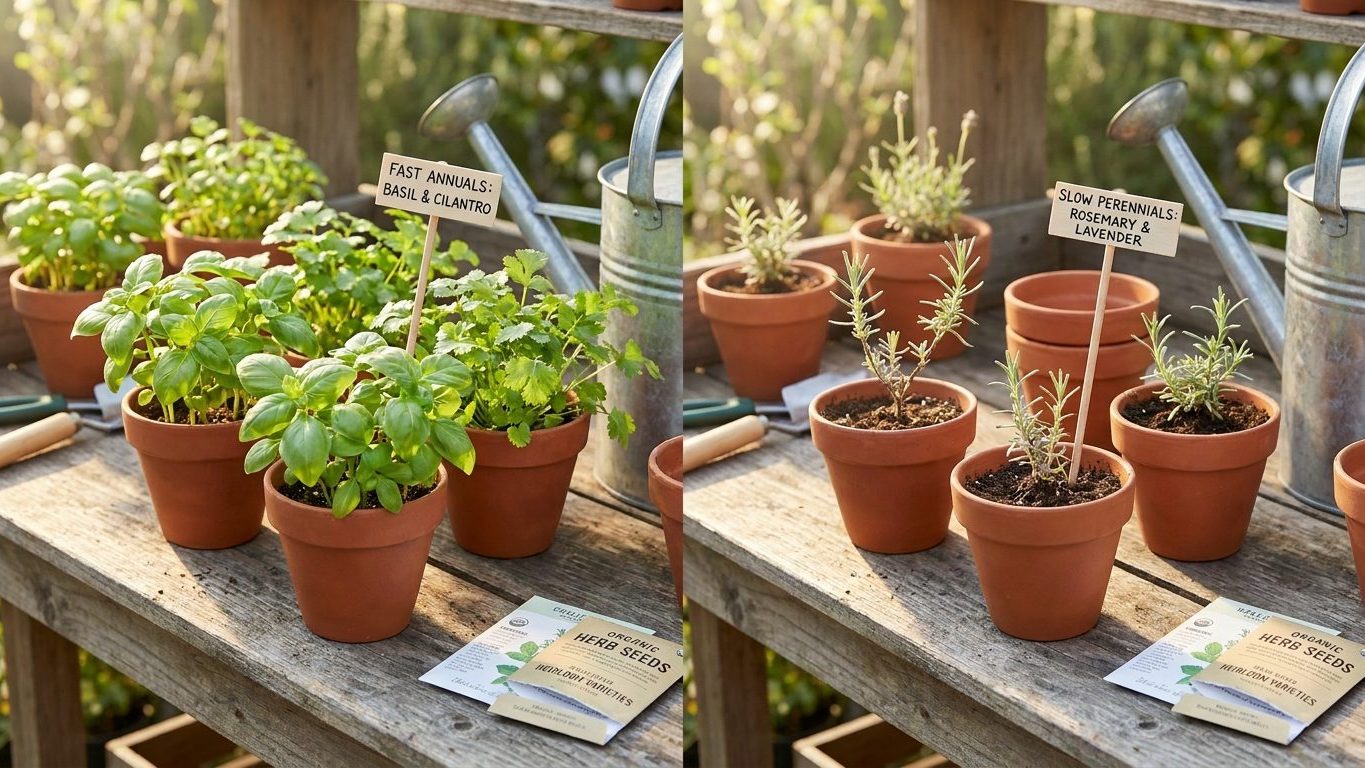

The quick answer: fast annual herbs like basil, cilantro, and dill do well started from seed, while slow woody perennials like rosemary, thyme, lavender, and tarragon are usually worth buying as small plants. The reason comes down to growth rate, not difficulty, and that changes how you should plan a herb bed this season.
What is actually going on

Herbs split into two broad growth patterns, and that split explains almost everything about whether seed makes sense. Soft-stemmed annual and biennial herbs, the basils, cilantros, dills, parsleys, and chervils of the world, are built to sprint. They germinate within days to about two weeks under decent warmth and moisture, then bulk up fast because their entire biological strategy is to grow, flower, set seed, and die within one season. A seed packet of basil sown in warm soil can give you a usable plant in a matter of weeks, no shortcuts needed.
Woody perennial herbs run on a completely different clock. Rosemary, thyme, lavender, sage, and the various woody sub-shrubs from Mediterranean climates put their early energy into root and stem structure, not leaf mass, because in their native habitat they need to survive through a dry season and come back year after year. Seed germination on these types is often slow and uneven, sometimes stretching a month or more with spotty results, and the seedlings that do come up can take a full growing season, sometimes closer to two years, before they reach a size worth harvesting from regularly. That’s not a sign you did something wrong. It’s the plant’s own strategy showing up in your garden bed.
There’s a second wrinkle that has nothing to do with speed. Some herbs simply don’t reproduce reliably from seed at all. French tarragon is the classic case: the plant sold under that name is typically sterile or produces seed that doesn’t grow into a true copy of the parent, so it’s propagated by division or rooted cuttings instead. Mint behaves similarly in practice, not because seed won’t sprout, but because named mint types cross so easily that seed-grown plants are a genetic gamble. Buying a small plant sidesteps that problem entirely.
One more thing worth separating out clearly: several herbs discussed on gardening sites, lavender among them, carry a long-standing reputation for medicinal or wellness use. Growing them in a garden bed is a separate matter from any medicinal or wellness use. That’s a different question than the one this article answers.
So the mechanism boils down to this: annual herbs are built for speed and reward seed-starting, woody perennials are built for longevity and punish impatience, and a few herbs simply need to be propagated clonally to stay true to type. Everything in the next section follows from that.
In the garden
Given that split, the practical decision for most home gardeners is straightforward once you separate herbs by growth habit rather than treating them as one category. The table below lays out the honest divide, plus what typically goes wrong when someone makes the opposite choice.
| Herb type | Sow or buy | What goes wrong with the other choice |
|---|---|---|
| Basil, cilantro, dill, parsley, chervil, borage (annual/biennial, soft stem) | Sow from seed | Buying nursery plants works fine too, but it costs more for a herb that would have caught up from seed within weeks anyway, and these types often resent having their roots disturbed during transplant, which can slow them down right after planting |
| Rosemary, thyme, lavender, sage (woody perennial sub-shrubs) | Buy a small plant | Sowing seed directly means weeks of patchy, uneven germination followed by a full season, sometimes closer to two, before the plant is large enough to harvest from without setting it back |
| French tarragon | Buy a plant, or get a division/cutting from another gardener | Seed sold as tarragon frequently isn’t true French tarragon at all, or won’t reliably reproduce it, leaving you with a plant that doesn’t match what you thought you were growing |
| Named mint types (spearmint, peppermint, and similar) | Buy a plant or take a rooted cutting | Seed-grown mint can drift genetically from the parent type through cross-pollination, so the flavor and vigor you get is unpredictable, and you may not know until the plant is already established |
| Chives | Either works | Seed takes a bit longer to reach a clump worth cutting from, but there’s no genetic gamble involved, so it’s a reasonable place to save money if you’re patient |
Notice the pattern in that “what goes wrong” column: the failure mode is almost never total. Rosemary seed will germinate for plenty of gardeners. The problem is timing. Someone who sows a rosemary seed in spring expecting a bushy plant by midsummer, the same way basil behaves, is comparing two different biological strategies and will end up disappointed with a plant that’s technically alive and technically fine, just months or years behind schedule.
The reverse mistake costs money rather than time. Buying six-packs of basil and dill seedlings from a nursery every few weeks through the season works, but it’s paying a premium for something a seed packet does just as well, since these herbs grow fast enough from seed that the head start barely matters by midsummer.
There’s also a middle category worth naming honestly: herbs like oregano and marjoram will grow from seed, and reasonably well, but germination can be slower and less predictable than the true annuals, and named types don’t always come true. A gardener with a full season and no rush can start these from seed without much risk. Someone who wants a harvest this month should buy a plant.
What it depends on where you are
Everything above describes the mechanism, which holds true no matter where you garden. What changes by location is the timing and the margin for error, and that part genuinely is local. Season length is the biggest variable. A gardener with a long, warm growing season has room to sow even the slower herbs and still get a usable plant before frost, or can restart a failed batch and try again. A gardener with a short season has much less slack, and for that reader, buying an already-established plant of a slow perennial herb isn’t a shortcut, it’s often the only way to get a harvest at all within one year.
Summer heat matters almost as much. Herbs from cool, temperate origins, cilantro and chervil among them, tend to bolt to flower and stop producing usable leaf once summer heat sets in, which changes the sowing calendar in hot climates compared to mild ones. Herbs from hot, dry Mediterranean origins, the rosemary and thyme group, can struggle instead with heavy summer humidity and rainfall, which affects root health regardless of whether the plant started life as seed or as a nursery transplant.
Rainfall and humidity levels shift the buy-versus-sow calculation too, mostly through their effect on damping off and root rot in young seedlings. A humid climate raises the failure rate of direct-sown seed for some herbs, which nudges the math slightly toward starting seed indoors under controlled conditions, or toward buying a plant that’s already past its most vulnerable seedling stage.
Frost dates, typical summer humidity, and soil temperature in April vary by state and even by county. That’s exactly the kind of detail worth checking against the state-specific herb guides elsewhere on this site, and against your local Cooperative Extension office, which tracks regional planting windows and can tell you what actually performs well in your specific county rather than in a national average.
The mistake that costs the most
Of all the ways this decision goes wrong, one mistake shows up more than any other and costs more than any other: direct-sowing a slow woody perennial herb outdoors on the same schedule as the fast annuals, then judging it a failure when it doesn’t measure up by midsummer.
It plays out the same way almost every time. A gardener sows a tray or a row with basil, dill, and rosemary seed side by side in spring, treating them as equivalent because they’re sold in the same rack at the same store. Eight weeks later the basil is bushy and ready to cook with, the dill is feathering out, and the rosemary is a few thin, spindly seedlings an inch tall, if it germinated at all. The natural conclusion is that something went wrong, that the soil was bad or the seed was old, and the tray gets tossed. What actually happened is that two annual sprinters were compared against a perennial that was never going to run at their pace, and the plant paid the price for a scheduling mismatch that had nothing to do with care.
The fix isn’t more patience with the seed, though patience helps. It’s separating the two categories from the start. Sow the fast annual and biennial herbs directly, because their whole biology rewards that approach and the low cost of seed matches the low risk. For rosemary, thyme, lavender, sage, and anything else in that woody, slow-growing category, buy a small plant instead, and treat seed-starting those types as a longer-term project for a gardener with a spare year and no urgency about harvest. That single adjustment, matching the propagation method to the plant’s actual growth strategy rather than to what’s convenient at the seed rack, prevents more wasted seasons than any other single piece of herb-growing advice.