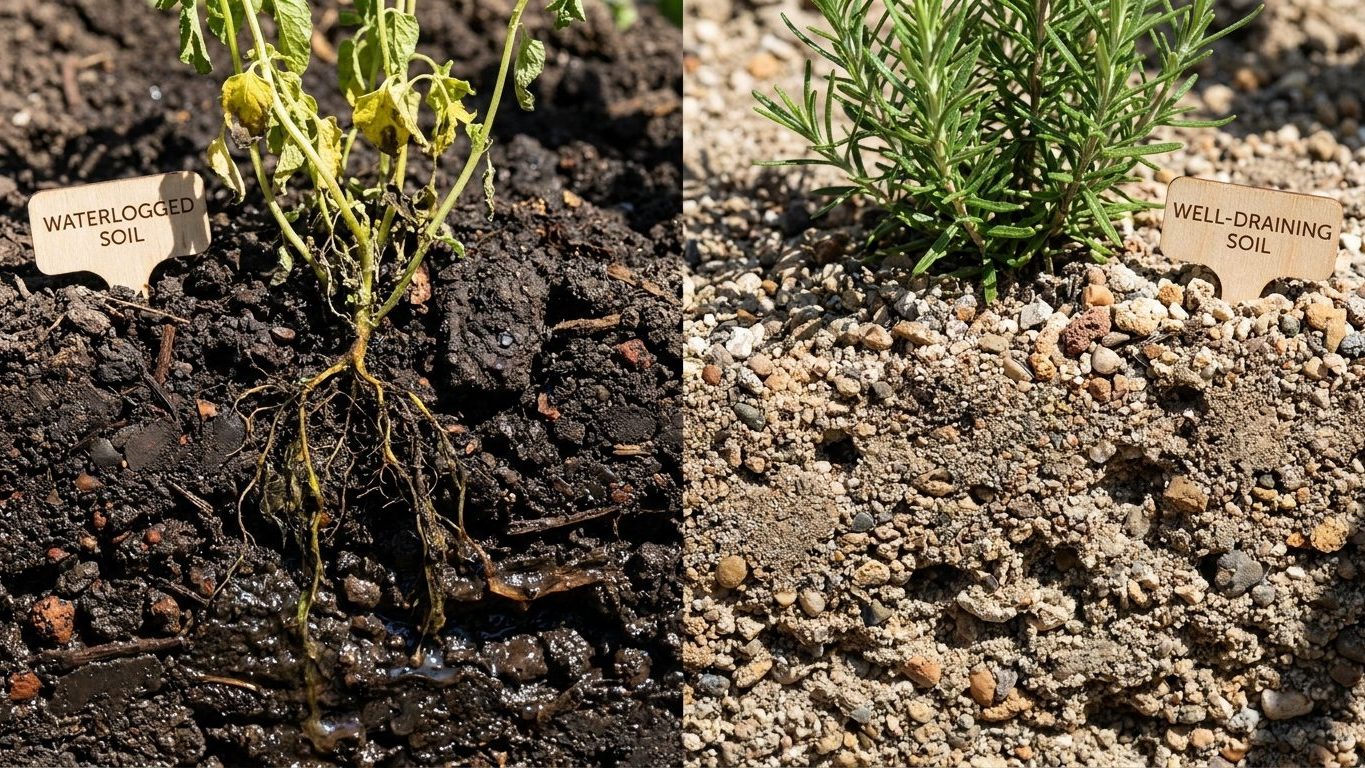

The short answer: most culinary herbs from the Mediterranean, rosemary, thyme, oregano, sage, lavender, marjoram, evolved on rocky hillsides where rainwater vanishes within minutes. Give them rich, moisture-retentive soil and you’re not being generous. You’re recreating the one condition their roots never learned to handle, and drainage herbs need is less about watering less and more about letting water leave fast.
What is actually going on
The thing to understand here is root rot, and it has nothing to do with the plant being “thirsty” or “sensitive.” Rosemary, thyme, sage, and their relatives spent millions of years rooting into thin, stony ground on Mediterranean hillsides, the kind of soil that holds almost no organic matter and drains within minutes of a downpour. Their root systems adapted to short bursts of moisture followed by long dry stretches. What they never adapted to is standing water.
Roots need oxygen as much as they need moisture. In loose, gritty soil, air pockets stay open between particles even after a rain, so roots keep breathing while they take up what water they need. In dense, rich, or compacted soil, those pockets fill and stay filled. Water clings to clay particles and organic matter far longer than it clings to sand or grit, and the roots sitting in that saturated zone start to suffocate. Within days, the fine feeder roots turn soft and dark. Within a couple of weeks, in warm weather, the rot moves up into the crown, and by the time the foliage yellows or the plant suddenly wilts despite damp soil, the root system is often already unsalvageable.
This is why gardeners so often kill these herbs by trying to help them. A well-meaning schedule of regular watering, a bed enriched with compost, a heavy potting mix meant for vegetables: all three raise the risk rather than lower it. The herb doesn’t fail because it was neglected. It fails because its roots never dry out enough to breathe.
Sharply drained soil solves this by getting water away from the root zone quickly rather than by supplying less of it. A gritty, mineral-heavy mix lets a hard rain pass straight through in an hour or two, leaving the top few inches barely damp underneath and the deeper roots in air, not standing water. That’s the entire mechanism drainage herbs are built around, and it explains why the fix isn’t “water less” so much as “let the water leave.”
In the garden
In an open bed, the fix is structural, not seasonal. Work coarse sand, fine gravel, or crushed stone into the top eight to ten inches of soil, aiming for a mix that feels gritty rather than silky when squeezed. Heavy clay soil often needs a raised mound or a raised bed altogether, since digging grit into clay without lifting the bed just creates a bathtub that holds water even better than before. A slope or a spot near the high point of the yard helps more than any amendment, because gravity is doing free work that no soil additive can replace.
In containers, the same logic applies but the stakes are higher, since a pot has nowhere for excess water to migrate except out the bottom. A standard potting mix formulated for vegetables or flowering annuals holds far too much moisture for rosemary or lavender. Cutting it with an equal part of coarse sand, perlite, or small gravel, and choosing an unglazed terracotta pot over a glazed or plastic one, lets the container wall itself pull moisture out of the mix between waterings. A saucer left full of water under the pot cancels out all of that work in a single afternoon.
Herbs that want the opposite
Not every herb on the windowsill follows the same rule, and treating all of them like rosemary is its own common mistake.
| Herb | Soil preference | What goes wrong if reversed |
|---|---|---|
| Mint | Consistently moist, rich soil | In gritty, fast-draining soil it stays stunted and dries out between waterings |
| Parsley | Moist, humus-rich soil | In lean, sharply drained soil it bolts early and produces thin, bitter leaves |
| Chives | Moist, fertile soil | Sharp drainage without regular water leaves growth sparse and pale |
| Basil | Evenly moist, nutrient-rich soil | Left to dry out repeatedly in lean soil, it wilts hard and turns woody fast |
The pattern is simple once you see it: herbs native to woodland edges and damp ground want soil that behaves like a sponge, while herbs native to dry hillsides want soil that behaves like a sieve. Planting both groups in the same bed with the same watering schedule guarantees one of them struggles.
What it depends on where you are
Everything above is mechanism, and mechanism doesn’t change by zip code. What does change is how hard the local climate leans on that mechanism. A summer of frequent, heavy rain forces sharply drained soil to work overtime, since the same gritty mix that dries out fast in an arid region may still stay damp longer than a Mediterranean herb likes in a region with regular downpours. A long, hot, dry summer does the opposite: it can make even a moderately rich bed drain fast enough on its own, and over-amending with grit in that setting can leave rosemary or lavender stressed for water instead.
Season length matters too. A short growing season means less time for a herb to recover from a rot setback before frost ends the year, which raises the cost of getting drainage wrong early on. A long, humid growing season means the risk of fungal and root problems stays elevated for more months out of the year, not just during a rainy spring.
None of that is something a national page can pin down responsibly. Rainfall patterns, soil type by region, and typical summer humidity vary enough across the country that a drainage recipe tuned for one state can be the wrong recipe two states over. The most reliable next step is checking the state-specific guide on this site for the reader’s own region, and pairing that with a call to the local cooperative extension office, which can usually speak to the exact soil type and rainfall pattern of a given county in a way no general guide can match.
The mistake that costs the most
If there’s one error that does more damage than everything else combined, it’s this: watering a Mediterranean herb on the same schedule as the vegetables or flowers planted next to it. Gardeners rarely set out to overwater rosemary. They water the tomatoes, the herb happens to be in the splash zone or the same irrigation line, and it gets the same daily or every-other-day drink as everything else in the bed.
That single habit undoes even good soil work. A perfectly amended, gritty bed can still stay too wet if it’s watered on a vegetable’s schedule rather than a Mediterranean herb’s, because the schedule matters as much as the soil texture. These herbs generally want the top few inches of soil to go fully dry between waterings, sometimes for a week or more depending on the local climate covered in the previous section. Watering on a fixed calendar, rather than checking the soil first, ignores that need entirely.
The fix costs nothing and takes ten seconds: before watering a rosemary, thyme, sage, or lavender plant, push a finger two inches into the soil. If it’s still damp, walk away and check again in a few days. If it’s planted alongside herbs that want the opposite, like mint or parsley, separate them onto their own watering zone, whether that’s a different bed, a different container, or a different position on the drip line, so one group’s needs stop dictating the other’s. That single separation, more than any soil amendment, is usually what decides whether a Mediterranean herb makes it through its first full season.