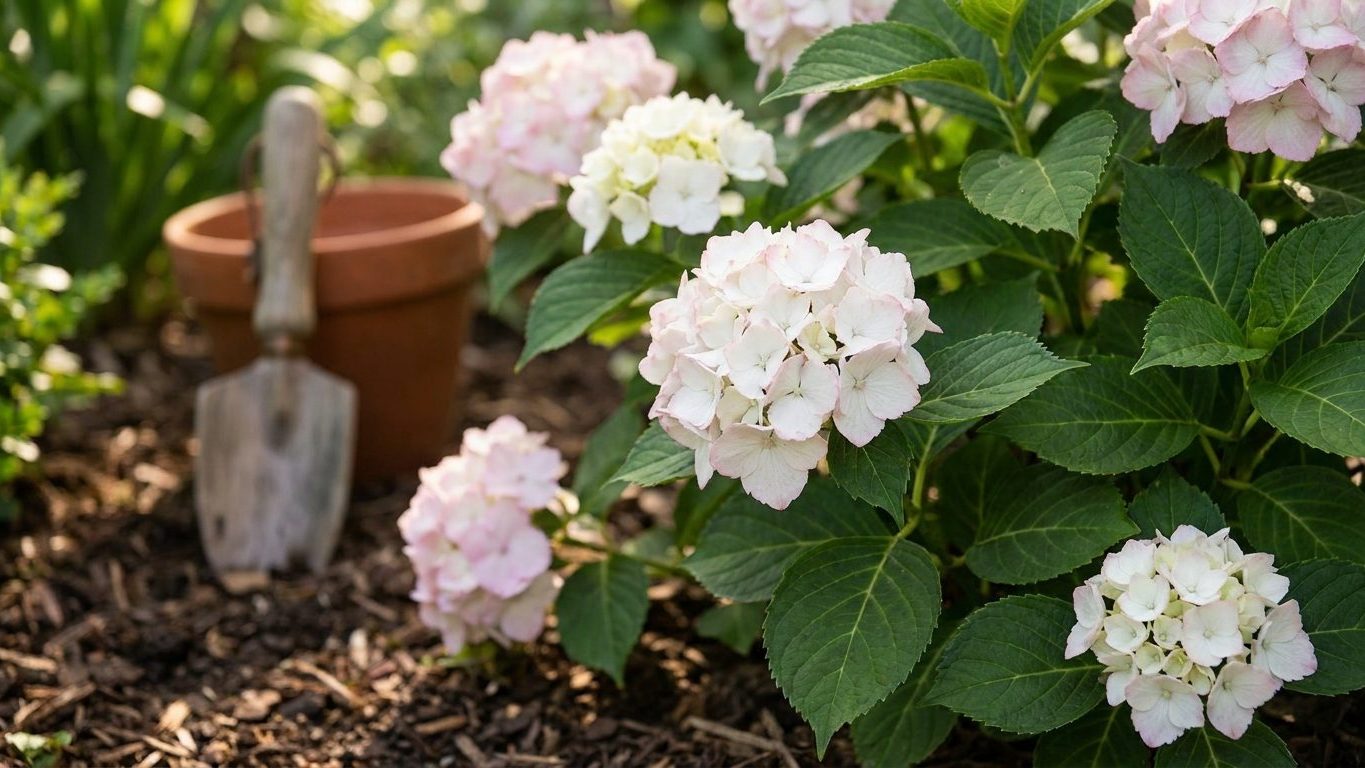

Blushing Bride is a bigleaf hydrangea from the Endless Summer series, hardy in USDA zones 6a through 11b, with semi-double white mophead flowers that shift to pink or pale blue depending on soil pH. It flowers on last year’s wood, meaning this year’s blooms were already set as buds by last summer. That single fact decides most of what follows: how it survives winter, when you can prune it, and why a late frost can erase a season’s flowers even in a zone where the shrub itself is perfectly hardy.
What Blushing Bride actually is
Blushing Bride belongs to Hydrangea macrophylla, the bigleaf group, according to the North Carolina Extension Gardener Plant Toolbox. That classification carries most of what follows: hardiness of 6a-11b, a mature size of 3 to 6 feet tall and wide, and flower buds that form the previous summer rather than on new spring growth. The source rates its growth rate as rapid for the species, but rates the genus overall as low maintenance once established. It is shallow-rooted, which is why mulch matters more here than digging depth. Propagation runs through stem cuttings or layering, not seed.
The bigleaf group is only one branch of a genus whose care instructions change sharply from type to type, as the table below shows.
| Type | USDA zones | Flowers on | Typical size |
|---|---|---|---|
| Bigleaf / mop-head (Blushing Bride’s group) | 6a-11b | Last year’s wood | 3-6 ft |
| Panicle / peegee | 3a-8b | Current season’s growth | 8-25 ft |
| Smooth (e.g. Annabelle) | Hardiest of the genus | New wood | Varies |
| Oakleaf | Not given here | Old wood | To about 5 ft |
| Mountain | Not given here | Old wood (hardier buds) | Varies |
| Climbing | Not given here | Old wood | 15 ft and up |
Everything specific to Blushing Bride in this article applies to the bigleaf row only, and should never be borrowed for a hydrangea from another row.
What Blushing Bride is good for

This is an ornamental shrub, not a food crop, and the source does not describe any culinary use for it. It suits a shaded or partially shaded border where a shrub needs to stay compact and change appearance without much intervention. Its semi-double white flowers shift toward pink or pale blue depending on soil chemistry, so a single planting can read differently over time, unlike a fixed-color cultivar.
Bigleaf Hydrangeas, Blushing Bride included, are shallow-rooted and rated for dappled sun to deep shade, with an explicit instruction to protect the plant from afternoon sun. A shallow root mass cannot pull enough water to keep large, thin leaves turgid under direct afternoon heat, so the plant does best under high tree canopy or on the north or east side of a house, where morning sun is fine but afternoon glare is blocked.
One use it is specifically not suited to: this cultivar belongs to the one hydrangea type the source documents as toxic if eaten in quantity, producing nausea, stomach pain, vomiting and sweating in people, and the same effects in dogs, cats and horses. That does not make it dangerous to plant near a patio, but it is not a candidate for a bed where a toddler or grazing pet has easy access to the leaves and bark.
Where it ripens in time, and where it is a gamble
Bigleaf hydrangeas do not “ripen,” but they do have a comparable margin problem: flower buds formed on old wood last summer must survive an entire winter intact before opening. The width of that margin depends heavily on where in the 6a-11b range a garden sits.
At the cold edge, zone 6a, winters routinely dip low enough to damage buds already on the stems, and even where the shrub survives winter, a late spring frost after buds have started to swell can nip them before they open. That is a bloom failure, not a plant failure: the hydrangea leafs out fine but skips flowering for the year. Gardeners in zone 6a, found across parts of the interior Northeast and higher Mid-Atlantic elevations, work with the thinnest margin this cultivar has.
Toward the middle of the range, roughly zones 8 to 9, winter minimums rarely fall cold enough to threaten old-wood buds, so flowers set the previous summer generally survive to spring. This is why the source recommends panicle hydrangeas as a substitute in areas where bigleaf types are not winter hardy : Blushing Bride’s reliability is tied closely to a mild winter, not just to general vigor.
At the top of the range, 10b and 11b, winter cold stops being a limiting factor, since temperatures barely approach freezing. The margin problem instead shifts to a light and heat management task, covered below, and the shrub’s already-rapid growth rate tends to run faster still, calling for closer attention to its 3 to 6 foot mature spread.
The two ways a season goes wrong
Two separate failures can take Blushing Bride’s flowers away, sitting at opposite ends of its hardiness range, which is why generic hydrangea advice cannot cover both.
In colder zones, the failure is a late frost hitting buds that have already broken dormancy on old wood. Once buds begin swelling in spring they lose the cold tolerance they had while fully dormant, so a frost that barely troubles the leaves can still take out the flower buds, with no way to reset them until next summer’s growth. This is the more consequential failure for Blushing Bride, since it can eliminate bloom entirely for the year.
In warmer zones, the documented risk is direct afternoon sun exposure, which NC State Extension explicitly instructs gardeners to protect bigleaf hydrangeas against. The result is scorched foliage and wilted flowers rather than a missed bloom altogether, and unlike the frost failure, it has a management fix: move the planting, add shade cloth, or choose a site under high canopy.
What it resists, and what it does not
The NC State source lists diseases for the hydrangea genus generally, without a separate resistance rating for Blushing Bride or bigleaf hydrangeas as a group. At the genus level it names three diseases relevant here: leaf spot, bacterial wilt and powdery mildew.
On the pest side, the picture is more reassuring. Aphids, scales, nematodes and mites are named, but described as rarely a problem for hydrangeas overall. Deer are a separate matter, and the source contains a genuine contradiction: deer are listed both as a pest that damages hydrangeas and, elsewhere on the same page, under a heading about resistance to challenges. The honest reading is to trust the observed damage over the label, hydrangeas get browsed where deer pressure is heavy, and calling the genus deer-resistant would set a gardener up for disappointment.
The toxicity note belongs here too, since it is functionally a resistance issue in reverse: only Hydrangea macrophylla, Blushing Bride’s group, is documented as toxic if bark, flowers, leaves or stems are eaten in quantity, through compounds called hydracyanosides. Effects include nausea, stomach pain, vomiting and sweating, in dogs, cats, horses and people.
Growing it without the usual mistakes
The most common mistake with Blushing Bride, and bigleaf hydrangeas generally, is pruning at the wrong time relative to when next year’s buds form. Because this cultivar flowers on last year’s wood, next spring’s buds are laid down on current-season growth right after this year’s flowers fade. Cut the plant back too late, and a gardener removes the growth that was about to carry next year’s flowers, leaving a healthy but bloomless shrub the following spring. The exact safe window shifts with local frost timing, but the rule holds everywhere: prune promptly after flowering finishes, not months later.
Spacing should account for the shrub’s mature spread of 3 to 6 feet in both directions, easy to underestimate when planting from a small container. Because the root system is shallow, a 2 to 3 inch layer of mulch does more for this plant than deep soil amendment, holding moisture near the surface roots and buffering soil temperature through winter.
Feeding deserves one caution tied to color: a high-phosphorus fertilizer locks up aluminum in the soil, and since available aluminum is what shifts flowers toward blue, heavy phosphorus feeding pushes color toward pink even in acidic soil. Where cut stems are left standing over winter, trim them to 12 to 24 inches rather than to the ground, since native bees use dead hollow stems as nesting sites until the wood breaks down naturally.
Common questions
Does Blushing Bride hydrangea change color on its own?
Only in response to soil pH, not spontaneously. The source documents blue tones below roughly pH 5.5 and pink tones above roughly pH 6.5, with purple shades in between, driven by how much aluminum the roots can take up at that pH.
Will coffee grounds turn Blushing Bride blue?
The source notes this as a widely held belief, but the pH shift from kitchen coffee grounds is small. What actually moves the color is available aluminum in the soil, which acidity releases; a mild kitchen remedy rarely acidifies soil enough to matter.
Is Blushing Bride hydrangea safe around dogs?
Not if eaten in quantity. The source documents Hydrangea macrophylla, the group Blushing Bride belongs to, as toxic to dogs, cats and horses as well as people, causing nausea, stomach pain, vomiting and sweating from compounds in the bark, flowers, leaves and stems.
Can Blushing Bride hydrangea grow in full sun?
The source instructs protecting bigleaf hydrangeas from afternoon sun and recommends dappled sun, partial shade or deep shade instead. Panicle hydrangeas are the type documented as tolerant of full sun, not this one.