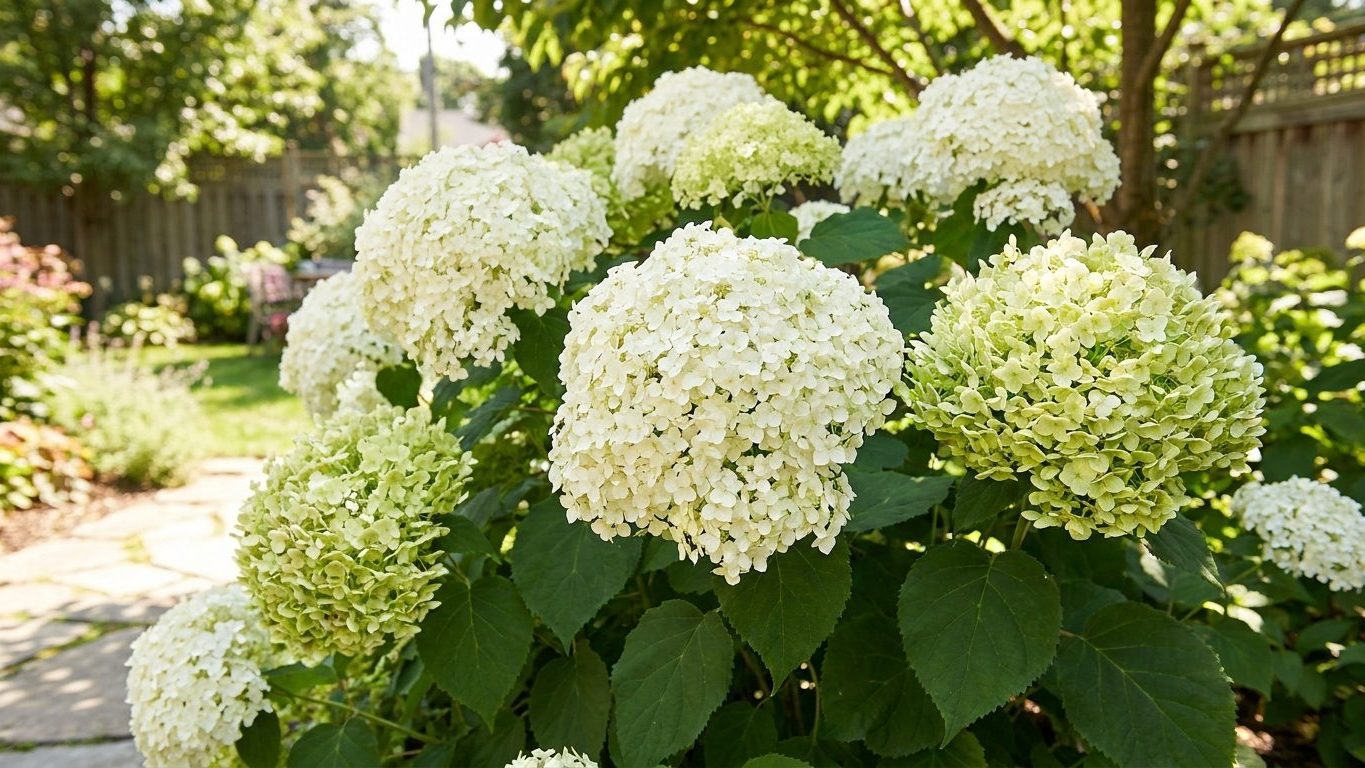

Annabelle hydrangea is a smooth hydrangea (Hydrangea arborescens) that flowers on the current season’s growth, which makes it the hardiest type in the genus. Its blooms open as big white balls that fade to green as summer wears on, and no soil amendment will ever turn them blue or pink. That single fact about wood age changes almost everything else about growing it.
What Annabelle actually is
The distinction that matters most with Annabelle is which wood carries the flowers. According to the North Carolina Extension Gardener Plant Toolbox, smooth hydrangeas bloom on the current season’s growth, not on stems that survived from last year. That single mechanism is why the source calls this type “the hardiest of the genus”: a hard winter can kill the top growth back to the ground and the plant still blooms that same summer, because the flowers come from wood the plant hasn’t grown yet.
The blooms themselves are the reason gardeners plant it in the first place: large, rounded clusters, white or fading to green, described plainly in the source as “big white balls.” Unlike the mophead and mountain types, color here is fixed. It does not shift with soil pH, so there’s no acid-loving or lime-loving decision to make.
The source does not publish a specific height range or USDA zone bracket for the smooth type the way it does for bigleaf (6a-11b) or panicle (3a-8b) hydrangeas. Rather than guess at a figure, it’s worth saying plainly: that detail isn’t documented at the cultivar level here, only the comparative claim that smooth hydrangeas are the hardiest of the genus.
What Annabelle is good for

Annabelle earns its keep as a low-maintenance mass planting or foundation shrub rather than a fussy specimen. The source rates hydrangeas as medium growth rate for the genus, with low overall maintenance, and lists tolerance for clay, loam or sandy soil across a wide pH range, from acid below 6.0 to alkaline above 8.0. That range matters practically: a gardener who has already fought soil pH battles with a mophead hydrangea elsewhere in the yard can plant Annabelle without repeating the exercise, because its white-to-green color is fixed regardless of what the soil does.
That same fixed color is also the honest limit of the plant. Anyone hoping to coax blue or pink out of an Annabelle by working aluminum sulfate or lime into the bed is applying a technique that only affects bigleaf and mountain hydrangeas. Coffee grounds and citrus peel, often repeated as a home remedy for turning hydrangeas blue, shift soil pH by an amount too small to matter even on the types that do respond to it. On Annabelle, none of it does anything at all.
Where the plant does earn real value is as habitat. The Toolbox notes that native bees nest inside dead, hollow hydrangea stems over winter, and recommends cutting stems back to 12 to 24 inches and leaving them standing rather than clearing the bed in fall. For a gardener who wants a low-input shrub that also supports pollinators through the cold months, that’s a concrete, actionable detail, not a generic “good for wildlife” claim.
Propagation is straightforward too: stem cuttings or layering, per the source, which means a single established Annabelle can become several plants without buying more stock.
Where it ripens in time, and where it is a gamble
For most hydrangeas, timing is a gamble because their flower buds form the summer before, sit through winter, and can be wiped out by a late frost or a poorly timed prune. Bigleaf hydrangeas are the clearest example: hardy roughly USDA 6a to 11b, but flowering on last year’s wood means a cold snap after bud formation, or pruning after the buds are set, erases the season’s display even where the plant itself survives fine.
Annabelle sidesteps that gamble almost entirely, because it flowers on wood it grows fresh each spring. A late frost that damages the previous year’s stems doesn’t touch this year’s flowers, since those flowers haven’t been built yet. That’s the whole mechanism behind the “hardiest of the genus” label, and it’s why gardeners in harsh-winter regions who’ve given up on reliable bigleaf blooms often switch to a new-wood type instead.
Panicle hydrangea illustrates the same principle from the other direction. It’s rated hardy USDA 3a-8b, also flowers on current-season growth, and the source describes it explicitly as “a good substitute for the mop-head hydrangea in areas where that species is not winter hardy.” Annabelle occupies the same practical niche in colder regions, minus the panicle’s tolerance for full sun.
What the Toolbox does not publish is a specific USDA zone bracket for the smooth type on its own, the way it does for bigleaf, panicle, oakleaf and climbing hydrangeas. So the honest answer for a reader trying to map Annabelle onto their own zone is this: the genus overall spans 3a through 9b depending on type, smooth hydrangea is described as the hardiest within that span, and a reader in a zone where bigleaf hydrangeas reliably fail to bloom is exactly the reader this variety is built for. Zone-by-zone planting specifics belong on a state-level page, not here, since pruning timing and hardening details vary by local frost dates.
The two ways a season goes wrong
The first failure mode with Annabelle isn’t a physical one at all, it’s an expectation problem. Gardeners who’ve grown bigleaf or mountain hydrangeas elsewhere sometimes bring the same playbook to Annabelle, working aluminum sulfate into the soil or switching to a low-phosphorus fertilizer to chase a blue bloom. None of that moves the needle, because color in smooth hydrangeas isn’t governed by soil aluminum the way it is in bigleaf and mountain types. The bloom will be white, then green, on schedule, regardless.
The second failure mode is physical and it’s specific to new-wood bloomers: deer. The Toolbox lists deer as a damage agent for hydrangeas generally, and the same source’s genus page also lists them under “resistance to challenges,” a contradiction worth naming plainly rather than smoothing over. The honest read is that hydrangeas get browsed by deer; there’s no documented resistance to rely on. For a bigleaf hydrangea, browsing damages next year’s flower buds. For Annabelle, because the flowers come from this year’s growth, deer eating fresh spring stems can cost the current season’s bloom outright, not just a future one. A browsed Annabelle in May can still leaf out and look healthy through summer with far fewer flowers to show for it.
What it resists, and what it does not
The Toolbox names three diseases across the hydrangea genus broadly: leaf spot, bacterial wilt and powdery mildew, with rust and bud blight added specifically for panicle hydrangea. No cultivar-level disease resistance rating is published for Annabelle in this source, which means the honest position is to treat it as subject to the same genus-wide disease list rather than to claim any special resistance it hasn’t earned in the data.
On pests, the source is more reassuring: aphids, scales, nematodes and mites are named but described as “rarely a problem” across the genus. Deer are the exception, listed as a damage agent even though a separate entry in the same source lists them under resistance to challenges. Where a source contradicts itself like that, the safer read for a gardener is to plan around browsing rather than assume protection.
On toxicity, there’s good news specific to this type. The Toolbox documents toxicity only for bigleaf hydrangea (H. macrophylla), tied to cyanogenic glycosides in the bark, flowers, leaves and stems, and only in large quantities, causing nausea, stomach pain, vomiting and sweating in people, dogs, cats and horses. Smooth hydrangea isn’t part of that documented toxic list. That’s not the same as a guarantee of safety, since the source simply doesn’t address it either way, but it’s worth being precise: the toxicity warning belongs to bigleaf, not to Annabelle.
Growing it without the usual mistakes
The single most useful thing to know about growing Annabelle is what its new-wood bloom habit permits: because next year’s flowers grow from scratch each spring, the plant “can be cut back hard while dormant,” per the source, without sacrificing bloom the way a bigleaf hydrangea would. That’s a genuine advantage for anyone who wants a tidy, controlled shrub rather than a sprawling one, since a hard dormant-season cutback resets the plant’s size annually instead of accumulating years of old wood. Exact timing within the dormant season depends on local frost dates, which is a question for a zone-specific guide rather than a national one.
Soil flexibility is another point in Annabelle’s favor. The source lists clay, loam and sand as all workable, with good drainage preferred but occasional wetness tolerated, and a pH range running from acid to alkaline without penalty since color doesn’t track pH here anyway. Mulching is generally recommended across hydrangeas in this source, and it’s a reasonable practice for Annabelle too, even though the specific note about shallow roots benefiting from mulch is documented for bigleaf and panicle types rather than smooth hydrangea directly.
The mistake to avoid isn’t a soil or pruning error so much as a wildlife one: skipping deer protection on the assumption that hydrangeas are deer-resistant. They aren’t, by this source’s own account, and for a plant that blooms on fresh spring growth, unprotected browsing in April or May can erase a summer’s flowers before they ever form.
Common questions
Does Annabelle hydrangea change color with soil pH?
No. Color-shifting with soil pH is documented only for bigleaf and mountain hydrangeas. Annabelle is white, fading to green, regardless of soil acidity or alkalinity.
What USDA zone does Annabelle hydrangea need?
The source describes smooth hydrangea as the hardiest type in a genus that spans USDA 3a through 9b overall, without publishing a specific bracket for the smooth type on its own. Zone-specific verdicts are better answered on a state-level guide.
When should Annabelle hydrangea be pruned?
It flowers on the current season’s growth, so it can be cut back hard while dormant without losing that year’s bloom. The exact month depends on local frost timing, which varies by region.
Is Annabelle hydrangea toxic to pets?
The documented toxicity in this source applies to bigleaf hydrangea specifically, from cyanogenic glycosides in the bark, flowers, leaves and stems. Smooth hydrangea isn’t listed among the documented toxic types.