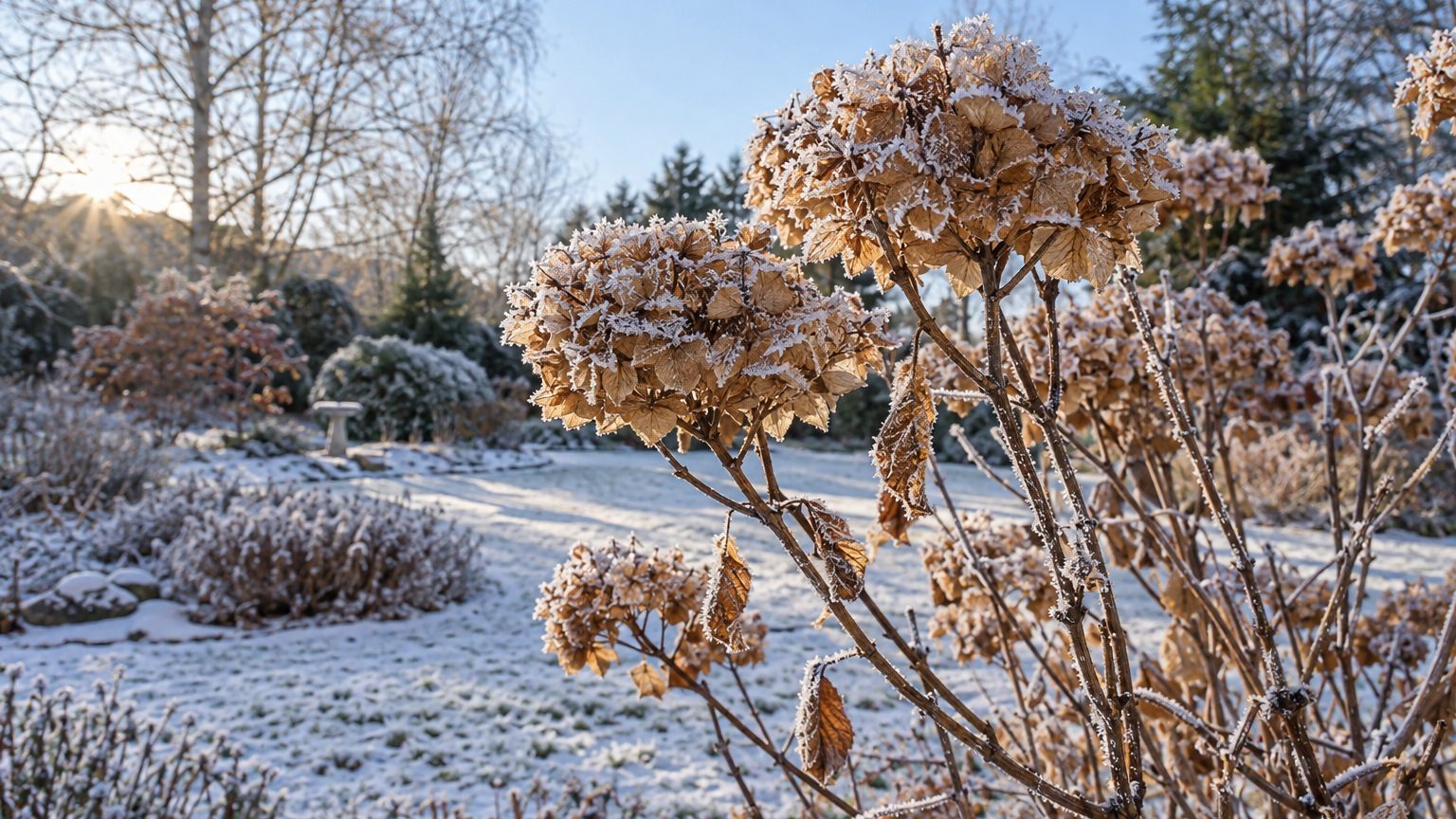

Only some hydrangeas need winter protection, and the type decides which. Bigleaf, oakleaf, mountain and climbing hydrangeas carry next summer’s flowers on old wood, so a hard winter or a late frost can take the bloom. Panicle and smooth hydrangeas flower on the current season’s growth and can lose their stems without losing the show. These plants are already in the ground; the full crop is covered in How to Grow Hydrangeas.
Why this matters
A bigleaf hydrangea sets its flower buds the summer before it blooms. Those buds ride through the winter on last year’s stems, exposed. If the cold kills the buds, the plant itself usually survives, leafs out in spring, and gives you a handsome green shrub with no flowers. That is the failure most people meet: not a dead plant, but a silent one. The same logic explains why a spring haircut on an old-wood type removes the season’s flowers along with the stems.
Hardiness ranges can mislead here. NC State Extension lists bigleaf at USDA zones 6a to 11b and panicle at 3a to 8b, and the genus as a whole at 3a through 9b, but the source is blunt that it depends on the type. Whether your plant needs a cage, a mulch blanket or nothing at all turns on your zone and your type together, and the state-by-state pages carry those verdicts.
| Type | Flowers on | What winter puts at risk |
|---|---|---|
| Bigleaf / mop-head / lacecap (H. macrophylla) | Last year’s wood | Buds on the stems, so the bloom |
| Mountain (H. serrata) | Last year’s wood | Buds, though they take late frost better than bigleaf |
| Oakleaf (H. quercifolia) | Last year’s wood | Buds on the stems |
| Climbing (H. petiolaris) | Last year’s wood | Buds, but it is slow to flower anyway and hard to wrap |
| Panicle (H. paniculata) | This season’s growth | Little; it can be cut back hard in late winter |
| Smooth (H. arborescens, e.g. Annabelle) | This season’s growth | Little; the hardiest of the genus |
When to do it
Let the plant set the schedule. Protection goes on after the leaves have yellowed and dropped, and after the stems have changed from soft, green and flexible to firm and brown. That change is the wood ripening, and a plant in that state has hardened for the season. Wrap too early, while stems are still green and growing, and you trap moisture against tissue that is not ready to be enclosed.
Watch the weather in terms of the plant’s behavior, not the calendar. Once growth has stopped and a few frosts have come through without bothering the wood, you are in the window. Your own first-frost timing comes from local sources.
Removal matters just as much, and it is the step people forget. Take the covering off in stages once the buds start to swell and the plant shows it wants to grow. Pull the top layer first, leave the rest for a short while, then clear it. Keep the material nearby in case a late frost arrives after you have uncovered. Buds that have begun to open are tender, and a late frost is exactly the event that removes bigleaf flowers.
How to do it

Confirm the type first
Check the tag, your purchase records or the leaf shape. Oakleaf is unmistakable, with lobed leaves and wine-red autumn color. Panicle has cone-shaped blooms and can be a shrub or a small tree up to 25 feet. If the plant is panicle or smooth, skip the wrapping. Leave the stems standing through winter and cut them back hard in late winter, which suits new-wood bloomers. Bigleaf, mountain and oakleaf are the plants worth the effort.
Mulch the root zone
Bigleaf and panicle are both shallow-rooted, and both benefit from mulch. Use shredded leaves, shredded bark or pine straw, spread over the whole root zone and up around the base of the stems. Keep it loose rather than pressed flat. How deep to pile it depends on your zone, and that figure is left to the state pages.
Build a cage for old-wood types
Mulch protects the roots and the lowest buds. To protect the stems above, build a collar:
- Drive three or four stakes in a ring a little wider than the plant, so nothing presses on the stems.
- Wrap the ring with chicken wire or hardware cloth to make an open cylinder.
- Fill it loosely with dry leaves or pine straw. Do not stuff it.
- Cap it with something that sheds rain, such as a board, a bucket or a layer of burlap held down with twine.
For a smaller or more sheltered plant, a burlap wrap tied loosely around the stems can be enough. Burlap breathes. Plastic does not.
Done right, the cage looks a little overbuilt: stems upright inside, filling dry and springy, the cap keeping the top dry, the base open to the soil. A cage also gives some defense against browsing. The source lists deer as a damage agent on hydrangeas, even though another entry on the same page suggests resistance, and what gardeners observe is that hydrangeas get browsed. Bigleaf is also the one species documented as toxic if eaten in large quantity, so a wire barrier keeps pets and livestock off it as well.
Pruning decisions are separate from this. Old-wood types should not be cut back in fall or spring to tidy up, since the buds are on those stems. Your state page has the timing for the pruning that is safe.
What goes wrong

The most common error looks like extra care: wrapping the plant tightly in plastic, or packing the cage with wet leaves and sealing the top. It feels protective. It holds moisture against the stems and swings in temperature on sunny days. By spring the wood is gray, mushy or blackened where it should be dry and tan, and the buds underneath are dead. A scratch test on a stem shows green under the bark on a healthy one and brown on a failed one.
Covering too early causes a similar failure. Stems still growing get enclosed and stay soft. The tell is soft, discolored tips in spring, while the lower stems look fine.
Uncovering too late, or all at once, is the quiet mistake. The plant leafs out under cover, weak and pale, then a frost catches it when the cover comes off. You will see healthy leaves and no flower buds, or buds that blacken and drop. Staged removal with the material kept on hand prevents it.
Fall pruning an old-wood type is the other familiar one. The plant looks tidy and then blooms very little, or only at the stem bases where wood survived. Applying winter protection to a panicle or smooth hydrangea is wasted effort, not a mistake that harms them, but it shows the type was never checked.
One more: stems that die back to the ground are not always a loss. A bigleaf can regrow from the base and give a leafy summer with few flowers. A panicle or smooth will bloom normally from that same new growth.
Doing it differently
Containers change the equation. A pot exposes roots to cold from the sides as well as from above, and roots in a pot are more vulnerable than roots in the ground. Where winters are hard for the type, moving a potted bigleaf into an unheated garage or shed, out of drying wind, is better than any wrap. Water it lightly now and then so the root ball does not go bone dry, and bring it back out when growth begins.
Siting is a form of protection too. A spot near a house wall or among other shrubs, away from the harshest wind and from afternoon sun, softens the winter and the summer both. See Planting a Hydrangea: Where It Goes and How Deep for placement, and How Much Sun Hydrangeas Need, and Which Ones Take Full Sun for light.
Sometimes the better variation is a different plant. NC State Extension calls panicle a good substitute for mop-head in areas where bigleaf is not winter hardy, and it is the only hydrangea that takes full sun well. Mountain hydrangea, also an old-wood bloomer, handles late frost on its buds better than bigleaf does. Climbing hydrangea clings by aerial rootlets, reaches 15 feet and more, and is too big to wrap in any case.
Common questions
Which hydrangeas need winter protection?
The old-wood bloomers: bigleaf (mop-head and lacecap), mountain, oakleaf and climbing. Panicle and smooth flower on new growth and can be cut back hard, so protection is mostly unnecessary for flowering. Whether your bigleaf needs it at all depends on your zone.
Is my zone safe without protection?
Bigleaf is listed for USDA 6a to 11b and panicle for 3a to 8b, and the genus runs 3a through 9b, but the answer depends on type and location. The state pages give the local verdict.
Can I wrap hydrangeas in plastic?
Avoid it. Plastic traps moisture and heats up in winter sun. Burlap or an open wire cage filled with dry leaves lets the plant breathe while still buffering the cold.
If my hydrangea dies back to the ground, is it finished?
Not necessarily. Many regrow from the base. Panicle and smooth will bloom on the new growth, while bigleaf may give you foliage and few flowers. If you cut stems on panicle or smooth, leave 12 to 24 inches standing where you can, because native bees nest in dead hollow stems.